


L-Theanine Supplement: 200 mg, With or Without Caffeine
An L-theanine supplement is the simplest way to get a fixed dose of the amino acid found in tea. SILT™ puts 200 mg L-theanine into two drinks, so you choose the caffeine. SILT Mornings pairs it with 80 mg caffeine for the start of the day. SILT™ Nights carries it with no caffeine for the evening, alongside 3 g glycine, 250 mg magnesium and KSM-66® ashwagandha.
Both are stevia-sweetened stick packs you stir into water, with no added sugar and every dose printed on the back of the pack. Below: what the trials of L-theanine with and without caffeine actually found, how a drink compares with L-theanine tablets and capsules, and which one fits your day.
MRP ₹1,125 ₹900 · 15 sticks or ₹1,500 for 30 (MRP ₹2,250)
Same price for both: ₹60 a stick, or ₹50 a stick in the 30-pack.
Shop SILT Mornings Shop SILT Nights
L-theanine and caffeine: what the trials show
In small, short-term lab studies, taking L-theanine with caffeine improved some attention measures, mostly accuracy when switching between tasks, for an hour or two after a single dose. The effects are modest, the caffeine seems to do most of the work, and no trial tested a product like ours.
| Study | L-theanine + caffeine (mg) | People | Main findings |
|---|---|---|---|
| Owen et al., 2008 | 100 + 50 | 27 healthy volunteers, crossover | Faster, more accurate attention switching at 60 min; less distraction in a memory task |
| Haskell et al., 2008 | 250 + 150 | Healthy adults, crossover | Faster simple and working-memory reaction times, better sentence-verification accuracy, higher "alert" and lower "tired" ratings. L-theanine alone raised "headache" ratings |
| Kelly et al., 2008 | 100 + 50 | Healthy adults, 4 test days | Higher hit rate and target discrimination on an attention task; L-theanine alone showed no effect |
| Giesbrecht et al., 2010 | 97 + 40 | 44 young adults | Better task-switching accuracy and self-rated alertness (both p < 0.01), less tiredness; no change in visual search, choice reaction time or mental rotation |
| Einöther et al., 2010 | 97 + 40 | Healthy adults, crossover | Better attention on a switch task; self-rated alertness and intersensory attention did not improve significantly |
| Rogers et al., 2008 | 200 + 250 | 48 healthy adults | L-theanine blunted caffeine's rise in blood pressure but did not significantly change jitteriness or alertness |
| Dodd et al., 2015 | 50 + 75 | 24 adults (12 regular, 12 non-regular caffeine users) | At these tea-level doses, adding L-theanine cancelled caffeine's effects on cognition and mood, with no benefit on behaviour |
Pooled together, a 2014 systematic review and meta-analysis of 11 placebo-controlled studies of tea compounds (L-theanine or EGCG, alone or with caffeine) found moderate effect sizes in favour of the combination for alertness and attention-switching accuracy in the first two hours after a dose. It also found trends suggesting the caffeine dose mattered more than the L-theanine dose (Camfield et al., 2014). A larger 2025 review of 50 trials, 15 of them pooled, found small-to-moderate gains for the pair in vigilance accuracy and attention-switching accuracy, with a less certain trend for choice reaction time, and noted that the confidence intervals often left the size and even the direction of effects uncertain; a tea brand funded the first author's PhD, and two co-authors worked for that brand and its parent company (Payne et al., 2025).
What this evidence can't tell you. These were single-dose lab sessions lasting a few hours, not weeks of daily use, and most enrolled a few dozen people. They measured attention tasks on a screen, not work output. Researchers at a consumer-goods company that owned a major tea brand at the time ran several of them (Owen, Giesbrecht and Einöther). The "no jitters" idea is the weakest link: in the trial above that reports jitteriness (Rogers et al.), 200 mg L-theanine didn't significantly reduce it. So we describe the pair as studied for focus, not proven for it, and we don't claim a stick of Mornings reproduces any trial.
Tea's natural pairing, with the doses listed.
Where L-theanine comes from
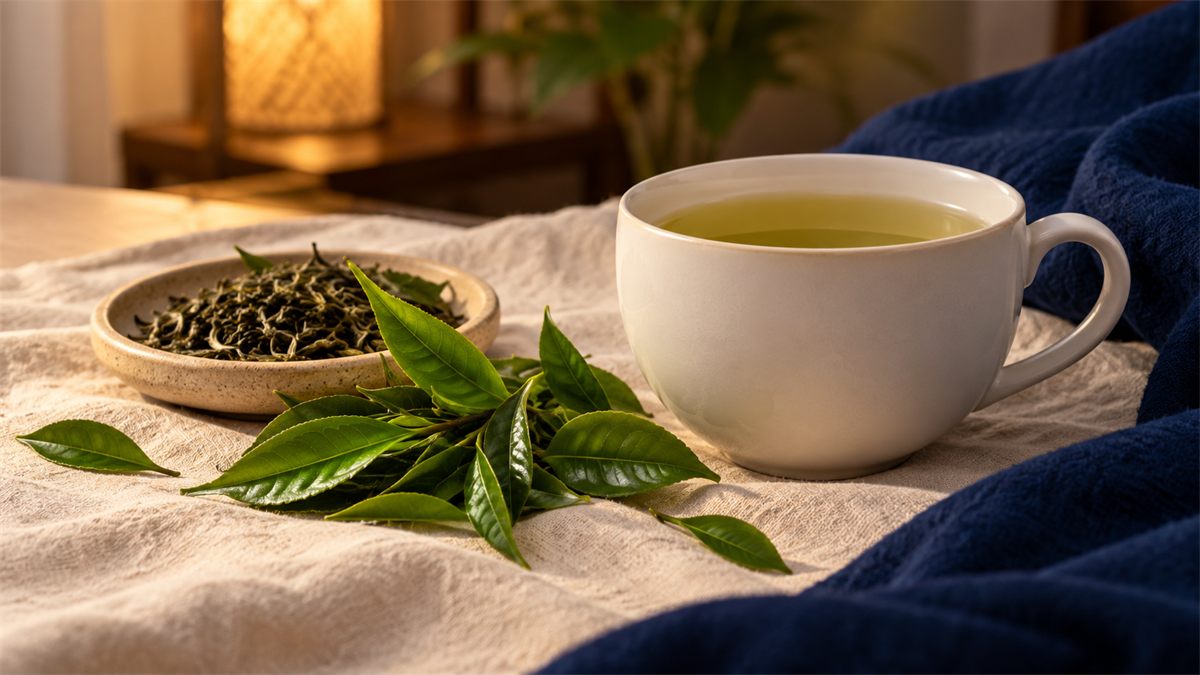
L-theanine is an amino acid found naturally in tea, which is why a cup of tea delivers it alongside caffeine (Haskell et al., 2008). Coffee has caffeine but no theanine (Rogers et al., 2008). A cup of black tea holds roughly 20 mg of L-theanine (Nobre et al., 2008), so the 200 mg in one stick is about what you'd get from ten cups.
L-theanine alone for calm and sleep
Without caffeine, L-theanine has been studied mostly for stress and sleep scores rather than focus. The best-known trial used the same 200 mg a day that's in each SILT stick, and the results are encouraging but small-scale.
In a Japanese crossover trial, 30 healthy adults (21 women and 9 men, average age 48) took 200 mg L-theanine or placebo tablets daily for four weeks. Compared with placebo, their sleep-quality questionnaire (the PSQI) showed lower scores for time taken to fall asleep, sleep disturbance and use of sleep medication. Depression, trait-anxiety and overall sleep-quality scores also fell after L-theanine, but the abstract reports those as before-and-after changes, not as differences from placebo (Hidese et al., 2019). Two of the authors worked for the company that supplied the tablets.
The reviews point the same way, with caveats:
- Sleep, 2025: a review of 19 studies (897 people), 18 of them pooled in a meta-analysis, found small improvements in self-reported time to fall asleep and daytime dysfunction, and a small-to-moderate one in overall sleep quality. Its authors flag that many studies didn't test L-theanine on its own (Bulman et al., 2025).
- Sleep, 2026: a systematic review of 13 trials (550 people; 11 randomised, 2 open-label) using 50-900 mg a day concluded that 200-450 mg a day appears safe and may support healthy sleep in adults, and called for better trials with objective sleep measures. Three of its four authors work in a tobacco company's research division (Cotter et al., 2026).
- Stress, 2020: a systematic review of 9 randomised trials found that 200-400 mg a day may help lower stress and anxiety scores in people exposed to stressful conditions, and asked for longer, larger studies (Williams et al., 2020).
What that means for Nights: we say L-theanine is studied for calm and sleep, not that a stick will change your sleep. Nights also contains glycine, magnesium and KSM-66 ashwagandha, and none of the studies above tested that combination. For the longer story, read our guide to L-theanine: calm by night, focus by day.
Capsules vs tablets vs a drink
L-theanine capsules and tablets are the cheapest way to take it. A drink costs more per dose and only makes sense if you also want what else is in the stick.
| Product type | Format | L-theanine | Caffeine | Listed price | Cost per 200 mg L-theanine |
|---|---|---|---|---|---|
| L-theanine capsule, 200 mg | Capsule | 200 mg | None | ₹509 for 60 (MRP ₹799) | About ₹8.50 (1 capsule) |
| L-theanine capsule, 100 mg | Capsule | 100 mg | None | ₹709 for 90 (MRP ₹1,329) | About ₹15.80 (2 capsules) |
| Caffeine + L-theanine capsule, 95 mg + 100 mg | Capsule | 100 mg | 95 mg | ₹709 for 60 (MRP ₹1,159) | About ₹23.60 (2 capsules, 190 mg caffeine) |
| Caffeine + L-theanine tablet, 200 mg + 200 mg | Tablet | 200 mg | 200 mg | ₹449 for 60 (MRP ₹690) | About ₹7.50 (1 tablet) |
| SILT Mornings | Drink stick | 200 mg | 80 mg | ₹900 for 15, ₹1,500 for 30 | ₹60, or ₹50 in the 30-pack |
| SILT Nights | Drink stick | 200 mg | None | ₹900 for 15, ₹1,500 for 30 | ₹60, or ₹50 in the 30-pack |
Tablets or capsules? For L-theanine, the dose on the label matters more than the shell. We found no trial comparing L-theanine tablets with capsules, so we don't claim either works better. Read the per-unit dose: some capsules carry 100 mg, so two make one 200 mg serving. Combination products also vary widely in caffeine: the 200 mg + 200 mg tablet is labelled for use before a workout, and its 200 mg caffeine equals the largest single dose EFSA says raises no safety concerns for healthy adults (EFSA).
Why a drink, then? You're paying for the rest of the stick. In Mornings that's 5 g PHGG fibre, 6B CFU spore probiotics, 1.4 g taurine, digestive herbs and vitamins; in Nights it's 3 g glycine, 250 mg magnesium and 300 mg KSM-66 ashwagandha. If L-theanine is all you want, a capsule is cheaper, and we'd rather tell you that than pretend otherwise.
Which one should you take?
Choose by time of day and by how much caffeine you already drink. Both sticks carry the same 200 mg L-theanine.
| SILT Mornings | SILT Nights | |
|---|---|---|
| When | Any time in the morning | 30 to 60 minutes before bed (the window we recommend) |
| L-theanine | 200 mg | 200 mg |
| Caffeine | 80 mg | None |
| Also in the stick | 1.4 g taurine, 5 g PHGG, 6B CFU probiotics, 550 mg digestive herbs, vitamins D3, K2, C and B12 | 3 g glycine, 250 mg magnesium (from 1.8 g bisglycinate), 300 mg KSM-66 ashwagandha |
| Water | 200-250 ml, room-temperature or cold | 200-250 ml, lukewarm or cold |
| Flavour | Lemon Orange | Chamomile Lemon |
- Pick Mornings if you want L-theanine with a modest dose of caffeine, and 80 mg on top of your usual chai or coffee keeps you inside the limits in the safety section below.
- Pick Nights if you want L-theanine without caffeine, you're cutting back on caffeine, or you want an evening wind-down drink.
- Taking both gives you 400 mg L-theanine a day, inside the 200-400 mg range in the 2020 stress review and the 200-450 mg range in the 2026 sleep review (Williams et al., 2020; Cotter et al., 2026).
- Skip Mornings if caffeine doesn't suit you; see who should limit it below.
The pack's own words for the job are short: L-theanine "Supports calm focus" on Mornings and "Supports evening calm" on Nights (SILT packs).

SILT Mornings: 200 mg with 80 mg caffeine
Mornings is the with-caffeine way to take L-theanine: one Lemon Orange stick with 200 mg L-theanine and 80 mg caffeine, plus fibre, spore probiotics, taurine, herbs and vitamins. One stick sits inside the ranges the trials above used (50-250 mg L-theanine, 40-250 mg caffeine) without copying any single study.
- 80 mg caffeine is about one 60 ml espresso, and a little less than a 200 ml filter coffee, by EFSA's estimates of 80 mg and 90 mg. It's well under the 200 mg single dose EFSA says raises no safety concerns for healthy adults, and leaves room within 400 mg a day for the chai or coffee you already drink (EFSA).
- Why not more? In the 2014 meta-analysis, effects tracked the caffeine dose more than the L-theanine dose, so a bigger caffeine number is the easy way to make a drink feel stronger. We kept it at 80 mg because Mornings is meant to be a daily habit.
| Ingredient | Per 8.8 g stick | What it is |
|---|---|---|
| L-theanine | 200 mg | Calm focus. Studied alongside caffeine for alertness. |
| Caffeine | 80 mg | A clean morning lift. Less than a cup of filter coffee. |
| PHGG (Sunfiber®, partially hydrolysed guar gum) | 5 g | Feeds your good gut bacteria. 16.5% of your daily fibre. |
| Probiotics | 6B CFU | Built to make the trip. Spore-formers are studied for surviving stomach acid. |
| Taurine | 1.4 g | Supports energy and alertness. Caffeine's usual research partner. |
| Digestive herbs (saunf, jeera, ajwain, amla) | 550 mg | The after-meal ritual from Indian kitchens. Four traditional extracts. |
| Vitamin D3 | 600 IU | Helps fill everyday vitamin gaps. 100% RDA each. |
| Vitamin K2 (menaquinone) | 55 mcg | Helps fill everyday vitamin gaps. 100% RDA each. |
| Vitamin C | 80 mg | Helps fill everyday vitamin gaps. 100% RDA each. |
| Vitamin B12 | 100% RDA | Helps fill everyday vitamin gaps. 100% RDA each. |
| Lemon Orange | Flavour only | For taste. Not dosed actives. |
| Other ingredients | Listed on the pack | Black salt, acidity regulators (citric and malic acid), anti-caking agent (silicon dioxide), steviol glycosides (stevia) and natural beta-carotene for colour |
| Free from, as printed | No added sugar, no maltodextrin, no gluten | The pack: "Contains a natural sweetener and natural colour." |
| Added sugar | 0 g | None; sweetened with stevia |
The fibre and probiotics are the gut half of the ritual. We explain the fibre choice in our guide to a daily fibre supplement and in how PHGG compares with psyllium.
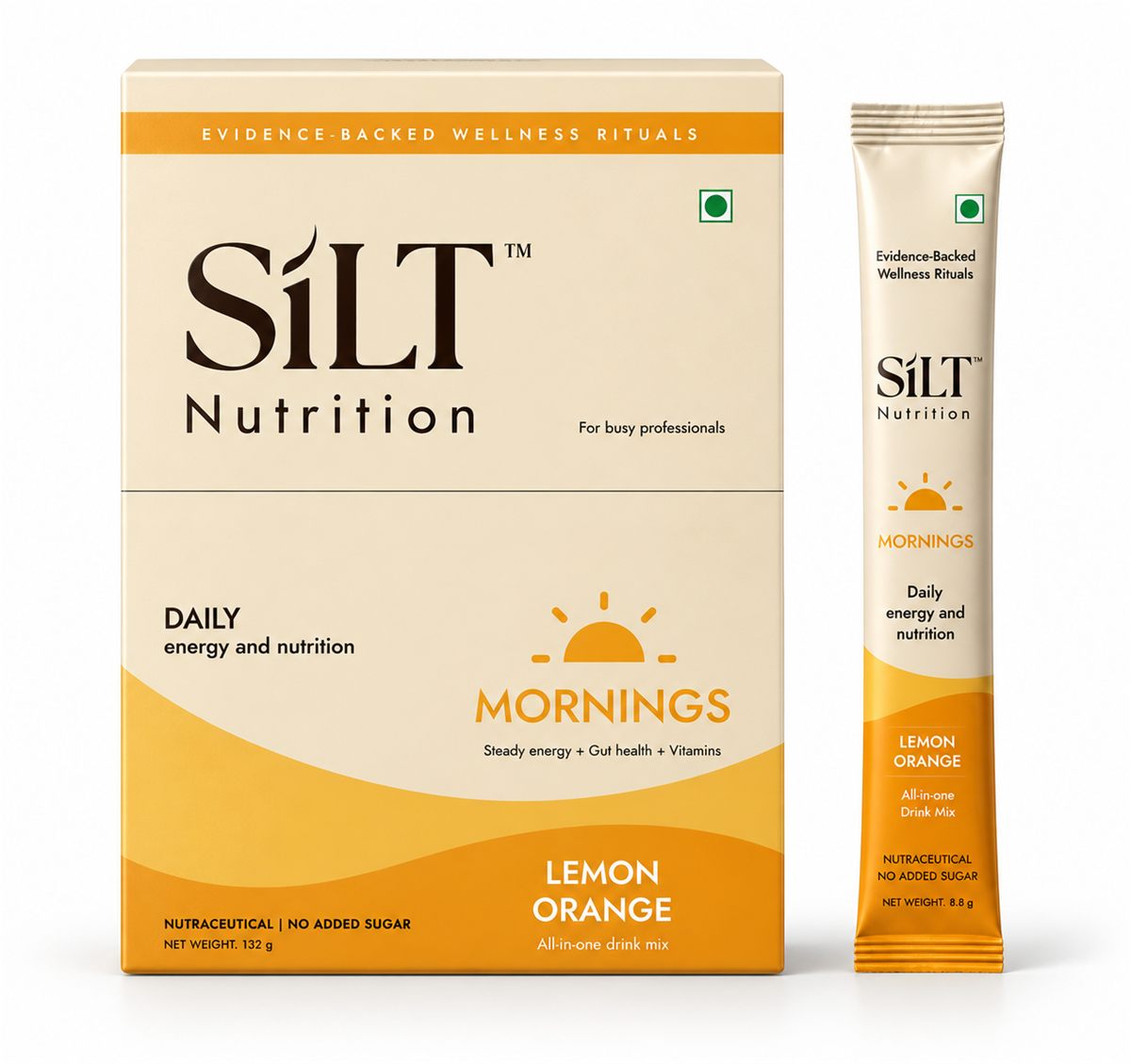
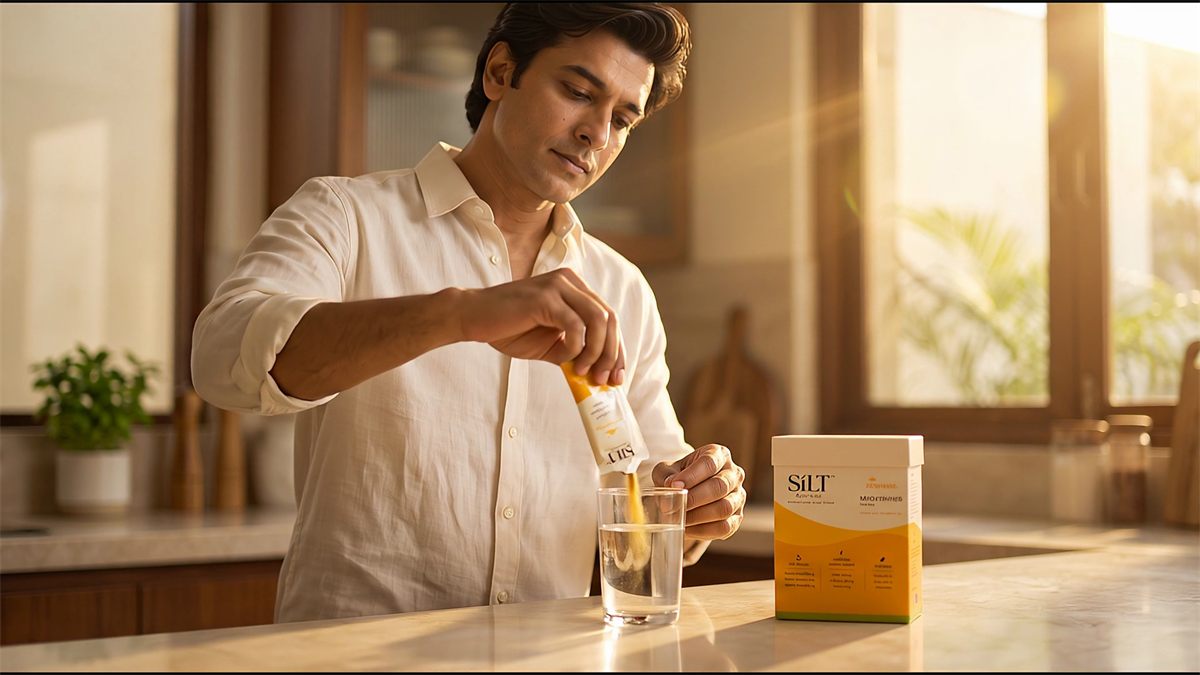
How to take it: stir one stick into 200-250 ml of room-temperature or cold water (not boiling) until it dissolves, and drink it any time in the morning, once a day. The pack says not to use boiling water, because heat degrades sensitive actives, and its direction is "for best results, use consistently for at least 3 months".
SILT Nights: 200 mg, no caffeine
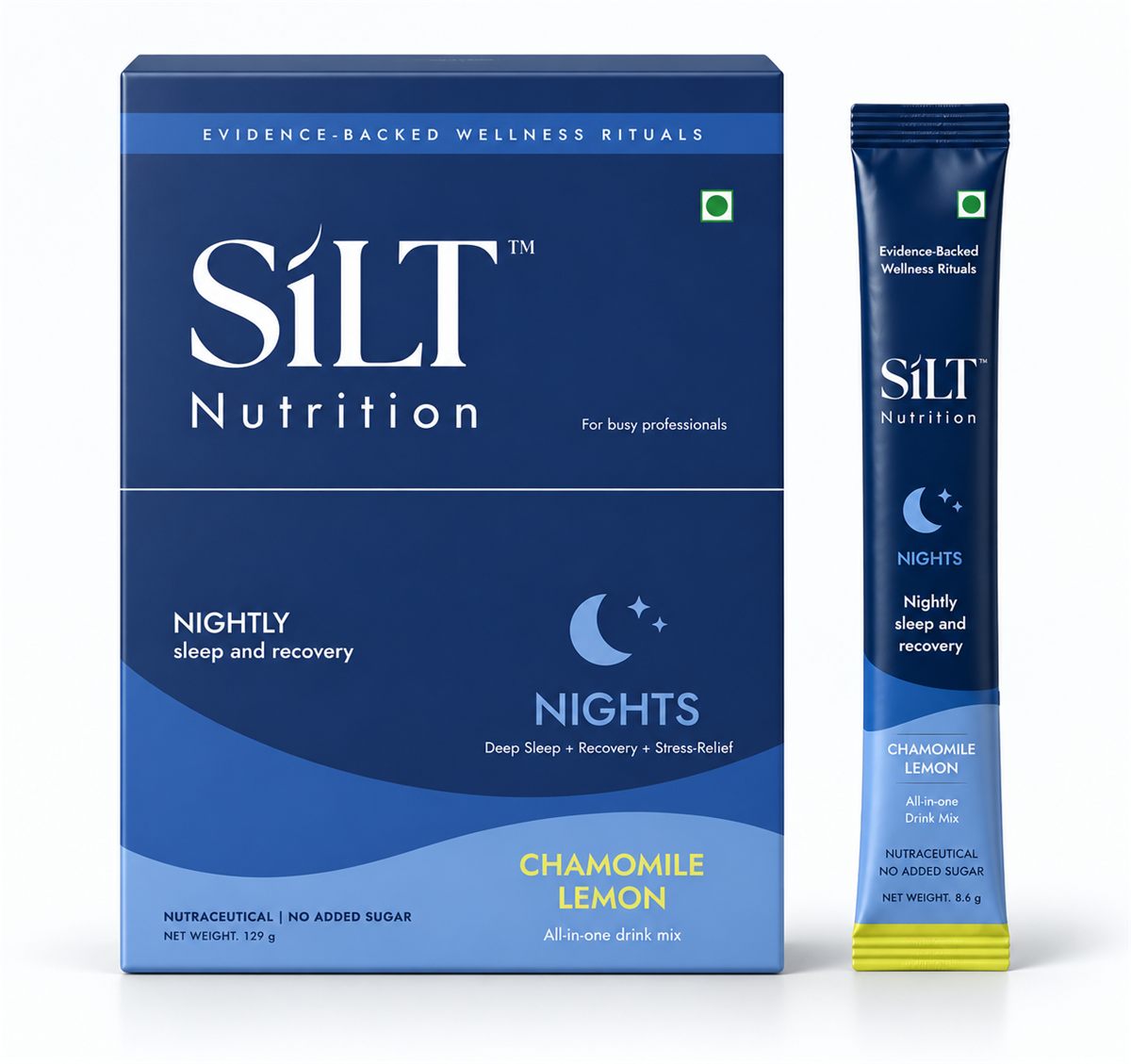
Nights is the caffeine-free way to take the same 200 mg L-theanine: one Chamomile Lemon stick for the evening, with no melatonin, no caffeine and no added sugar.
| Ingredient | Per 8.6 g stick | What it is |
|---|---|---|
| L-theanine | 200 mg | Calm, not knocked out. From tea leaves. No melatonin. |
| L-glycine | 3 g | Built around the sleep research. The amino acid studied before bed. |
| Magnesium bisglycinate | 1.8 g | For the body that won't switch off. Supports normal muscle and nerve function. |
| KSM-66® ashwagandha root extract | 300 mg | For days that run on stress. Root-only extract, 5.30% withanolides. |
| Caffeine | 0 mg | None |
| Melatonin | 0 mg | None |
| Chamomile Lemon | Flavour only | For taste. Not dosed actives. |
| Other ingredients | Listed on the pack | Cumin powder, black salt, iodised salt, acidity regulators (citric and malic acid), anti-caking agent (silicon dioxide) and steviol glycosides (stevia); taste and processing ingredients, not dosed actives |
| Free from, as printed | No added sugar, no maltodextrin, no melatonin | The pack: "Contains a natural sweetener." |
| Added sugar | 0 g | None; sweetened with stevia |
How to take it: stir one stick into 200-250 ml of lukewarm or cold water (not boiling) and drink it 30 to 60 minutes before bed, the window we recommend, once a day. The same pack directions apply: no boiling water, 1 stick a day. The other ingredients have their own write-ups: glycine at three grams and ashwagandha for stress.
MRP ₹1,125 ₹900 · 15 sticks or ₹1,500 for 30 (MRP ₹2,250)
Every active in both drinks is listed on the back of the pack with its dose or % RDA, with no proprietary blend. Every ingredient comes with a supplier certificate of analysis; the L-theanine certificate reads 100.0% assay (supplier certificate). A finished-product NABL lab report is pending; we'll publish it when it's ready. SILT is FSSAI compliant (FSSAI Lic. No. 12826999000631), vegetarian and made in India. See the full formulas and the certificates on our science page.
L-theanine dose and caffeine safety
Both drinks carry 200 mg L-theanine, the daily amount used in the four-week Hidese trial and the low end of the ranges in the reviews above. The part that needs counting is the caffeine in Mornings.
Caffeine limits and timing
For healthy adults, EFSA says up to 400 mg of caffeine a day and single doses up to 200 mg raise no safety concerns; in pregnancy the figure is 200 mg a day from all sources (EFSA). Count everything: one Mornings stick (80 mg) plus two 200 ml filter coffees (about 90 mg each) comes to roughly 260 mg. Too much caffeine can cause restlessness, insomnia, a fast heart rate and anxiety (MedlinePlus).
Keep caffeine away from bedtime, L-theanine or not. A 2023 meta-analysis of 24 studies found caffeine cut total sleep time by 45 minutes on average, and estimated that a 107 mg coffee should be drunk at least 8.8 hours before bed (Gardiner et al., 2023). In a home study, 400 mg taken even 6 hours before bed disturbed sleep (Drake et al., 2013). EFSA adds that a single 100 mg dose may affect sleep in some adults when taken close to bedtime (EFSA). If you sleep at 11 pm, the 8.8-hour figure puts your last coffee at about 2 pm. That's why the evening stick is the caffeine-free one.
Who should check with a doctor first
The packs say "not for medicinal use" and ask anyone who is pregnant or nursing, taking any medications, or with a medical condition (and, for Mornings, anyone allergic or sensitive to caffeine) to contact their healthcare practitioner first.
Our own rule for both drinks: if you have a liver or thyroid condition, are pregnant, or take regular medicines, especially for thyroid, blood pressure, blood sugar or sleep, check with your doctor first. If you take a blood thinner such as warfarin, ask your doctor before using SILT Mornings, because it contains vitamin K2 (55 mcg). Because Mornings contains caffeine, also check before using it, or any caffeine, if you (MedlinePlus):
- are pregnant or breastfeeding;
- have a sleep disorder such as insomnia, or anxiety;
- have a heart rhythm problem (arrhythmia) or high blood pressure;
- have GERD, ulcers, or migraines or other chronic headaches;
- take stimulants, certain antibiotics, asthma medicines or heart medicines.
Mornings isn't meant for children or teenagers, who should have less caffeine than adults (MedlinePlus).
L-theanine supplement questions
Can I drink coffee while taking L-theanine?
For most healthy adults, yes, as long as you count the caffeine. A stick of Mornings already has 80 mg, and a 200 ml filter coffee adds about 90 mg more by EFSA's estimate. Stay within 400 mg a day, or 200 mg if you're pregnant (EFSA). Nights adds no caffeine at all.
Should I take L-theanine at night or morning?
It depends on what it's paired with. With caffeine, as in Mornings, take it in the morning so the caffeine is long gone by bedtime. On its own, 200 mg a day of L-theanine has been studied over four weeks for stress and sleep scores (Hidese et al., 2019), which is why Nights carries it without caffeine for the evening.
Shop SILT Mornings or SILT Nights
Two ways to take 200 mg L-theanine, every dose printed on the back of the pack, no added sugar. Mornings adds 80 mg caffeine, 5 g PHGG, 6B CFU probiotics, taurine, digestive herbs and vitamins D3, K2, C and B12. Nights adds 3 g glycine, 250 mg magnesium and 300 mg KSM-66 ashwagandha, with no caffeine. ₹900 for 15 sticks (₹60 a stick) or ₹1,500 for 30 (₹50 a stick). Evidence, not hype.
MRP ₹1,125 ₹900 · 15 sticks or ₹1,500 for 30 (MRP ₹2,250)
See the full SILT Mornings formula · See the full SILT Nights formula
- Owen et al. (2008). The combined effects of L-theanine and caffeine on cognitive performance and mood. Nutr Neurosci. PubMed 18681988
- Haskell et al. (2008). The effects of L-theanine, caffeine and their combination on cognition and mood. Biol Psychol. PubMed 18006208
- Kelly et al. (2008). L-theanine and caffeine in combination affect human cognition. J Nutr. PubMed 18641209
- Giesbrecht et al. (2010). The combination of L-theanine and caffeine improves cognitive performance and increases subjective alertness. Nutr Neurosci. PubMed 21040626
- Einöther et al. (2010). L-theanine and caffeine improve task switching but not intersensory attention or subjective alertness. Appetite. PubMed 20079786
- Rogers et al. (2008). Time for tea: mood, blood pressure and cognitive performance effects of caffeine and theanine. Psychopharmacology. PubMed 17891480
- Dodd et al. (2015). Caffeine and L-theanine alone and in combination on cerebral blood flow, cognition and mood. Psychopharmacology. PMC4480845
- Camfield et al. (2014). Acute effects of tea constituents L-theanine, caffeine and EGCG on cognitive function and mood: systematic review and meta-analysis. Nutr Rev. PubMed 24946991
- Payne et al. (2025). Effects of tea or its bioactive compounds L-theanine or L-theanine plus caffeine on cognition, sleep and mood in healthy participants: systematic review and meta-analysis. Nutr Rev. PubMed 40314930
- Nobre et al. (2008). L-theanine, a natural constituent in tea, and its effect on mental state. Asia Pac J Clin Nutr. PubMed 18296328
- Hidese et al. (2019). Effects of L-theanine administration on stress-related symptoms and cognitive functions in healthy adults. Nutrients. PubMed 31623400 (full text PMC6836118)
- Bulman et al. (2025). The effects of L-theanine consumption on sleep outcomes: systematic review and meta-analysis. Sleep Med Rev. PubMed 40056718
- Cotter et al. (2026). Examining the effect of L-theanine on sleep: a systematic review of dietary supplementation trials. Nutr Neurosci. PubMed 41176609
- Williams et al. (2020). The effects of green tea amino acid L-theanine consumption on the ability to manage stress and anxiety levels: a systematic review. Plant Foods Hum Nutr. PubMed 31758301
- Gardiner et al. (2023). The effect of caffeine on subsequent sleep: systematic review and meta-analysis. Sleep Med Rev. PubMed 36870101
- Drake et al. (2013). Caffeine effects on sleep taken 0, 3, or 6 hours before going to bed. J Clin Sleep Med. PubMed 24235903
- European Food Safety Authority (EFSA). Caffeine (topic page: safe intake levels and caffeine in common drinks). efsa.europa.eu
- MedlinePlus, US National Library of Medicine. Caffeine. medlineplus.gov/caffeine.html