


Fibre Supplement With 5 g PHGG Prebiotic: SILT Mornings
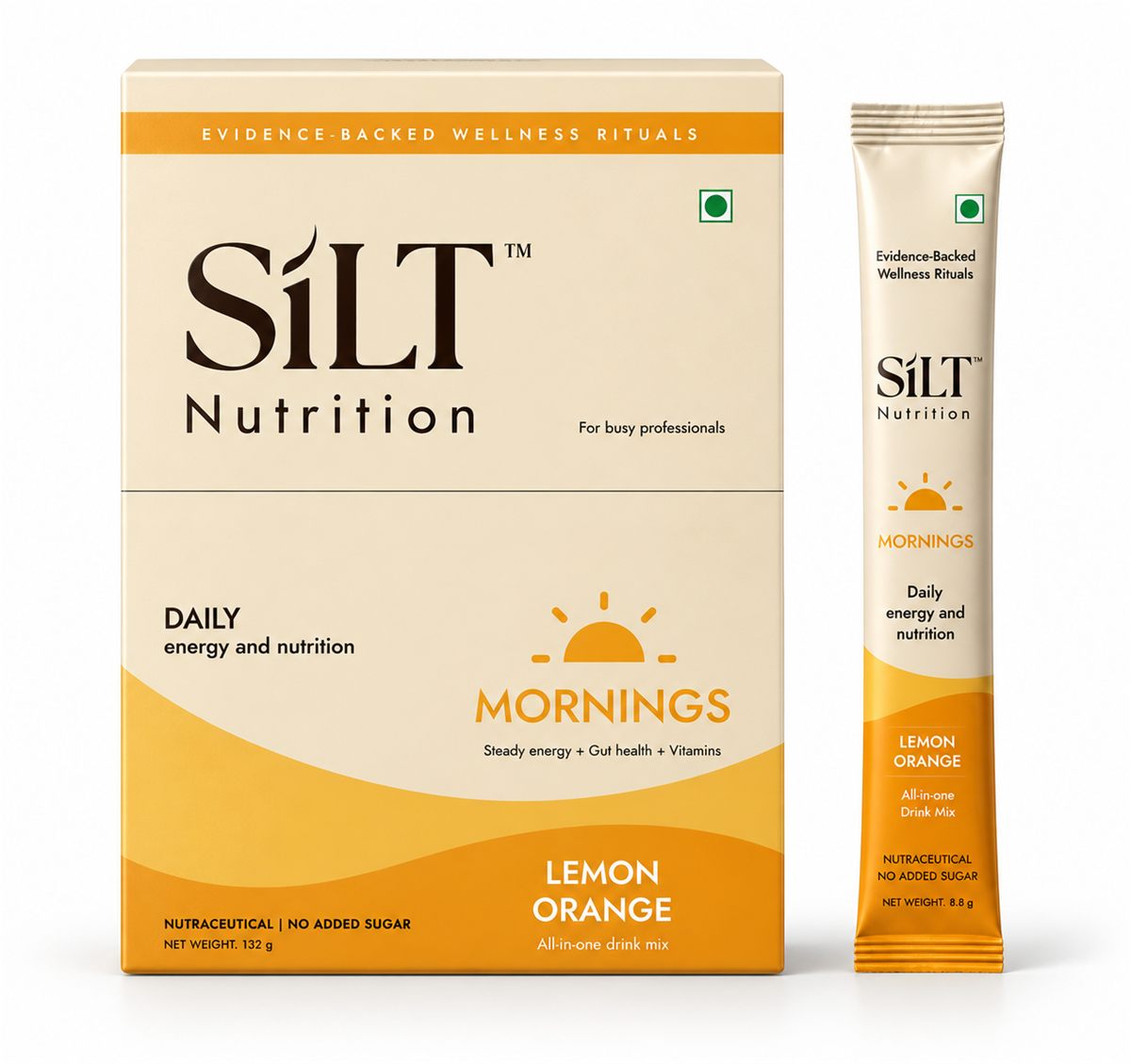
SILT™ Mornings is a fibre supplement you stir into water. Each 8.8 g stick carries 5 g of Sunfiber® PHGG (partially hydrolysed guar gum), a prebiotic fibre that dissolves without turning to gel, plus 6 billion CFU of spore-forming probiotics and 550 mg of digestive herb extracts (saunf, jeera, ajwain, amla). Every dose is printed on the back of the pack.
One thing to say up front: SILT Mornings is not a fibre-only product. The same stick has 80 mg caffeine, 1.4 g taurine, 200 mg L-theanine and vitamins D3, K2, C and B12. If you want a caffeine-free fiber supplement, this isn't it. If you want 5 g of a well-studied prebiotic fibre in one morning drink, with nothing hidden behind a blend, read on. (The caffeine half is explained on our caffeine and L-theanine page.)
MRP ₹1,125 ₹900 · 15 sticks or ₹1,500 for 30 (MRP ₹2,250)
That's ₹60 a stick in the 15-stick pack, or ₹50 a stick in the 30.
Shop SILT MorningsSee the full SILT Mornings formula
Sunfiber PHGG, explained
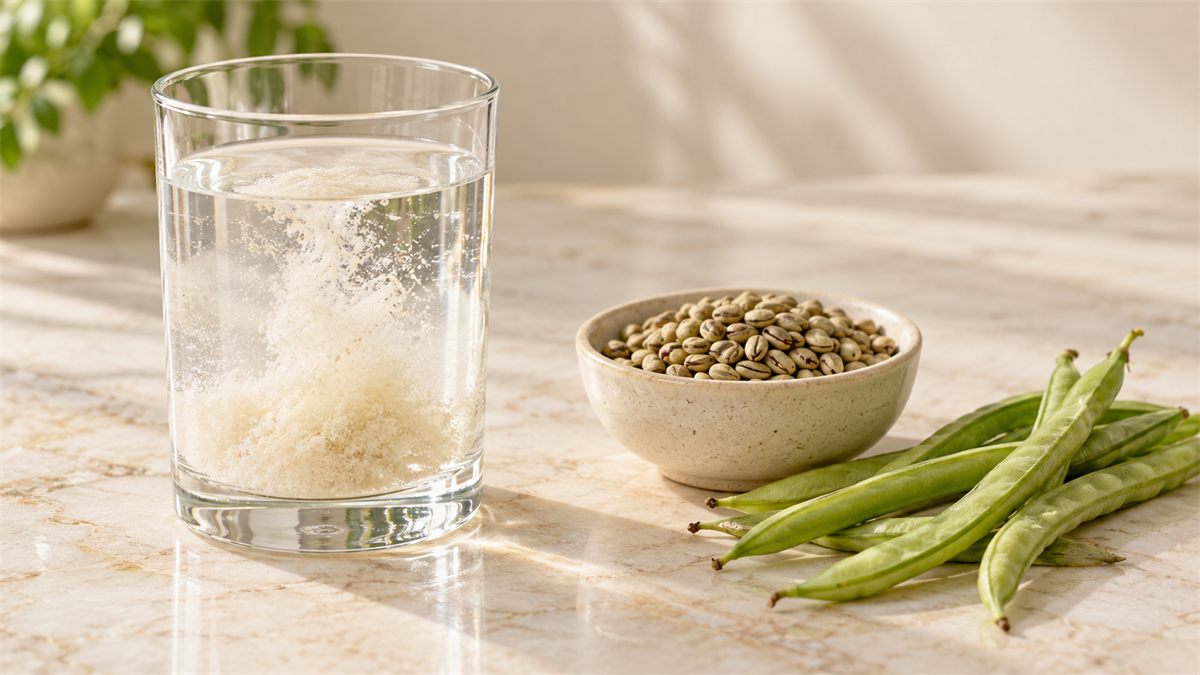
PHGG is guar gum, from the seed of the guar plant (gawar, or cluster bean), broken into shorter chains so it no longer forms a gel. Ordinary guar gum is highly viscous. Partially hydrolyzed guar gum is the non-viscous form sold in supplements today (McRorie, 2015).
That change is why it works in a drink. PHGG is highly soluble and has little physical effect on the food or water it goes into (Finley et al., 2013), and its low viscosity is what lets it be used in beverages (Slavin and Greenberg, 2003). Your glass stays a drink, not a paste. Sunfiber® is a branded PHGG, and it's the one in every stick of SILT Mornings.
How well people tolerate it
In the trials we could open, PHGG at 5-6 g a day was well tolerated:
- In a 12-week randomised, placebo-controlled trial in adults with IBS, 6 g a day improved journal bloating scores compared with placebo (−4.1 vs −1.2, p = 0.03). The authors reported no significant side effects. Other IBS symptoms and quality of life didn't improve (Niv et al., 2016).
- In an open trial of 188 adults with IBS, 5 g a day of PHGG was compared with 30 g a day of wheat bran for 12 weeks. Both groups improved, but far more people switched from bran to PHGG (49.9%) than the other way (10.9%) (Parisi et al., 2002).
To be straight about it: PHGG is still a fermentable fibre (Finley et al., 2013), and your gut bacteria make gas when they ferment fibre. If you eat little fibre now, you may notice some extra gas in the first days. More on that under how to take it.
PHGG vs isabgol vs inulin
Isabgol (psyllium) forms a gel and isn't fermented; inulin dissolves but ferments fast; PHGG dissolves clear and was gentle in trials, but it doesn't have psyllium's gel. Which one is "best" depends on what you want from it.
| Isabgol (psyllium husk) | Inulin / FOS (e.g. chicory) | PHGG (Sunfiber) | |
|---|---|---|---|
| In water | Forms a thick gel | Dissolves, no thickening | Dissolves, low viscosity |
| Fermented by gut bacteria? | No, so no gas from fermentation | Rapidly and completely | Yes, it's a fermentable fibre |
| What the evidence supports | Lower cholesterol, better blood-sugar control, softer or firmer stools as needed | May shift specific gut bacteria (a prebiotic effect), but no laxative effect at physiologic doses and none of the gel-based benefits | Better bloating scores in IBS at 6 g/day; preferred over wheat bran at 5 g/day |
| Watch out for | Thickens quickly, so drink it straight away | Rapid gas and more flatulence | Losing the gel also loses guar gum's cholesterol and blood-sugar effects |
Isabgol and inulin, as described in McRorie (2015): psyllium is soluble, gel-forming and not fermented, which is why it can lower cholesterol and normalise stools in both directions. Inulin and FOS are rapidly fermented, which brings gas and flatulence, and they don't provide psyllium's gel-dependent benefits.
So here's our honest view. If cholesterol or blood sugar is your main reason for taking fibre, isabgol has the stronger evidence. We chose PHGG for a daily morning drink because it dissolves clear, and because in trials people kept taking it. We go deeper in which fibre, and why we picked PHGG, and we compare the products on Indian shelves in the best fibre supplements in India.
A fibre you drink, not one you chew.
India's fibre gap, in grams
In a recent Indian study, adults ate well under half the fibre ICMR-NIN recommends. One stick helps, but it can't close that gap on its own.
ICMR-NIN recommendation: 40 g of dietary fibre per 2,000 kcal (Dega and Barbhai, 2023, citing ICMR-NIN). Measured intake: in a 2026 multicentre study of 1,104 adults recruited from diabetes-focused centres across 14 Indian states (690 of them with type 2 diabetes), fibre intake averaged 15.4 g a day (Kapoor et al., 2026). That's under 40% of the 40 g figure. The authors note that these were healthcare-seeking adults, not a sample of the whole population.
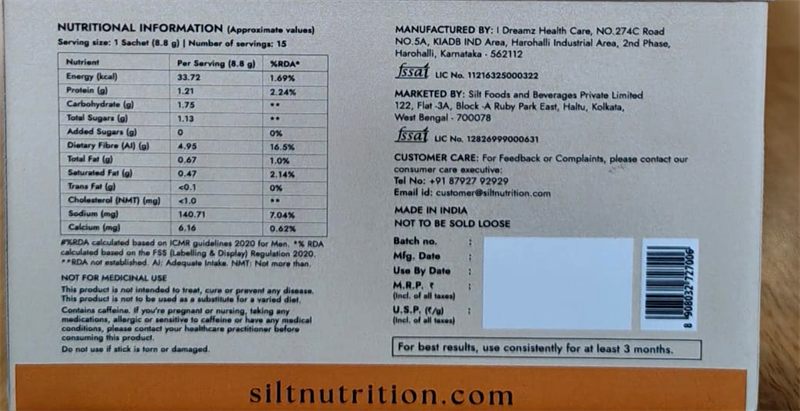
The pack's nutrition panel counts 4.95 g of dietary fibre per 8.8 g stick, 16.5% of the ICMR adequate intake for men (SILT pack; ICMR 2020 basis). Add a stick of SILT Mornings to that 15.4 g and you reach about 20 g, roughly half the recommendation. The rest has to come from food: dals, whole grains, vegetables and fruit. We cover the food side in how to improve gut health. A fibre supplement is a top-up, not a replacement for a fibre-rich plate.
Why 5 g a day
5 g is the daily amount most of the PHGG trials we opened used. Studies we opened gave 3-6 g a day, for 4 to 12 weeks:
| Study | People | PHGG a day | Length | What they found |
|---|---|---|---|---|
| Parisi et al., 2002 | 188 adults with IBS (open, vs wheat bran) | 5 g | 12 weeks | Both improved; success 60% on PHGG vs 40% on bran; more people switched to PHGG |
| Niv et al., 2016 | Adults with IBS (placebo-controlled) | 6 g | 12 weeks | Better bloating and bloating-plus-gas scores; no change in other IBS symptoms |
| Abe et al., 2023 | Healthy volunteers (placebo-controlled) | 3 g or 5 g | 8 weeks | Bowel-movement frequency improved in the 5 g group |
| Chan et al., 2022 | 52 care-home residents with constipation, average age 84 (placebo-controlled) | 5 g | 4 weeks | No difference in bowel frequency or stool type; fewer laxative doses in weeks 3-4 |
Two honest notes. First, the results are modest and mixed: the care-home trial found no change in bowel frequency. Second, two of the trials we cite, Abe et al. (2023) and Yasukawa et al. (2019), had authors employed by or funded by the company behind Sunfiber. We don't claim a stick of SILT Mornings reproduces any single trial's results. If bloating is what brought you here, start with how to reduce bloating, which covers what helps fast and what helps long term.
A prebiotic supplement, plus spores and herbs
A prebiotic is "a substrate that is selectively utilized by host microorganisms conferring a health benefit" (Gibson et al., 2017, ISAPP). PHGG fits the "selectively utilized" part: it increased Bifidobacterium in the gut (Slavin and Greenberg, 2003), and in a 3-month placebo-controlled trial of 44 adults with loose-stool tendencies it raised Bifidobacterium and improved stool form (Yasukawa et al., 2019; several authors worked for Sunfiber's maker). That's why we call SILT Mornings a prebiotic supplement as well as a fibre one.
The probiotics and herbs are in the same stick, each listed on the back of the pack with its dose or % RDA. The supplier certificate for the PHGG reads 91.2% dietary fibre (supplier certificate).
| Ingredient | Per 8.8 g stick | What it is |
|---|---|---|
| Sunfiber® PHGG (partially hydrolysed guar gum) | 5 g | Feeds your good gut bacteria. 16.5% of your daily fibre. |
| Probiotics | 6 billion CFU | Built to make the trip. Spore-formers are studied for surviving stomach acid. |
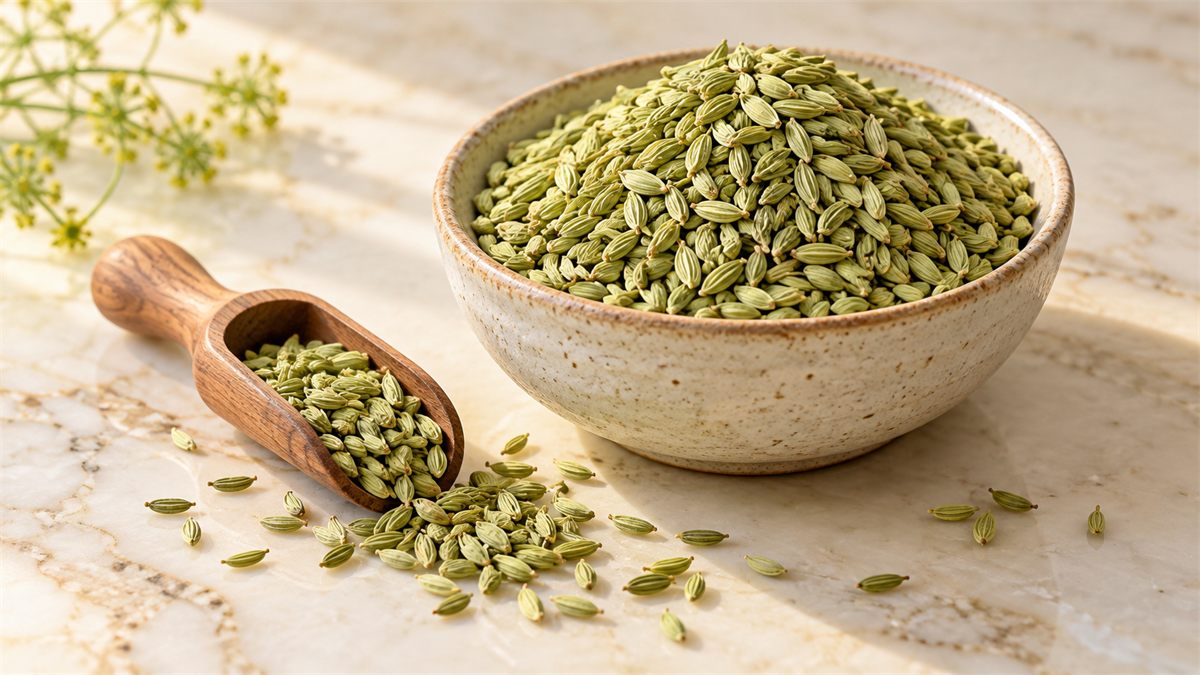
| Digestive herb extracts (saunf, jeera, ajwain, amla) | 550 mg | The after-meal ritual from Indian kitchens. Four traditional extracts. |
| Caffeine | 80 mg | A clean morning lift. Less than a cup of filter coffee. |
| Taurine | 1.4 g | Supports energy and alertness. Caffeine's usual research partner. |
| L-theanine | 200 mg | Calm focus. Studied alongside caffeine for alertness. |
| Vitamin D3 | 600 IU | Helps fill everyday vitamin gaps. 100% RDA each. |
| Vitamin K2 (menaquinone) | 55 mcg | Helps fill everyday vitamin gaps. 100% RDA each. |
| Vitamin C | 80 mg | Helps fill everyday vitamin gaps. 100% RDA each. |
| Vitamin B12 | 100% RDA | Helps fill everyday vitamin gaps. 100% RDA each. |
| Lemon Orange, stevia (steviol glycosides), natural beta-carotene colour | Flavour, sweetener and colour only | For taste. Not dosed actives; 0 g added sugar, no maltodextrin, no gluten. |
The pack's own lines are "Supports good gut bacteria" (the fibre), "Supports gut microbiome" (the probiotics) and "Helps in digestion" (the herbs). The nutrition panel shows 1.13 g total sugars and 0 g added sugars per stick, which is why we say "no added sugar". We list the probiotic species and herb amounts so you can check them. Evidence for the herbs is mostly traditional use and lab studies, so we list them as digestion support, not a treatment. The pack names the three probiotic species but not their strain codes, so strain-specific probiotic trial results can't be assumed to apply to it. The difference between the two "pre" and "pro" ideas is laid out in probiotics vs prebiotics, and what's known about each spore species is in our guide to Bacillus probiotics.
| Nutrient | Per stick | %RDA |
|---|---|---|
| Energy | 33.72 kcal | 1.69% |
| Protein | 1.21 g | 2.24% |
| Carbohydrate | 1.75 g | Not established |
| Total sugars | 1.13 g | Not established |
| Added sugars | 0 g | 0% |
| Dietary fibre (AI) | 4.95 g | 16.5% |
| Total fat | 0.67 g | 1.0% |
| Saturated fat | 0.47 g | 2.14% |
| Trans fat | <0.1 g | 0% |
| Cholesterol (NMT) | <1.0 mg | Not established |
| Sodium | 140.71 mg | 7.04% |
| Calcium | 6.16 mg | 0.62% |
%RDA basis printed on the pack: ICMR 2020 (men); FSS (Labelling and Display) Regulations 2020. AI = adequate intake; NMT = not more than.
How to take it
Stir one stick into 200-250 ml of room-temperature or cold water (not boiling) and drink it any time in the morning, once a day. The PHGG dissolves, so there's no gel to race against. The pack adds: "Do not use boiling water: heat degrades sensitive actives" and "For best results, use consistently for at least 3 months" (SILT pack).
- Tear one 8.8 g stick.
- Stir it into 200-250 ml of room-temperature or cold water until it dissolves.
- Drink it any time in the morning. One stick a day.
If you're new to fibre, go gently. Eating a lot of fibre in a short time can cause gas, bloating and cramps; MedlinePlus advises adding fibre gradually over a few weeks and drinking plenty of fluids, because water helps fibre pass through the gut (MedlinePlus). Keep it to the morning, because the stick also carries 80 mg caffeine.
Check with a doctor first
If you have a liver or thyroid condition, are pregnant, or take regular medicines, check with your doctor first. That's the standing caution on SILT Mornings. If you take regular medicines, especially for thyroid, blood pressure, blood sugar or sleep, ask your doctor before you start. If you take a blood thinner such as warfarin, ask your doctor before using SILT Mornings, because it contains vitamin K2 (55 mcg). The pack also says it is not for medicinal use or a substitute for a varied diet, and to contact your healthcare practitioner if you're pregnant or nursing, taking any medications, sensitive to caffeine or have any medical condition.
- Caffeine. Each stick has 80 mg. EFSA says up to 400 mg a day from all sources raises no safety concerns for healthy adults, and up to 200 mg a day in pregnancy and breastfeeding (EFSA). Count your chai and coffee too.
- Gut conditions. If you live with IBS, IBD or another gut condition, talk to your doctor before adding any fibre supplement. The trials above were in specific groups, not everyone.
- New or lasting symptoms. SILT is for everyday energy, gut and sleep. It doesn't treat medical conditions. For those, or if you're pregnant or on medication, talk to your doctor.
Lab testing, ingredient by ingredient
Our suppliers' certificates of analysis cover 13 ingredients and 198 checks, with none failed. The vitamin blend's certificate is still pending. The finished drink is to be tested by an NABL-accredited lab, and we'll publish that report when it's ready.
Every dose is printed on the back of the pack, with no proprietary blend. Both SILT products are made by I Dreamz Health Care (FSSAI Lic. No. 11216325000322). SILT is FSSAI compliant (FSSAI Lic. No. 12826999000631), vegetarian and made in India. You can see the formula and the supplier certificates on our science page.
What it costs per stick
SILT Mornings costs ₹60 a stick in the 15-stick pack and ₹50 a stick in the 30. Each stick gives you 5 g PHGG, 6 billion CFU probiotics and 550 mg digestive herb extracts, along with the caffeine, taurine, L-theanine and vitamins.
| Price (MRP) | Per stick (= per 5 g PHGG) | |
|---|---|---|
| 15 sticks | ₹900 (₹1,125) | ₹60 |
| 30 sticks | ₹1,500 (₹2,250) | ₹50 |
To be fair to fibre-only products: SILT Mornings isn't a like-for-like comparison with a tub of plain isabgol or PHGG. Part of each stick's price pays for the probiotics, herbs, caffeine and vitamins. If fibre is all you want, compare plain fibre products on cost per gram of fibre.
Shop SILT Mornings
SILT Mornings: 5 g Sunfiber PHGG, 6 billion CFU spore probiotics, 550 mg digestive herb extracts, plus 80 mg caffeine, 1.4 g taurine, 200 mg L-theanine and vitamins D3, K2, C and B12. Every dose printed on the back of the pack. No added sugar.
MRP ₹1,125 ₹900 · 15 sticks or ₹1,500 for 30 (MRP ₹2,250)
₹60 a stick in the 15, ₹50 a stick in the 30.
Shop SILT Mornings- McRorie JW Jr (2015). Evidence-based approach to fiber supplements and clinically meaningful health benefits, part 1. Nutr Today. PubMed 25972618
- Finley JW et al. (2013). Safety assessment and caloric value of partially hydrolyzed guar gum. J Agric Food Chem. PubMed 23347282
- Slavin JL, Greenberg NA (2003). Partially hydrolyzed guar gum: clinical nutrition uses. Nutrition. PubMed 12781858
- Niv E et al. (2016). PHGG versus placebo in patients with irritable bowel syndrome. Nutr Metab (Lond). PubMed 26855665
- Parisi GC et al. (2002). Wheat bran vs PHGG in irritable bowel syndrome: a multicentre randomised open trial. Dig Dis Sci. PubMed 12184518
- Abe A et al. (2023). PHGG, gut health, sleep and motivation in healthy subjects. J Clin Biochem Nutr. PubMed 36936875
- Chan TC et al. (2022). PHGG for constipation in long-term care residents. J Nutr Health Aging. PubMed 35297467
- Yasukawa Z et al. (2019). Repeated PHGG consumption, faecal characteristics and gut microbiota. Nutrients. PubMed 31509971
- Gibson GR et al. (2017). ISAPP consensus statement on the definition and scope of prebiotics. Nat Rev Gastroenterol Hepatol. PubMed 28611480
- Dega V, Barbhai MD (2023). Exploring the underutilized novel foods and starches for formulation of low glycemic therapeutic foods: a review (cites the ICMR-NIN fibre RDA). Front Nutr. PMC10160467
- Kapoor N et al. (2026). Macronutrient intake and carbohydrate quality in Indian adults: the I-STARCH-1 study. Nutrients. PubMed 42796976
- MedlinePlus (US National Library of Medicine). Fiber. medlineplus.gov
- EFSA. Caffeine topic page. efsa.europa.eu