


How to improve gut health, in short: eat more fibre (most Indians eat far too little), add a fermented food like curd or chaas most days, eat a wide variety of plant foods, protect your sleep, and use antibiotics only when a doctor prescribes them. None of this is glamorous, and no single food or powder replaces it. Below, every habit is graded by the evidence behind it, with Indian food swaps and the signs that mean you should see a doctor rather than change your breakfast. Disclosure: we make a morning drink with prebiotic fibre and probiotics; our fibre supplement page covers it, and we keep it to one short section here.
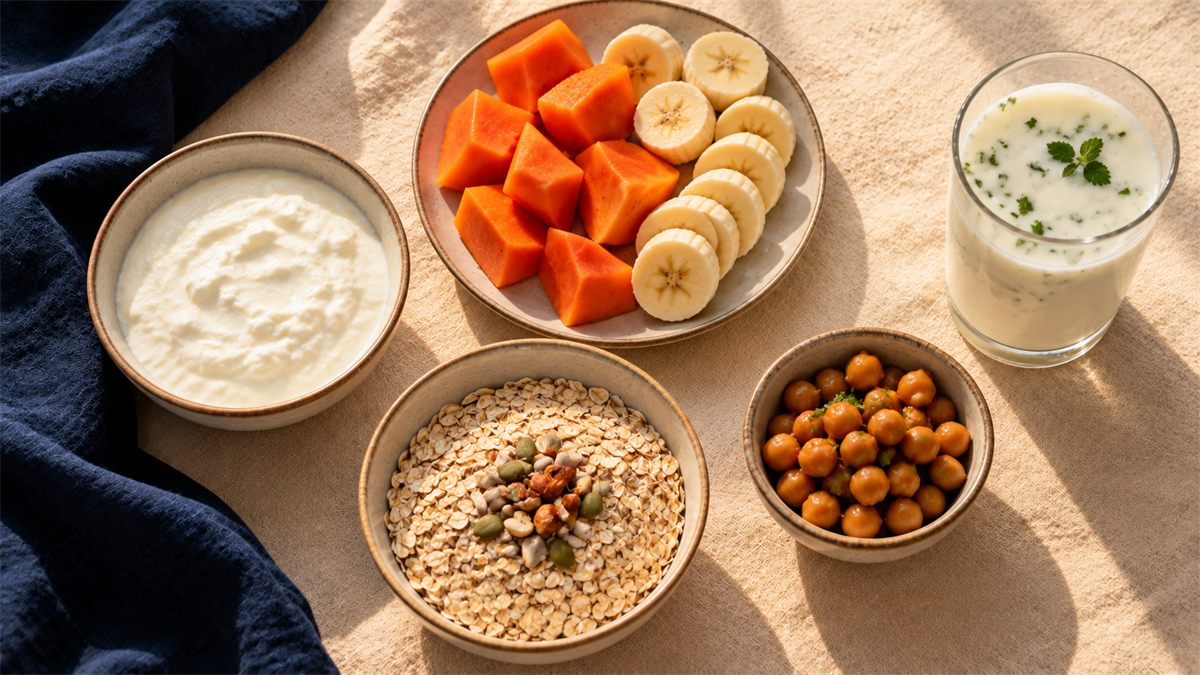
Start with these six habits
Gut health isn't one number you can fix overnight. It's the result of what you eat, how you sleep and which medicines you take, repeated daily. Start here:
- Add one fibre-rich food to every meal: a katori of dal, a millet roti, a fruit eaten whole (ICMR-NIN, 2011).
- Raise fibre gradually and drink more water as you do (NHS, Constipation).
- Have a fermented food most days: curd, chaas or kanji (Wastyk et al., 2021).
- Vary your plants: different vegetables, fruits, pulses and grains through the week.
- Protect your sleep and move daily: a daily walk helps keep you regular (NHS, Constipation).
- Take antibiotics only when prescribed, exactly as prescribed, and ask your doctor about a probiotic if you're prone to antibiotic diarrhoea (Esmaeilinezhad et al., 2025).
If you have blood in your poo, unexplained weight loss or a change in bowel habit that isn't usual for you, skip the diet tips and see a doctor (NHS, Bowel cancer symptoms).
Gut health habits ranked by evidence
Most gut health advice online is presented as equally proven. It isn't. "Strength" below is our editorial read of the sources linked on this page, not a clinical grade.
| Habit | What to do | Strength of evidence | Source |
|---|---|---|---|
| Eat more fibre | Work towards 30 g a day from dals, millets, whole grains, vegetables, fruit | Standard health-body advice; Indian estimates are about 15-20 g, well short of the target | NHS; ICMR-NIN; Kapoor 2026; Hebbar 2026 |
| Fermented foods | Curd, chaas, kanji most days | One randomised study, 36 healthy adults (18 on fermented foods): more microbial diversity, fewer inflammatory markers | Wastyk 2021 |
| Probiotics with antibiotics | Ask your doctor | Cochrane review, 38 trials: fewer C. difficile diarrhoea cases (low certainty); one study found slower microbiome recovery | Cochrane 2025; Suez 2018 |
| Antibiotics only when needed | No leftover or self-prescribed courses | Small study, 3 adults, two ciprofloxacin courses: microbiome recovery often incomplete | Dethlefsen 2011 |
| Variety of plant foods | Different colours and pulses each week | Nutrition-guideline advice; no trial of a set number of plants | ICMR-NIN 2011 |
| Movement | A daily walk | NHS advice for regularity | NHS |
| Relaxation | Find ways to unwind | NHS advice for IBS; little direct evidence in healthy people | NHS |
| Sleep | Keep regular, full nights | One crossover study, 9 men: small shifts, no change in overall community make-up | Benedict 2016 |
Close the fibre gap, slowly
Fibre is the clearest place to start, and most Indian adults are well short. Fibre is also what your gut bacteria eat: in the Stanford diet study below, a high-fibre diet raised the bacterial enzymes that break down carbohydrates (Wastyk et al., 2021).
How short are we? In a 2026 study of 1,104 adults recruited at 29 diabetes-focused centres in 14 Indian states (690 of them with type 2 diabetes), fibre intake averaged 15.4 g a day, and carbohydrates supplied 62% of energy (Kapoor et al., 2026). The authors note these were adults seeking healthcare, not a sample of the general population, though fibre intake was similar with and without diabetes. A separate 2026 Indian paper, summarising earlier research, puts typical intake at about 15-20 g a day, below a recommended 25-30 g (Hebbar et al., 2026). The NHS target for adults is 30 g a day (NHS, Fibre).
Where to find it. ICMR-NIN's dietary guidelines list wheat, jowar, bajra, ragi, maize, pulses, dals and fenugreek seeds as having more than 10 g of fibre per 100 g, and rate fresh fruit above fruit juice (ICMR-NIN, 2011). So the Indian kitchen already has the answer; the problem is polished rice, maida and too little dal on the plate.
| Instead of | Try | Why |
|---|---|---|
| A plate of white rice | Half rice, half millet (jowar, bajra or ragi), or more dal alongside | Millets and dals are in ICMR-NIN's >10 g per 100 g group |
| Maida bread or naan | Whole-wheat roti | Whole wheat is in the same group |
| Fruit juice | The whole fruit | ICMR-NIN rates fresh fruit above juice |
| Plain poha or upma | Add peas, vegetables or a handful of soaked chana | More pulses and vegetables |
| Biscuits with chai | Roasted chana or a fruit | Pulses and fruit over refined flour |
Go slowly. The NHS advises increasing fibre gradually and drinking plenty of water and other fluids (NHS, Constipation). A jump from 15 g to 30 g overnight is a common route to gas and bloating; add one swap a week. If bloating is already your problem, our guide on how to reduce bloating covers which fibres are gentler.
Add a fermented food most days
Fermented foods have direct trial evidence for gut bacteria, though it comes from one small but well-run study. An expert panel convened by the International Scientific Association for Probiotics and Prebiotics (ISAPP) defines fermented foods as foods made through desired microbial growth and enzymatic conversions of food components (Marco et al., 2021).
In a 17-week randomised study at Stanford, 36 healthy adults were assigned to a high-fermented-food diet or a high-fibre diet. The fermented-food group's gut microbial diversity rose steadily and their inflammatory markers fell (Wastyk et al., 2021). It's one small US study, so read it as a promising lead rather than settled science.
Curd before capsules.
Indian kitchens are full of fermented foods:
- Curd (dahi) and chaas: eaten uncooked, the easiest daily habit.
- Kanji: the fermented black-carrot drink of North Indian winters.
- Idli, dosa and dhokla batters: fermented, then steamed or cooked. Cooking is heat, so these may carry far fewer live microbes than curd; they still count as fermented foods under the ISAPP definition.
- Homemade pickles fermented in brine (not the oil-and-vinegar kind).
For more on the bacteria themselves, read how your gut microbiome works.
Variety over superfoods
There is no single gut superfood. ICMR-NIN's guidelines make the point for nutrients: no single fruit or vegetable provides everything, so eat a variety of different colours (ICMR-NIN, 2011). The same logic suits your gut bacteria, which feed on different fibres.
You'll see a "30 plants a week" target online. We couldn't verify a trial that tested a set number, so we don't give one. A practical version: rotate your dals (moong, masoor, rajma, chana), your grains (rice, wheat, millets, oats) and your sabzi through the week, rather than eating the same three things every day.
Sleep, stress and movement
Food is the main lever, but not the only one. The evidence here is thinner, and we'll say so.
Sleep. In a lab crossover study, 9 normal-weight men slept about 4 hours a night for two nights. Their gut bacteria shifted (a higher Firmicutes-to-Bacteroidetes ratio), but the overall make-up of their gut community (beta diversity) didn't differ from after normal sleep (Benedict et al., 2016). That's a tiny, short study. Sleep matters for plenty of other reasons; just don't expect a gut transformation from one good night.
Stress. For people with irritable bowel syndrome (IBS), the NHS advice includes finding ways to relax and getting plenty of exercise (NHS, IBS diet and lifestyle). If stress reliably upsets your stomach, that's a reason to see a doctor about IBS, not to buy a supplement.
Movement. The NHS notes that a daily walk or run can help you poo more regularly (NHS, Constipation). A 15-minute walk after lunch is an easy start.
Antibiotics: use them well
Antibiotics are sometimes essential; the aim is to use them only when needed, not to avoid them. Diarrhoea is one of their common side effects, usually mild and gone once the course ends (NHS, Antibiotic side effects).
What they do to gut bacteria. In a study that sampled three adults over 10 months spanning two courses of ciprofloxacin, each course changed their gut bacteria within 3-4 days. Recovery began about a week after each course ended but was often incomplete (Dethlefsen & Relman, 2011). So: no leftover strips, no antibiotics for a viral cold, and only on a doctor's prescription.
Should you take a probiotic with them? The evidence cuts both ways. A 2025 Cochrane review of 38 trials (13,179 people) found C. difficile diarrhoea in 1.6% of those given probiotics alongside antibiotics, against 3.2% of controls (low-certainty evidence), and its authors call for large trials in people at low baseline risk (Esmaeilinezhad et al., 2025). But in a study in mice and people, probiotics taken after antibiotics delayed the gut microbiome's return to its usual state compared with no probiotic (Suez et al., 2018). Ask the doctor who prescribed the antibiotic.
Do gut supplements help?
Sometimes, modestly, and never instead of food. The NHS says there's some evidence probiotics may ease some IBS symptoms, but little evidence for many of the health claims made for them; people with a weakened immune system or an existing health condition should talk to a doctor first (NHS, Probiotics).
If you can't get enough fibre from food, a fibre supplement can help close the gap. Compare the options in our best fibre supplement in India guide, or see how PHGG compares with isabgol. For the difference between the two kinds of gut supplement, read probiotics vs prebiotics, and for spore-forming strains, our guide to Bacillus probiotics.
When to see a doctor
Diet changes are for everyday gut health, not for symptoms that need a diagnosis. See a doctor if you notice changes in your poo that aren't usual for you (softer poo, diarrhoea or constipation), blood in your poo, needing to poo more or less often than usual, a lump in your tummy, unexplained weight loss, or feeling very tired or short of breath. Get urgent help if your poo is black or dark red (NHS, Bowel cancer symptoms). Most of these symptoms have other, common causes, but they still need checking.
See a doctor too if constipation isn't getting better with self-help or pharmacy remedies, or keeps coming back (NHS, Constipation).
A gut-friendly start, not a shortcut
SILT Mornings is a drink for the fibre-and-probiotic part of the routine, not a replacement for dal, curd and vegetables. Stir one stick into 200-250 ml of room-temperature or cold water (not boiling: the pack says heat degrades sensitive actives), any time in the morning. The pack says 1 stick per day, and "use consistently for at least 3 months".
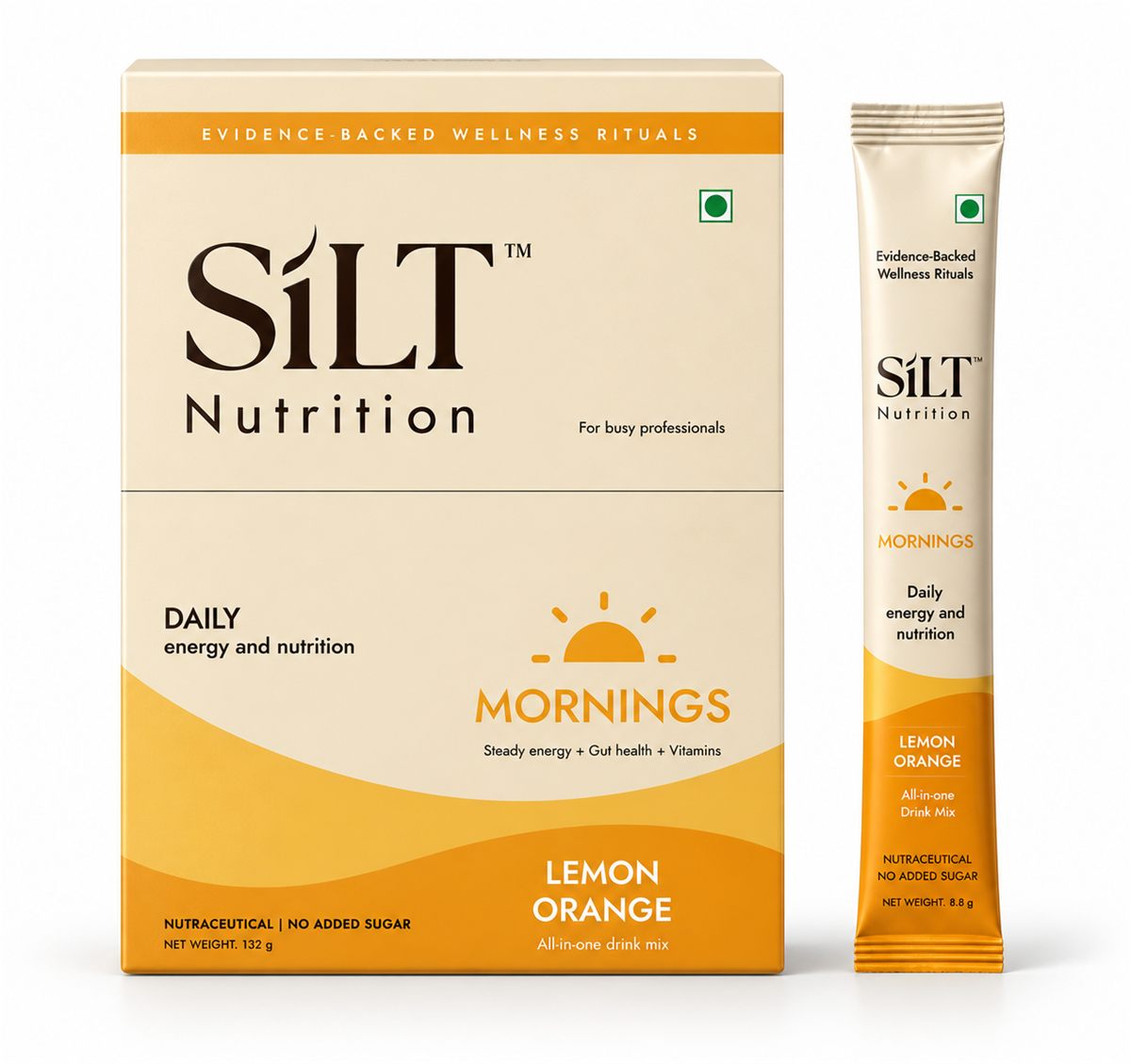
Each stick has 5 g Sunfiber® PHGG (partially hydrolysed guar gum, a soluble prebiotic fibre), 6 billion CFU of three spore-forming probiotics (Bacillus subtilis, B. coagulans and B. clausii, 2 billion CFU each) and 550 mg of digestive herb extracts (saunf, jeera, ajwain, amla). The pack names the three probiotic species but not their strain codes, so strain-specific probiotic trial results can't be assumed to apply to it. It also has 80 mg caffeine, 200 mg L-theanine and vitamins D3, K2 (menaquinone), C and B12 at 100% RDA. The pack lists it as no added sugar, no maltodextrin and no gluten, and says it contains a natural sweetener (stevia) and natural colour. The flavour is Lemon Orange. The nutrition panel on the pack shows 4.95 g dietary fibre per stick, 16.5% of the ICMR 2020 adequate intake for men, with 1.13 g total sugars and 0 g added sugars (SILT pack). The PHGG supplier certificate reads 91.2% dietary fibre (supplier certificate). Supplier certificates of analysis are on our science page; the vitamin blend certificate and a finished-product NABL lab report are pending, and we'll publish them when they're ready. If you take regular medicines, especially for thyroid, blood pressure, blood sugar or sleep, ask your doctor first, and the same goes if you have a liver or thyroid condition or are pregnant. The pack also says it contains caffeine, and if you are nursing or sensitive to caffeine, to check with your healthcare practitioner first. If you take a blood thinner such as warfarin, ask your doctor before using SILT Mornings, because it contains vitamin K2 (55 mcg). The evidence for PHGG at 5 g is on our fibre supplement page.
MRP ₹1,125 ₹900 · 15 sticks or ₹1,500 for 30 (MRP ₹2,250)
That's ₹60 a stick, or ₹50 in the 30-stick pack.
Shop SILT MorningsGut health is a daily habit
Work your fibre up towards 30 g with dals, millets, whole grains and whole fruit; add curd, chaas or kanji most days; rotate your plants; walk daily; sleep properly; and keep antibiotics for when a doctor prescribes them. See a doctor for red-flag symptoms. If fibre from food falls short, our fibre supplement page explains where a fibre supplement fits. Evidence, not hype.
- Kapoor et al., 2026. Macronutrient intake and carbohydrate quality in Indian adults with and without type 2 diabetes. Nutrients. pubmed.ncbi.nlm.nih.gov/42796976
- Hebbar et al., 2026. Perceptions and barriers to dietary fiber intake among middle-aged south Indian women. PLOS Glob Public Health. pubmed.ncbi.nlm.nih.gov/42340992
- ICMR-National Institute of Nutrition, 2011. Dietary Guidelines for Indians: a manual. nin.res.in
- NHS. How to get more fibre into your diet. nhs.uk/live-well/eat-well/digestive-health
- NHS. Constipation. nhs.uk/conditions/constipation
- Wastyk et al., 2021. Gut-microbiota-targeted diets modulate human immune status. Cell. pubmed.ncbi.nlm.nih.gov/34256014
- Marco et al., 2021. ISAPP consensus statement on fermented foods. Nat Rev Gastroenterol Hepatol. pubmed.ncbi.nlm.nih.gov/33398112
- Benedict et al., 2016. Gut microbiota and glucometabolic alterations in response to recurrent partial sleep deprivation in normal-weight young individuals. Mol Metab. pubmed.ncbi.nlm.nih.gov/27900260
- NHS. Irritable bowel syndrome (IBS): diet, lifestyle and medicines. nhs.uk/conditions/irritable-bowel-syndrome-ibs
- NHS. Antibiotics: side effects. nhs.uk/conditions/antibiotics/side-effects
- Dethlefsen & Relman, 2011. Incomplete recovery and individualized responses of the human distal gut microbiota to repeated antibiotic perturbation. PNAS. pubmed.ncbi.nlm.nih.gov/20847294
- Esmaeilinezhad et al., 2025. Cochrane review (update of Goldenberg 2017): probiotics and Clostridioides difficile-associated diarrhoea in adults and children. Cochrane Database Syst Rev. pubmed.ncbi.nlm.nih.gov/40931979
- Suez et al., 2018. Post-antibiotic gut mucosal microbiome reconstitution is impaired by probiotics and improved by autologous FMT. Cell. pubmed.ncbi.nlm.nih.gov/30193113
- NHS. Probiotics. nhs.uk/conditions/probiotics
- NHS. Bowel cancer: symptoms. nhs.uk/conditions/bowel-cancer/symptoms