


The truly vitamin D rich foods are oily fish, egg yolks, mushrooms that have been exposed to UV light or sun, and foods with vitamin D added. That's a short list, and most of it isn't on an Indian vegetarian plate: unfortified milk, curd and paneer carry close to none. So below, every food is measured against the 600 IU a day India's RDA asks for, alongside what fortification and sunlight add, and why food alone usually falls short. Disclosure: we make a morning drink that contains vitamin D3 and keep it to one short section near the end; our vitamin D3 + K2 guide covers supplements in full.
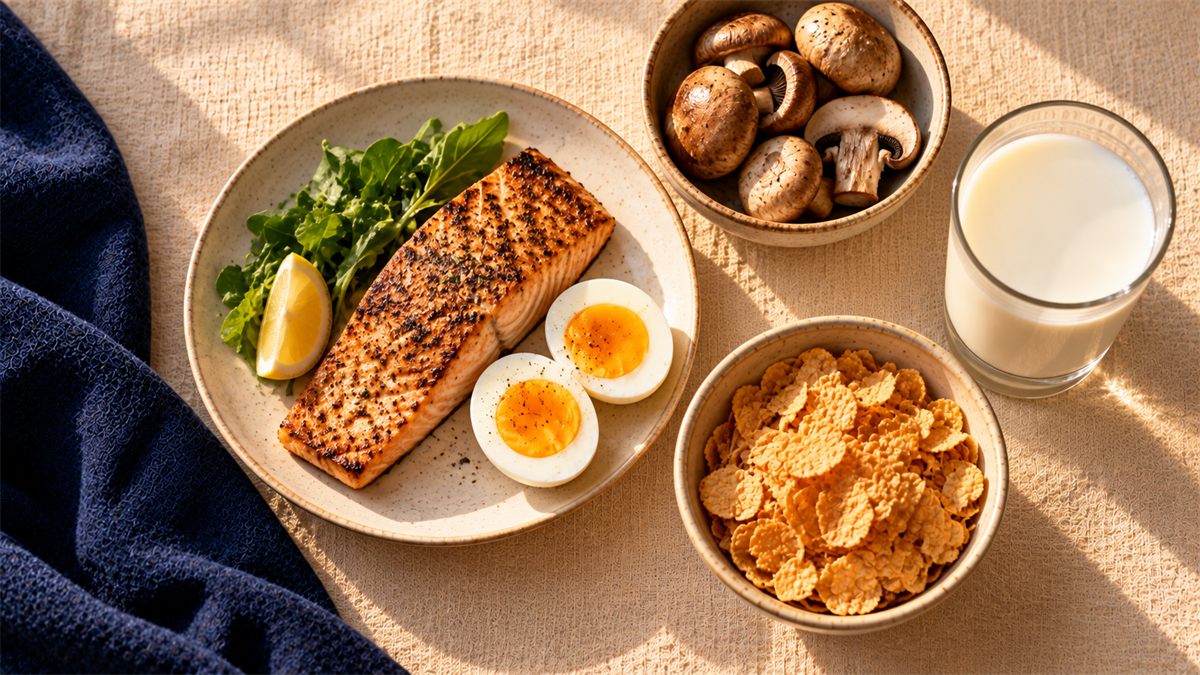
How much vitamin D you need
Adults in India need 600 IU (15 µg) of vitamin D a day. That's the Recommended Dietary Allowance in ICMR-NIN's 2020 guidelines for both men and women, up from 400 IU in 2010 (ICMR-NIN 2020, Tables 3 and 4).
Two units show up on labels and tables. 1 µg of vitamin D = 40 IU (NHS, Vitamin D), so 15 µg and 600 IU are the same amount. FSSAI's fortification rules use the same conversion, written as 1 IU = 0.025 µg (FSSAI Fortification Regulations).
There's a ceiling, too. The NHS advises adults not to take more than 100 µg (4,000 IU) a day, as it could be harmful (NHS, Vitamin D). You won't get near that from food; it matters if you stack supplements.
Vitamin D foods, ranked per serving
Very few foods naturally contain vitamin D; the best are fatty fish, with smaller amounts in egg yolks, cheese and liver, plus mushrooms, especially UV-exposed ones (MedlinePlus, Vitamin D). Here's how much a normal serving gives you.
Values are from USDA FoodData Central (SR Legacy, read 8 October 2026), except the fortified rows, which we calculated from FSSAI's legal range. "% RDA" is against ICMR-NIN's 600 IU.
| Food | Serving | Vitamin D | % of 600 IU |
|---|---|---|---|
| Mushrooms, white, UV-exposed, raw | 100 g | 1,050 IU | 175% |
| Rainbow trout, farmed, cooked | 100 g | 759 IU | 127% |
| Sockeye salmon, cooked | 100 g | 670 IU | 112% |
| Atlantic salmon, farmed, cooked | 100 g | 526 IU | 88% |
| Mackerel, Pacific and jack, cooked | 100 g | 457 IU | 76% |
| Cod liver oil | 1 tsp (4.5 g) | 450 IU | 75% |
| Light tuna, canned in oil, drained | 100 g | 269 IU | 45% |
| Herring, cooked | 100 g | 214 IU | 36% |
| Sardines, canned in oil, drained | 100 g | 193 IU | 32% |
| Fortified oil, at FSSAI's range | 10 g (about 2 tsp) | 44-64 IU | 7-11% |
| Egg, whole, hard-boiled | 1 large (50 g) | 44 IU | 7% |
| Fortified milk, at FSSAI's range | 200 ml glass | 40-60 IU | 7-10% |
| Cheddar cheese | 30 g | 12 IU | 2% |
| Mushrooms, white, ordinary, raw | 100 g | 7 IU | 1% |
| Chicken breast, roasted | 100 g | 5 IU | 1% |
| Whole milk, unfortified | 200 ml glass | ~4 IU | under 1% |
| Plain curd (whole-milk yogurt) | 100 g | 2 IU | under 1% |
Fish: the richest everyday source
A 100 g piece of sockeye salmon or farmed trout covers a full day on its own, farmed Atlantic salmon gets you 88% of the way, and mackerel three-quarters. Canned fish varies: light tuna packed in oil has 269 IU per 100 g, while the same tuna packed in water has just 47 IU (USDA FoodData Central).
The catch for India: the USDA measures Atlantic and Pacific species. Bangda (Indian mackerel), pomfret, rohu and hilsa are different fish, and we didn't find their values in the USDA tables, so don't assume a USDA number for them. Count oily sea fish as a likely good source, not a known quantity.
Eggs: useful, not enough
One large boiled egg has about 44 IU, around 7% of the RDA, and most of it sits in the yolk: raw yolk has 218 IU per 100 g (USDA FoodData Central). Two eggs a day is a real contribution, but still under 15% of the target.
Dairy: only if it's fortified
This is the surprise for most Indian kitchens. Milk doesn't naturally carry much vitamin D: unfortified whole milk has about 2 IU per 100 g, so a glass gives roughly 4 IU, and plain curd is the same. Fortified milk is different, but at the FSSAI range a glass still gives only 40-60 IU (more on that below). Butter has none listed (USDA FoodData Central).
Mushrooms: the vegetarian exception
Mushrooms are the one non-animal, unfortified food that can supply a large amount of vitamin D in a single serving, but only if they've seen UV light. Exposed to sunlight or a UV lamp, they make vitamin D2 (Cardwell et al., 2018).
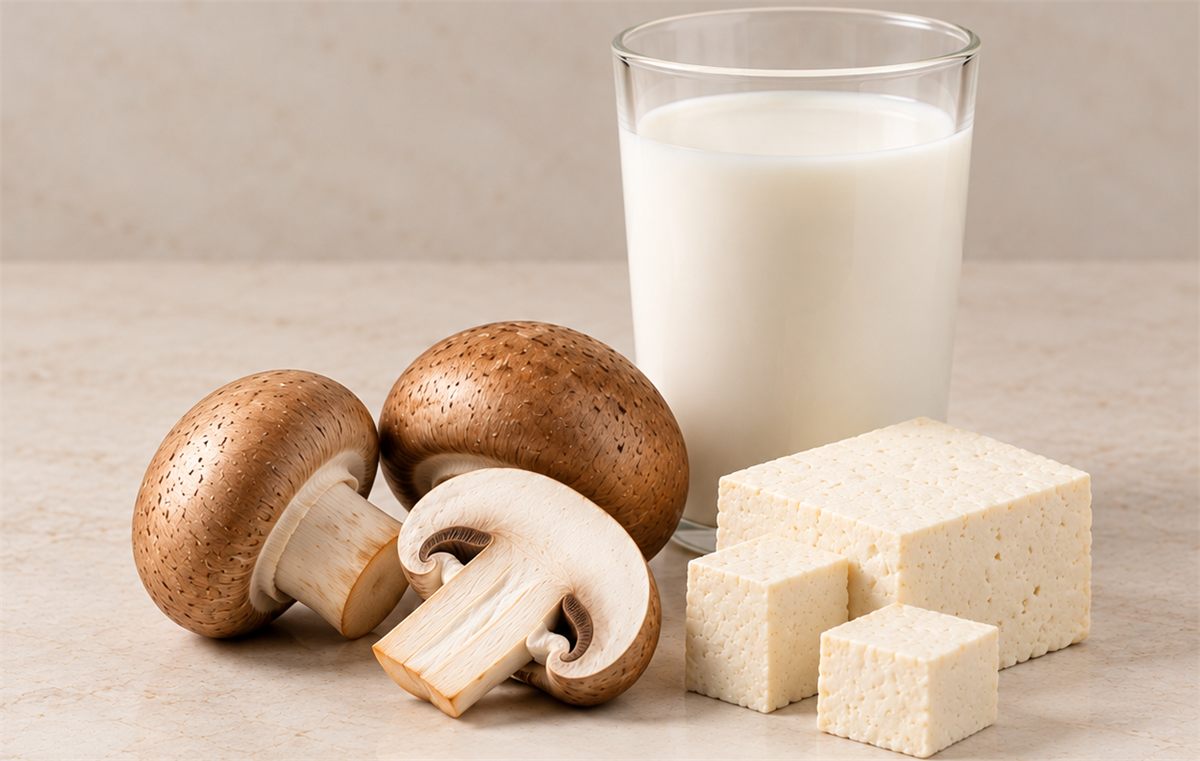
The difference is huge. Ordinary button mushrooms in shops usually carry under 1 µg (40 IU) per 100 g. UV-exposed ones, eaten before their best-before date, are likely to stay above 10 µg (400 IU) per 100 g even after storage and cooking (Cardwell et al., 2018). The USDA lists 1,050 IU per 100 g for UV-exposed white mushrooms against 7 IU for ordinary ones (USDA FoodData Central).
Can you do it at home? The same review reports that fresh button mushrooms left in midday sun for 15-120 minutes usually reached over 10 µg per 100 g. Sliced mushrooms make more than whole ones: in one German midsummer test, slices reached 17.5 µg per 100 g after 15 minutes and 32.5 µg after an hour (Cardwell et al., 2018). Those were European and Australian tests; Indian sun is stronger, but we found no Indian trial, so we can't give you a timing.
Cooking: pan-frying for 5 minutes without oil kept 88% of the vitamin D2, while 20 minutes of boiling or 10 minutes in the oven kept 62-67% (Cardwell et al., 2018).
Does the body use it? In human studies the review cites, vitamin D2 from UV mushrooms raised blood levels as well as a D2 supplement. It also notes that research evidence indicates vitamin D3 raises blood levels more effectively than D2. Disclosure: the review's lead author had worked as a consultant to the Australian mushroom industry before September 2017 (Cardwell et al., 2018).
Fortified foods in India
In India, vitamin D is added to two staples: milk and edible oil. FSSAI's standards cover both, with vitamins A and D, and a logo identifies fortified foods on the pack (FSSAI press release, 2018).
The legal ranges (FSSAI Fortification Regulations, 2018, version of 1 June 2022):
- Milk: 5-7.5 µg of vitamin D per litre. That's 40-60 IU per 200 ml glass, our calculation.
- Edible oil: 0.11-0.16 µg per gram. That's 44-64 IU per 10 g (about two teaspoons), our calculation.
FSSAI set the doses to supply 30-50% of daily requirements, and its 2018 release said 21% of the organised milk industry and 47% of the packaged refined oil industry were fortifying (FSSAI press release, 2018). Against today's 600 IU RDA, a glass of fortified milk covers 7-10%.
Is it compulsory? In December 2020 FSSAI published a draft amendment that would require packaged toned, double-toned, skimmed and standardised milk, and packaged refined oil, to be fortified with vitamins A and D (FSSAI draft notification, 2020). We could not find a final notification on fssai.gov.in (searched 8 October 2026), so check your brand's label for the fortification logo and a vitamin D line in the nutrition panel. The same goes for breakfast cereals: amounts vary by brand, so read the label rather than trusting a generic number.
Does fortified milk work? In a randomised trial at AIIMS, New Delhi, 713 schoolchildren aged 10-14 drank 200 ml of milk a day for 12 weeks. With unfortified milk, 5.9% ended with blood levels above 20 ng/ml; with milk carrying 600 IU, 70%; with 1,000 IU, 81%. At the start, 92% were below 20 ng/ml (Khadgawat et al., 2013). Note the trial milk held 600-1,000 IU a glass, roughly 10 to 25 times the FSSAI range. The PubMed record lists no funding or conflict statement, and we couldn't open the full text.
Sunlight: India's main source
For most Indians, sunlight, not food, is where vitamin D is meant to come from. India lies between 8.4° and 37.6° N, and historically people got most of their vitamin D from the sun. Darker skin, more hours indoors and air pollution now limit that (Babu & Calvo, 2010).
Timing. In Tirupati (13.4° N), researchers exposed sealed vials of the skin's vitamin D precursor to sunlight every hour from 8 am to 4 pm for over a year. Conversion peaked between 11 am and 2 pm in every season, so at that latitude midday sun can make vitamin D year round (Harinarayan et al., 2013). Early-morning and late-afternoon sun, the comfortable kind, does less. The authors also recorded a dip during a hazy season they linked to air pollution. No conflicts of interest were disclosed.
Skin tone. Melanin reduces how much UVB gets into the skin. In a UK study, 15 South Asian adults and 109 white adults got the same simulated summer sunlight. Blood levels rose by an average of 4.3 ng/ml in the South Asian group against 10.5 ng/ml in the white group, and every South Asian participant stayed insufficient (Farrar et al., 2011). A follow-up in 60 South Asian adults (51 completed) gave doses equal to 15-90 minutes of unshaded UK summer noon sun, three times a week for 6 weeks, with 35% of the skin uncovered. Everyone's levels rose, but only 6 people reached 20 ng/ml; at 45 minutes or more, 94% got above 10 ng/ml (Farrar et al., 2013). Both studies were funded by Cancer Research UK, according to PubMed's grant listing, and both used Manchester's latitude, so the minutes don't transfer to Indian sun.
Sunlight first, food second.
What that means in practice. Midday is when the sun does the work. The Tirupati authors suggest that casual exposure of arms and legs, for about half the time it takes your skin to turn faintly pink, three times a week, can provide adequate vitamin D (Harinarayan et al., 2013). Don't burn: the NHS advises covering up or protecting your skin during long periods in the sun to reduce the risk of skin damage and skin cancer (NHS, Vitamin D from sunlight).
Why food alone falls short
The NHS says it's difficult for people to get enough vitamin D from food alone (NHS, Vitamin D), and a 2010 review of Indian data described dietary vitamin D intake in India as very low, because of low intake of vitamin D foods, little fortification at the time and low supplement use (Babu & Calvo, 2010). Here's what that looks like on a plate, using the table above.
| A typical day | Vitamin D | % of 600 IU |
|---|---|---|
| Vegetarian, nothing fortified: 2 glasses of milk, 100 g curd | about 10 IU | about 2% |
| Vegetarian, fortified milk and oil: 2 glasses, 20 g oil, 100 g curd | 170-250 IU | 28-42% |
| Same, plus 2 boiled eggs | 260-340 IU | 43-56% |
| Fish-eater: 100 g canned sardines | 193 IU | 32% |
| Fish-eater: 100 g cooked sockeye salmon or trout | 670-759 IU | 112-127% |
| Vegetarian with 100 g UV-exposed mushrooms | 1,050 IU | 175% |
These are our calculations from the USDA values and the FSSAI ranges, not a dietary survey. Real intakes vary: a 2024 study validating a food questionnaire in 385 Indian adults, run at a Chennai institute, measured a mean intake of about 390-400 IU a day (Priyadharshini et al., 2024). The PubMed record lists no funding or conflict statement.
The pattern is clear: unless you eat oily fish or UV-exposed mushrooms regularly, food gets you to around a third or half of the RDA at best, and sunlight or a supplement has to cover the rest. If you're vegetarian, B12 is the other vitamin worth checking food by food; our guide to vitamin B12 rich foods covers it.
When to get tested
Food lists can't tell you your vitamin D status; a blood test for 25-hydroxyvitamin D, or 25(OH)D, is how studies measure it (Khadgawat et al., 2013; Farrar et al., 2013). If you rarely get midday sun, or you're vegetarian and eat neither fortified foods nor UV-exposed mushrooms, ask your doctor whether a test makes sense. Our guide to vitamin D deficiency symptoms covers the signs.
If you're found deficient, follow the dose your doctor gives you. And don't self-prescribe high-dose supplements: the NHS's adult ceiling is 100 µg (4,000 IU) a day (NHS, Vitamin D).
A daily 600 IU, in a morning drink
SILT™ Mornings is a morning drink mix, and one of the things in it is vitamin D3: 600 IU per stick, 100% of the ICMR-NIN RDA, with vitamin K2 (menaquinone) 55 mcg. It isn't a fix for a diagnosed deficiency, and it doesn't replace sunlight or a doctor's dose. For scale, using this page's own numbers: matching one stick's 600 IU from boiled eggs alone would take about 14 eggs (44 IU each), or 10 to 15 glasses of milk fortified at the FSSAI range (40-60 IU). That is our arithmetic.
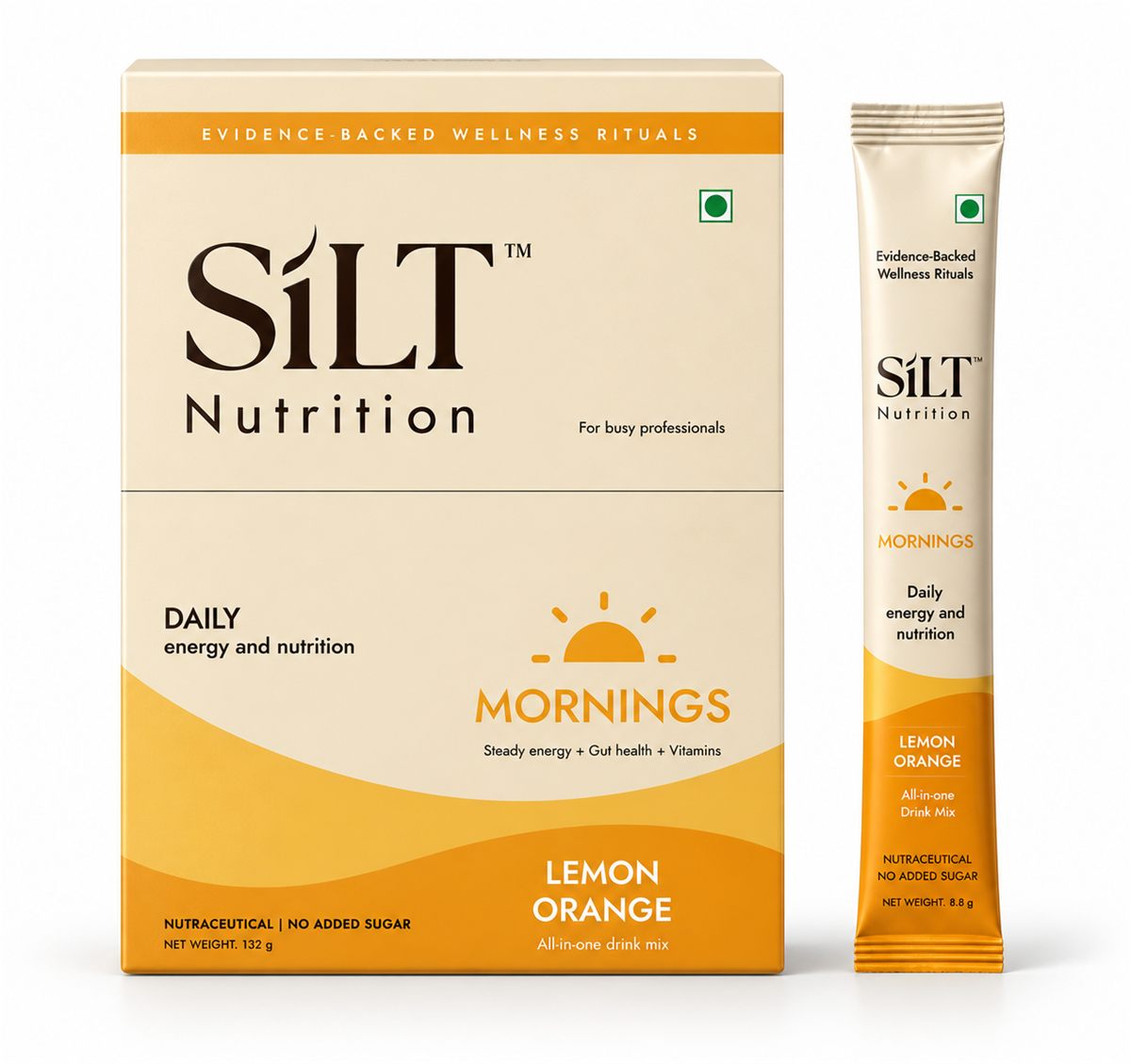
Each 8.8 g stick also has 80 mg caffeine, 200 mg L-theanine, 1.4 g taurine, 5 g Sunfiber® PHGG fibre, 6 billion CFU of three spore-forming Bacillus species (B. subtilis, B. coagulans and B. clausii, 2 billion each), 550 mg of digestive-herb extracts (saunf, jeera, ajwain, amla), vitamin C 80 mg and vitamin B12 at 100% RDA. It has a natural sweetener (stevia) and natural colour, with no added sugar, no maltodextrin and no gluten. Stir one stick into 200-250 ml of room-temperature or cold water (never boiling), any time in the morning, one stick a day. Every dose is printed on the back of the pack, and the pack itself says it is not a substitute for a varied diet (SILT pack).
The honest limits. It contains 80 mg caffeine. If you take a blood thinner such as warfarin, ask your doctor before using SILT Mornings, because it contains vitamin K2 (55 mcg). MedlinePlus notes that people on warfarin may need to limit vitamin K (MedlinePlus, Vitamin K). If you already take a prescribed vitamin D dose, tell your doctor before adding another source. Supplier certificates of analysis for our ingredients are on our science page; the vitamin D3 one reads 105,010 IU/g against a 90,000-110,000 IU/g specification. The vitamin-blend certificate and a finished-product NABL lab report are pending, and we'll publish them when they're ready. If you have a liver or thyroid condition, are pregnant, or take regular medicines, check with your doctor first. More on the D3 and K2 pairing in our vitamin D3 + K2 guide.
MRP ₹1,125 ₹900 · 15 sticks or ₹1,500 for 30 (MRP ₹2,250)
That's ₹60 a stick, or ₹50 in the 30-stick pack.
Shop SILT MorningsSun, fish, mushrooms, labels
Vitamin D rich foods are few: oily fish, egg yolks, UV-exposed mushrooms and fortified milk or oil. On a typical Indian vegetarian diet, food covers a fraction of the 600 IU RDA, so midday sun on your arms and legs matters more than any food list, and a test tells you where you stand. Read the label for fortification, and see our vitamin D3 + K2 guide if you're weighing a supplement. For the other vitamins vegetarians often miss, read vitamin B12 rich foods and vitamin C foods. Evidence, not hype.
- ICMR-NIN. Nutrient Requirements for Indians 2020: brief note (Tables 3 and 4). nin.res.in/rdabook/brief_note.pdf
- NHS. Vitamin D. nhs.uk/conditions/vitamins-and-minerals/vitamin-d
- NHS. How to get vitamin D from sunlight. nhs.uk/live-well/healthy-body/how-to-get-vitamin-d-from-sunlight
- MedlinePlus. Vitamin D. medlineplus.gov/ency/article/002405.htm
- MedlinePlus. Vitamin K. medlineplus.gov/ency/article/002407.htm
- USDA FoodData Central, SR Legacy, read 8 October 2026 (FDC IDs 169376, 173718, 173692, 175168, 171994, 173577, 173708, 173709, 175117, 175139, 173424, 172184, 170899, 169251, 171477, 172217, 171284, 173410). fdc.nal.usda.gov
- FSSAI. Food Safety and Standards (Fortification of Foods) Regulations, 2018, compendium version V (1 June 2022), Schedule I. fssai.gov.in
- FSSAI. Press release: Food fortification, final notification of standards (9 August 2018). fssai.gov.in
- FSSAI. Draft notification: Fortification of Foods Amendment Regulations, 2020 (oil and milk). fssai.gov.in
- Cardwell et al., 2018. A review of mushrooms as a potential source of dietary vitamin D. Nutrients. pubmed.ncbi.nlm.nih.gov/30322118
- Khadgawat et al., 2013. Impact of vitamin D fortified milk supplementation on vitamin D status of healthy school children aged 10-14 years. Osteoporos Int. pubmed.ncbi.nlm.nih.gov/23460234
- Babu & Calvo, 2010. Modern India and the vitamin D dilemma: evidence for the need of a national food fortification program. Mol Nutr Food Res. pubmed.ncbi.nlm.nih.gov/20440690
- Harinarayan et al., 2013. Vitamin D status and sun exposure in India. Dermatoendocrinol. pubmed.ncbi.nlm.nih.gov/24494046
- Farrar et al., 2011. Recommended summer sunlight exposure amounts fail to produce sufficient vitamin D status in UK adults of South Asian origin. Am J Clin Nutr. pubmed.ncbi.nlm.nih.gov/21918215
- Farrar et al., 2013. Efficacy of a dose range of simulated sunlight exposures in raising vitamin D status in South Asian adults. Am J Clin Nutr. pubmed.ncbi.nlm.nih.gov/23615828
- Priyadharshini et al., 2024. Developing and validating a quantitative food frequency questionnaire to assess dietary vitamin D intake among adults in Indian population. Indian J Public Health. pubmed.ncbi.nlm.nih.gov/39096253