


Vitamin D3 + K2: 600 IU + 55 mcg Daily in SILT Mornings
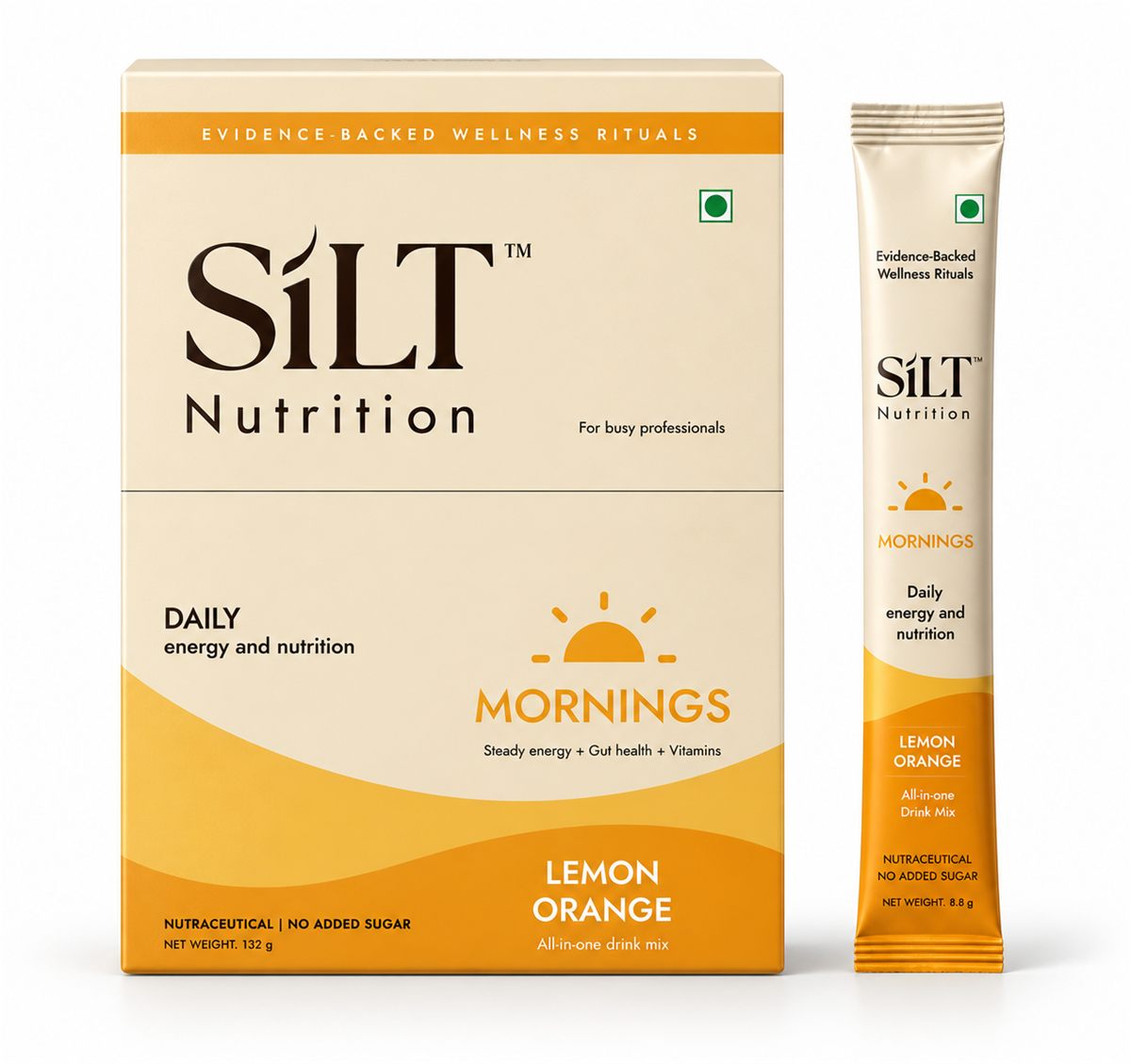
SILT™ Mornings gives you vitamin D3 and K2 in one glass. Each 8.8 g stick carries 600 IU of vitamin D3 and 55 mcg of vitamin K2 (menaquinone), each at 100% RDA, stirred into water each morning. The 600 IU matches India's ICMR-NIN 2020 RDA for adults. Every dose is printed on the back of the pack.
One thing to say up front: SILT Mornings is not a vitamins-only product. The same stick has 80 mg caffeine, 1.4 g taurine, 200 mg L-theanine, 5 g Sunfiber® PHGG fibre, 6 billion CFU of three spore-forming Bacillus species, 550 mg digestive herb extracts (saunf, jeera, ajwain, amla), vitamin C 80 mg and vitamin B12 (100% RDA). If you want a caffeine-free vitamin D3 K2 tablet and nothing else, this isn't it. (The fibre half is explained on our fibre supplement page, and the caffeine half on our L-theanine page.)
MRP ₹1,125 ₹900 · 15 sticks or ₹1,500 for 30 (MRP ₹2,250)
That's ₹60 a stick in the 15-stick pack, or ₹50 a stick in the 30.
Shop SILT MorningsSee the full SILT Mornings formula
If you take a blood thinner such as warfarin, ask your doctor before using SILT Mornings, because it contains vitamin K2 (55 mcg).
Why D3 and K2 come together
Vitamin D helps you absorb calcium, and vitamin K is needed to activate proteins, including one in bone, that handle it. That is the logic behind the pair. The trial evidence that the pair raises bone density is real but modest.
MedlinePlus puts the first half simply: vitamin D helps the body absorb calcium, which you need for normal bone formation (MedlinePlus, vitamin D). Vitamin K is a cofactor for making blood-clotting factors in the liver and osteocalcin in bone (Schurgers et al., 2007). Vitamin K "carboxylates" osteocalcin, and researchers use that carboxylation as a marker of vitamin K activity (Schurgers et al., 2007).
What the combined trials found
The best summary we found is a 2020 meta-analysis of 8 randomised controlled trials with 971 people (Kuang et al., 2020):
- Vitamin K plus vitamin D increased total bone mineral density (BMD), with a pooled effect size of 0.316 (95% CI 0.031 to 0.601). That is a small effect, and the lower end of the range is close to zero.
- The combination clearly lowered undercarboxylated osteocalcin, the vitamin K marker (−0.945).
- In a subgroup, K2 (or unspecified vitamin K) at under 500 mcg a day, combined with vitamin D, raised total BMD compared with a normal diet or no treatment.
Three honest limits. The analysis pooled different forms and doses of vitamin K, not only MK-7. BMD is a marker, not a fracture count, and the abstract reports no fracture result. The work was funded by China's National Basic Research Program and the National Natural Science Foundation of China; we found no industry funding in the record. We don't claim a stick of SILT Mornings reproduces these results.
Two vitamins, one glass, every active on the label.
Vitamin D in India: low, and common
Low vitamin D is widespread in India, including in cities with plenty of sun. Indian studies reviewed by ICMR scientists found hypovitaminosis D in 30% to 91.2% of adults, depending on the group studied (Kamboj et al., 2018).
One of the few representative surveys tested 1,403 adults aged 30 and over in urban and rural Delhi NCR (Praveen et al., 2023). In the urban group, the median blood level was 7.7 ng/mL; 71% were below 10 ng/mL and another 27% were between 10 and 20 ng/mL. Rural adults did better (median 16.2 ng/mL), but 67% were still below 20 ng/mL. Living in a city, being a woman and abdominal obesity were each linked to severe deficiency.
Why, in a sunny country? The same ICMR review lists the usual causes: how long and when you're in the sun, how much skin is exposed, latitude, season, air pollution, clothing, skin pigmentation, sunscreen, diet and genes (Kamboj et al., 2018). An office day indoors covers several of those at once.

A supplement is not a diagnosis. If you're worried, ask your doctor about a 25-hydroxy vitamin D blood test; we cover the signs in vitamin D deficiency symptoms and the food side in vitamin D rich foods.
600 IU: India's RDA, not a megadose
600 IU of vitamin D is the ICMR-NIN 2020 recommended dietary allowance for adult men and women in India. It was raised from 400 IU in the 2010 recommendations, and it matches the US Institute of Medicine RDA (ICMR-NIN, 2020, Tables 3 and 4).
Vitamin D3: 600 IU per stick = 100% of the ICMR-NIN 2020 RDA (men and women). Vitamin K2 (menaquinone): 55 mcg per stick, listed at 100% RDA on our label. Our label's 100% RDA figures follow ICMR/FSSAI standards. The ICMR-NIN 2020 brief note we opened has no vitamin K table, so we couldn't check the K2 figure against that document ourselves. Upper limit: MedlinePlus gives a safe upper limit of 4,000 IU (100 mcg) a day of vitamin D for adults and children 9 and over (MedlinePlus, vitamin D). One stick is 15% of that.
That makes Mornings a daily-RDA top-up, not a treatment dose. If a doctor has diagnosed a deficiency and prescribed a higher dose, follow that plan and tell them about any other supplements you take, so the totals add up correctly.
Why menaquinone, and why D3
In the research, MK-7 stays in the blood far longer than synthetic vitamin K1, and D3 raised blood vitamin D more than D2 in a meta-analysis, though mainly with large, infrequent doses.
- MK-7 vs K1. In healthy volunteers, both were absorbed well, peaking about 4 hours after intake. MK-7 has a very long half-life, giving steadier blood levels and a 7- to 8-fold build-up with daily intake, and it carboxylated osteocalcin more completely (Schurgers et al., 2007). The authors were from a vitamin K research company and the Cardiovascular Research Institute at Maastricht University; the PubMed record lists no funding statement.
- D3 vs D2. A meta-analysis of head-to-head trials found D3 raised blood 25-hydroxy vitamin D more than D2. The advantage was clear for large single (bolus) doses but disappeared with daily dosing (Tripkovic et al., 2012; supported by the UK BBSRC's Diet and Health Research Industry Club; no author conflicts declared). So D3 is a sensible choice, but at a daily 600 IU the form matters less than taking it.
Which K2 is in the stick? The pack says "Vitamin K2 (Menaquinone)" and doesn't give the MK number; our supplier certificate reports the K2 ingredient as 1.04% MK-7. We don't claim a stick reproduces the Schurgers results.
Tablets vs a daily drink
If all you want is vitamin D3 and K2, a plain tablet or capsule is cheaper and caffeine-free. Several D3 + K2 tablets on Indian pharmacy sites list the same 600 IU + 55 mcg pairing (as of October 2026). Mornings makes sense if you'd take those vitamins anyway and also want the fibre, probiotics and a measured morning caffeine dose in one step.
| D3 + K2 tablet or capsule | SILT Mornings stick | |
|---|---|---|
| Vitamin D3 / K2 | Varies by brand; 600 IU + 55 mcg is common | 600 IU + 55 mcg (menaquinone) |
| What else is in it | Usually nothing else, or calcium and other vitamins | 5 g PHGG fibre, 6 bn CFU of three spore-forming Bacillus species, 550 mg herb extracts, 80 mg caffeine, 1.4 g taurine, 200 mg L-theanine, vitamin C, vitamin B12 |
| Caffeine | Usually none | 80 mg |
| Format | Swallow a pill | Stir into 200-250 ml water |
| Best for | Vitamins only, any time of day | One morning drink instead of several pills |
If you already juggle a shelf of pills, our take on that is in the pill graveyard.
Vitamin D3, K2 and magnesium
SILT Mornings has no magnesium. Our magnesium is in SILT™ Nights: 1.8 g magnesium bisglycinate, which gives 250 mg of elemental magnesium per stick. If you've been searching for vitamin D3 K2 magnesium, the honest answer is that we split them across two drinks.
For scale, ICMR-NIN's 2020 magnesium RDA is 440 mg a day for adult men and 370 mg for adult women (ICMR-NIN, 2020), so one Nights stick covers about 57% and 68% of those. To read a magnesium label the same way: the Nights pack prints "Magnesium Bisglycinate (13.8% elemental)" at 1.8 g, "250 mg Magnesium"; 1.8 g of bisglycinate gives 250 mg of the element. Nights also carries glycine, KSM-66® ashwagandha and L-theanine, so read its cautions before you buy. We don't claim that taking D3, K2 and magnesium together does more than each one alone.
The SILT Combo pairs Mornings and Nights: 15 + 15 sticks for ₹1,500 (MRP ₹2,250) or 30 + 30 for ₹2,800 (MRP ₹4,500). If you only want magnesium, compare products in the best magnesium supplements in India.
Check with a doctor first
If you take warfarin or another vitamin K antagonist blood thinner, don't start any vitamin K2 product, including SILT Mornings, without your doctor's go-ahead. This is the most important caution on this page. Our caution for SILT Mornings, word for word: "If you take a blood thinner such as warfarin, ask your doctor before using SILT Mornings, because it contains vitamin K2 (55 mcg)."
- Blood thinners. In 18 healthy volunteers given the vitamin K antagonist acenocoumarol (15 reached the target INR), MK-7 at just 10-20 mcg a day caused a clinically relevant drop in INR in some people, and 45 mcg a day lowered the group's INR by about 40%. The authors concluded MK-7 supplements should be avoided in people on these drugs (Theuwissen et al., 2013; authors from a vitamin K research company and Maastricht University). An earlier study warned that 50 mcg a day or more could interfere in a clinically relevant way (Schurgers et al., 2007). A stick has 55 mcg of vitamin K2 (menaquinone). MedlinePlus advises people on warfarin to keep their vitamin K intake steady, because sudden changes can change the drug's effect (MedlinePlus, vitamin K).
- Too much vitamin D. Excess vitamin D can make the gut absorb too much calcium and raise blood calcium (MedlinePlus, vitamin D). If you take prescribed vitamin D or calcium, tell your doctor before adding more.
- Caffeine. Each stick has 80 mg. EFSA says up to 400 mg a day from all sources raises no safety concerns for healthy adults, and up to 200 mg a day in pregnancy (EFSA). Count your chai and coffee too.
- The standing caution on SILT Mornings: if you have a liver or thyroid condition, are pregnant, or take regular medicines, check with your doctor first. If you take regular medicines, especially for thyroid, blood pressure, blood sugar or sleep, ask your doctor before you start. The pack adds: not for medicinal use; not intended to treat, cure or prevent any disease; not a substitute for a varied diet; contains caffeine; and if you're pregnant or nursing, taking any medications, allergic or sensitive to caffeine or have any medical conditions, contact your healthcare practitioner first.
SILT is for everyday energy, gut and sleep. It doesn't treat medical conditions. For those, or if you're pregnant or on medication, talk to your doctor.
How to take it
Stir one stick into 200-250 ml of room-temperature or cold water (not boiling) and drink it any time in the morning, once a day.
- Tear one 8.8 g stick.
- Stir it into 200-250 ml of room-temperature or cold water.
- Drink it any time in the morning. One stick a day.
Keep it to the morning, because the stick also carries 80 mg caffeine. Don't double up on days you miss: one stick is the full daily amount. The pack's own directions say the same: "1 stick per day. Do not exceed the recommended usage level." It also says not to use boiling water, because heat degrades sensitive actives, and "For best results, use consistently for at least 3 months."
Lab certificates for D3 and K2
Our suppliers' certificates of analysis show the vitamin D3 ingredient at 105,010 IU per gram, within its specification, and the vitamin K2 ingredient at 1.04% MK-7.
| Ingredient | Result | Specification |
|---|---|---|
| Vitamin D3 | 105,010 IU/g | 90,000-110,000 IU/g |
| Vitamin K2 (reported as MK-7 on the certificate) | 1.04% | Not stated here |
These are the raw ingredients as supplied, before mixing. Across the formula, supplier certificates cover 13 ingredients and 198 checks, with none failed. Two things are still pending: the certificate for the vitamin blend, and the finished-drink test by an NABL-accredited lab, which we'll publish when it's ready. Supplier certificates show what went in; they don't prove what's in a finished stick.
Every dose is printed on the back of the pack, and there is no proprietary blend. For the vitamins the pack prints one line, "Vitamin D3 + K2 + B12 + C", at 100% RDA each; the 600 IU of D3 and 55 mcg of K2 are our formula figures, not printed amounts. The rest of the ingredient list: Sunfiber® (partially hydrolyzed guar gum), taurine, natural flavouring substances (Lemon Orange), black salt, L-theanine, amla, fennel, cumin and ajwain extracts, caffeine, vitamin C (L-ascorbic acid), vitamin D3 (cholecalciferol), vitamin K2 (menaquinone), vitamin B12, three Bacillus species, acidity regulators (citric acid, malic acid), an anti-caking agent (silicon dioxide), steviol glycosides as the natural sweetener and natural beta-carotene as the colour. The pack's free-from line reads no added sugar, no maltodextrin, no gluten. SILT is FSSAI compliant (FSSAI Lic. No. 12826999000631), vegetarian and made in India. See the formula and supplier certificates on our science page.
What it costs per stick
SILT Mornings costs ₹60 a stick in the 15-stick pack and ₹50 a stick in the 30.
| Price (MRP) | Per stick | |
|---|---|---|
| 15 sticks | ₹900 (₹1,125) | ₹60 |
| 30 sticks | ₹1,500 (₹2,250) | ₹50 |
To be fair to vitamin-only products: this isn't a like-for-like price with a D3 + K2 tablet. Most of each stick's cost pays for the fibre, probiotics, herbs, caffeine and L-theanine. If vitamins are all you want, a tablet will cost less.
Shop SILT Mornings
SILT Mornings: 600 IU vitamin D3 and 55 mcg vitamin K2 (menaquinone), plus vitamin C 80 mg and vitamin B12 at 100% RDA, 5 g Sunfiber PHGG, 6 billion CFU of three spore-forming Bacillus species, 550 mg digestive herb extracts, 80 mg caffeine, 1.4 g taurine and 200 mg L-theanine. Every dose is printed on the back of the pack. No added sugar.
If you take a blood thinner such as warfarin, ask your doctor before using SILT Mornings, because it contains vitamin K2 (55 mcg).
MRP ₹1,125 ₹900 · 15 sticks or ₹1,500 for 30 (MRP ₹2,250)
₹60 a stick in the 15, ₹50 a stick in the 30. Want magnesium too? See the SILT Combo.
Shop SILT Mornings- MedlinePlus (US National Library of Medicine). Vitamin D. medlineplus.gov
- Schurgers LJ et al. (2007). Vitamin K-containing dietary supplements: comparison of synthetic vitamin K1 and natto-derived menaquinone-7. Blood. PubMed 17158229
- Kuang X et al. (2020). The combination effect of vitamin K and vitamin D on human bone quality: a meta-analysis of randomized controlled trials. Food Funct. PubMed 32219282
- Kamboj P, Dwivedi S, Toteja GS (2018). Prevalence of hypovitaminosis D in India & way forward. Indian J Med Res. PubMed 30666982
- Praveen PA et al. (2023). Prevalence and correlates of vitamin D deficiency among adult population in urban and rural areas of the National Capital Region of Delhi, India. WHO South East Asia J Public Health. PubMed 38848530
- ICMR-NIN (2020). A brief note on nutrient requirements for Indians, the RDA and the EAR (Tables 3 and 4). nin.res.in
- Tripkovic L et al. (2012). Comparison of vitamin D2 and vitamin D3 supplementation in raising serum 25-hydroxyvitamin D status: a systematic review and meta-analysis. Am J Clin Nutr. PubMed 22552031
- Theuwissen E et al. (2013). Effect of low-dose supplements of menaquinone-7 (vitamin K2) on the stability of oral anticoagulant treatment. J Thromb Haemost. PubMed 23530987
- MedlinePlus (US National Library of Medicine). Vitamin K. medlineplus.gov
- EFSA. Caffeine topic page. efsa.europa.eu