


Vitamin D deficiency symptoms are often vague, and many people have none at all. The clearest signs are bone pain, muscle weakness and bones that break too easily, and they tend to show up only after a long, deep deficiency. Tiredness, low mood and frequent colds are widely listed, but the trial evidence for them is thin or negative. Because the symptoms overlap with so much else, the only way to know is a blood test for 25-hydroxyvitamin D, read against a stated cut-off. Below: which symptoms have real evidence, who is at risk in India, what your number means, and when to see a doctor. Disclosure: we make a morning drink with vitamin D3 and keep it to one short section near the end; our vitamin D3 + K2 guide covers supplements in full.

The signs, and the catch
The signs with the strongest evidence are about bones and muscles. Vitamin D helps the body manage calcium and phosphate, which keep bones, teeth and muscles healthy (NHS, Vitamin D). MedlinePlus lists the symptoms of low vitamin D as bone pain, muscle weakness or aches, soft or deformed bones, and weak bones that fracture (MedlinePlus, Vitamin D test).
When deficiency goes on long enough, bones soften. In children that's rickets; in adults it's osteomalacia (NHS, Vitamin D). Osteomalacia shows up as (MedlinePlus, Osteomalacia):
- Widespread bone pain, especially in the hips.
- Muscle weakness.
- Fractures without a significant injury.
- Low-calcium signs: numbness around the mouth, numbness or tingling in the arms and legs, and muscle spasms or cramps.
The catch: symptoms are a poor guide to your level. In 71 patients seen at a Mumbai hospital's rheumatology clinic with low vitamin D and muscle or bone symptoms (but no osteomalacia), researchers found no link between how low the level was and the symptoms, or between the severity of deficiency and the number of symptoms (Kanekar et al., 2010). It was a small look back through case charts, but the lesson holds: you can't feel your way to a number.
Symptom by symptom
Most "signs of low vitamin D" lists present every symptom as equally certain. They aren't. "Strength" below is our editorial read of the sources linked on this page, not a clinical grade.
| Symptom | What the evidence shows | Strength | Source |
|---|---|---|---|
| Bone pain, soft bones, fractures | An established result of long-term deficiency (osteomalacia, rickets) | Strong | MedlinePlus; NHS |
| Muscle weakness or aches | Listed as a symptom of low vitamin D and of osteomalacia | Strong when deficiency is deep | MedlinePlus |
| Tingling, numbness, cramps | Signs of low calcium in osteomalacia | Indirect | MedlinePlus |
| Stubborn aches and pains | 93% of 150 US clinic patients with persistent pain were deficient; no comparison group | Association only | Plotnikoff 2003 |
| Tiredness | One trial in 120 deficient adults: a single high dose improved fatigue scores | Limited | Nowak 2016 |
| Low mood | 18,353 adults aged 50+, 5.3 years of vitamin D3: no effect on depression | Not supported | Okereke 2020 |
| Frequent colds | 2025 meta-analysis of trials: no statistically significant protection | Not supported | Jolliffe 2025 |
Aches and pains
In a Minneapolis primary-care clinic, 150 people aged 10 to 65 with persistent, unexplained muscle and bone pain had their vitamin D checked: 93% were at or below 20 ng/mL, and 28% were at or below 8 ng/mL (Plotnikoff & Quigley, 2003). That shows how common low vitamin D is in people with this kind of pain. It doesn't prove the deficiency caused it, because the study had no pain-free comparison group and didn't test whether vitamin D relieved the pain.
Tiredness
There is one useful trial. 120 otherwise healthy adults (mean age 29) with fatigue and a level below 20 ng/mL got either a single 100,000-unit dose of vitamin D3 or a placebo. After four weeks, fatigue scores fell more with vitamin D, and 72% reported feeling better against 50% on placebo (Nowak et al., 2016). The trial was partly funded by the EMDO Foundation, and the authors report no conflicts. The authors call it a pilot, it was short, and they say the results don't apply to milder insufficiency. Tiredness has many causes, so if it lasts for weeks, read why am I always tired and get checked rather than guessing.
Low mood
Low vitamin D has been linked with depression in observational studies, but a large trial didn't bear it out. In VITAL-DEP, 18,353 US adults aged 50 or older without current depression took 2,000 IU of vitamin D3 a day or a placebo for a median of 5.3 years. Depression risk and mood scores didn't differ between the groups (Okereke et al., 2020). Some authors reported ties to supplement makers (one received research support from a supplement company; another's spouse advises a second supplement company). The trial wasn't limited to people who were deficient, so it can't rule out an effect in them, but it doesn't support low mood as a reliable sign.
Frequent colds
A 2021 meta-analysis found a small protective effect of vitamin D against acute respiratory infections. Its 2025 update, adding new trials including one with 15,804 people, found the effect was no longer statistically significant (odds ratio 0.94, 40 trials, 61,589 participants), and baseline vitamin D status didn't change the result (Jolliffe et al., 2025). The review had no funding; one author reported grants from two vitamin makers, outside this work. "I keep catching colds" isn't good evidence of low vitamin D.
Why it's so common in India
Low vitamin D is very common in India, despite the sunshine. A review of Indian studies by doctors at AIIMS New Delhi found prevalence ranging from 40% to 99%, with most studies reporting 80-90%, across all age groups. Most of those studies used a cut-off of 20 ng/mL, and some used others, which is part of why the numbers vary so much (Aparna et al., 2018).
The best population data comes from a representative survey of 1,403 adults aged 30 and over in the Delhi National Capital Region. The median level was 7.7 ng/mL in urban areas and 16.2 ng/mL in rural ones. In the cities, 71% were below 10 ng/mL (severe deficiency, by the study's definition), against 20% in villages. Living in a city, being a woman and abdominal obesity were each linked to severe deficiency (Praveen et al., 2023). One region, one age band, but it fits the office-worker pattern: commute, desk, home, little sun on skin.
Why it happens:
- Not enough sun on skin. About 90% of the vitamin D we need is made in the skin from the sun's UVB rays, and that is cut by atmospheric pollution, latitude and darker skin pigment (Aparna et al., 2018). Indoor work, covering clothing and strong sunscreen all reduce it too (MedlinePlus, Osteomalacia).
- Darker skin. The NHS names people of south Asian background among those who may not make enough vitamin D from sunlight (NHS, Vitamin D).
- Diet. Few foods contain much vitamin D, and the typical Indian diet generally falls short of the daily requirement (Aparna et al., 2018). Vegetarian diets, avoiding dairy and lactose intolerance are listed as dietary risks (MedlinePlus, Osteomalacia).
- Health conditions and medicines. Kidney failure, liver disease, problems absorbing food (including after some stomach surgery) and certain seizure medicines can all lower vitamin D (MedlinePlus, Osteomalacia).
Your 25(OH)D result, decoded
The test that matters measures 25-hydroxyvitamin D, written 25(OH)D, in your blood. MedlinePlus calls it the most accurate way to see whether you have enough, and it needs no special preparation, though you should tell the doctor about any supplements you take (MedlinePlus, Vitamin D test).
The confusing part: experts don't agree on the cut-offs. The two systems you'll see most (Gibson, Principles of Nutritional Assessment):
| Your result | IOM (2011) | Endocrine Society (2011) |
|---|---|---|
| Below 12 ng/mL (30 nmol/L) | Deficient | Deficient |
| 12-20 ng/mL (30-50 nmol/L) | Insufficient | Deficient |
| 20-30 ng/mL (50-75 nmol/L) | Sufficient | Insufficient (21-29) |
| 30-50 ng/mL (75-125 nmol/L) | No added benefit | Sufficient (30-100) |
| Above 50 ng/mL (125 nmol/L) | Possible harm | Sufficient up to 100 |
| Above 100 ng/mL (250 nmol/L) | Possible harm | Possible harm |
Units: results come in ng/mL or nmol/L. To convert, nmol/L = ng/mL × 2.5 (same source). So 20 ng/mL is 50 nmol/L.
Which cut-off is right? Nobody has settled it. The IOM set its lower limit from markers of bone health (Gibson). The US-based Endocrine Society's 2011 guideline used higher targets and suggested testing people at risk of deficiency (Holick et al., 2011). Its newer 2024 guideline, written for people without a specific reason for testing, found no clear evidence for an optimal target level and suggests against routine 25(OH)D testing in that group, including people with darker skin or obesity (Demay et al., 2024). The 2024 guideline doesn't apply to people with an established reason for testing, such as the symptoms and conditions above.
In practice: if you have bone pain, muscle weakness, a fracture from a minor fall, or a condition that affects vitamin D, a test makes sense and your doctor will read it in context. If you feel fine, a test "just to see" is less useful than it looks, and a borderline number is not a diagnosis.
You can't feel your way to a number.
When to see a doctor
See a doctor rather than self-testing and self-dosing if you have:
- Bone pain, especially widespread or in the hips, or a fracture after a minor fall (MedlinePlus, Osteomalacia).
- Muscle weakness that's new or getting worse (MedlinePlus, Vitamin D test).
- Numbness or tingling around the mouth or in the hands and feet, or muscle spasms (MedlinePlus, Osteomalacia).
- A child with soft or deformed bones (possible rickets), or a condition such as kidney or liver disease or a malabsorption problem (MedlinePlus, Vitamin D test).
- Tiredness lasting weeks. Low vitamin D is only one of several common causes; low B12, iron and thyroid problems are others (see vitamin B12 deficiency).
- Pregnancy. The 2024 Endocrine Society guideline suggests vitamin D in pregnancy (Demay et al., 2024), so ask your doctor what suits you.
Don't self-prescribe high doses. Too much vitamin D over a long time can raise blood calcium (hypercalcaemia), which can weaken bones and damage the kidneys and heart. The NHS says adults shouldn't take more than 100 micrograms (4,000 IU) a day unless a doctor advises it (NHS, Vitamin D). Signs of too much include nausea and vomiting, poor appetite, constipation, weakness and weight loss (MedlinePlus, Vitamin D test).
This is a real problem in India. An audit of 5,527 vitamin D reports at one Indian institute found that 4.1% of patients had excess vitamin D (above 250 nmol/L), and the share rose every year, from 1.48% in 2011 to 7.82% in 2016. The authors blamed unmonitored high doses, especially injections (Sharma et al., 2017). At a Kashmir hospital, vitamin D toxicity caused 8 of 40 adult admissions for high calcium in the first half of 2025 (20%), with the authors' review of earlier regional studies pointing to high-dose injections and repeated high oral doses as the main contributors (Sheikh et al., 2026). If you're found to be deficient, the dose and the re-check are your doctor's call.
Food and sun, the basics
For most people, the sun is the main source: the skin makes most of the vitamin D we need from UVB light (Aparna et al., 2018). Food helps but rarely covers it. The NHS lists oily fish, red meat, egg yolks, liver and fortified foods as sources (NHS, Vitamin D); the AIIMS review adds that vegetables and grains are poor sources (Aparna et al., 2018). That makes it harder for vegetarians who skip eggs and fortified foods.
How much you need: ICMR-NIN's 2020 RDA for vitamin D is 600 IU a day for adult men and women, up from 400 IU in 2010 (ICMR-NIN, 2020). For healthy adults under 75, the 2024 Endocrine Society guideline suggests against routinely taking more than the recommended intake to lower disease risk (Demay et al., 2024).
The sources we opened don't give a reliable "minutes of sun a day" figure for Indian skin, cities and seasons, so we won't invent one. Our guide to vitamin D rich foods covers foods per serving, sunlight and fortified foods in detail.
A daily 600 IU, not a fix
SILT™ Mornings is a morning drink with vitamin D3 at the adult RDA, alongside other vitamins and gut and focus ingredients. It isn't a way to correct a diagnosed deficiency, and we'd rather you knew its limits.
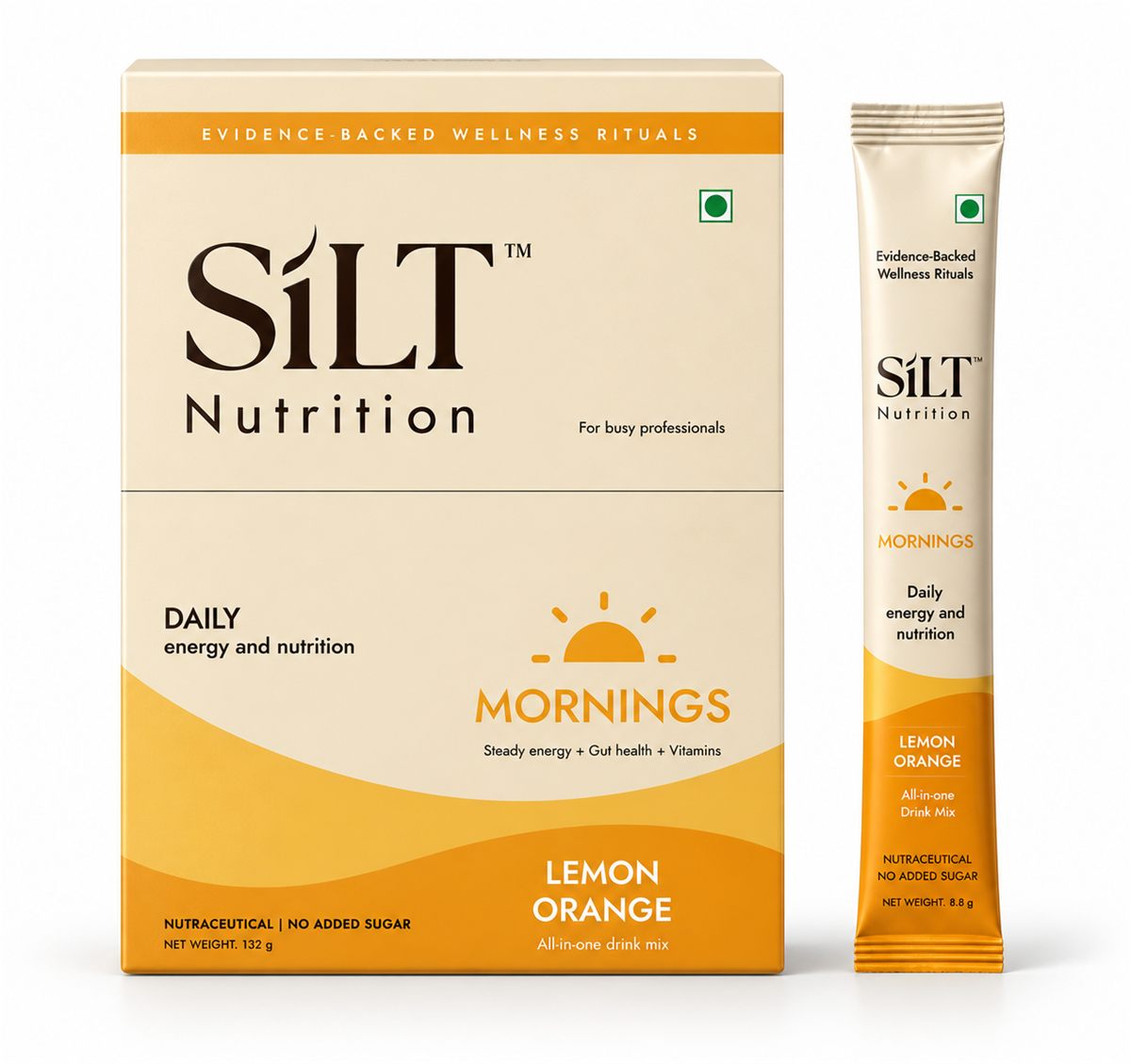
Each 8.8 g stick has 600 IU vitamin D3 (100% of the ICMR-NIN 2020 RDA), 55 mcg vitamin K2 (menaquinone), 80 mg vitamin C and vitamin B12 at 100% RDA. It also has 80 mg caffeine, 200 mg L-theanine, 1.4 g taurine, 5 g Sunfiber® PHGG fibre, 6 billion CFU of three spore-forming Bacillus species (B. subtilis, B. coagulans and B. clausii, 2 billion each) and 550 mg of digestive-herb extracts (saunf, jeera, ajwain, amla). It has a natural sweetener (stevia) and natural colour, with no added sugar, no maltodextrin and no gluten. Stir one stick into 200-250 ml of room-temperature or cold water (never boiling), any time in the morning. Every dose is printed on the back of the pack, and the pack's %RDA figures follow ICMR 2020 and the FSS (Labelling and Display) Regulations 2020 (SILT pack).
The honest limits:
- 600 IU is a daily-intake amount. If a test shows you're deficient, your doctor sets the dose and re-checks; a daily drink doesn't replace that. We don't claim Mornings reproduces any trial on this page.
- Add up your total. If you already take a vitamin D tablet or sachet, count it with this, and stay within your doctor's advice or the NHS adult limit of 4,000 IU a day. The pack's own direction is 1 stick a day, not to exceed the recommended usage level (SILT pack).
- It contains vitamin K2. If you take a blood thinner such as warfarin, ask your doctor before using SILT Mornings, because it contains vitamin K2 (55 mcg). Vitamin K can affect how warfarin works (MedlinePlus, Warfarin).
- It contains 80 mg caffeine, so it's a morning drink.
If you take regular medicines, especially for thyroid, blood pressure, blood sugar or sleep, ask your doctor first. The pack itself says it is not for medicinal use and not a substitute for a varied diet. We hold individual supplier certificates of analysis for our ingredients, summarised on our science page. The vitamin D3 supplier certificate shows 105,010 IU/g against a 90,000-110,000 IU/g specification, and the K2 supplier certificate shows 1.04% MK-7. What is still pending is the combined vitamin blend certificate and the finished-product NABL lab report, and we'll publish them when they're ready. For how D3 and K2 work together, read our vitamin D3 + K2 guide.
MRP ₹1,125 ₹900 · 15 sticks or ₹1,500 for 30 (MRP ₹2,250)
That's ₹60 a stick, or ₹50 in the 30-stick pack.
Shop SILT MorningsTest, don't guess
Bone pain, muscle weakness and easy fractures are the real vitamin D deficiency symptoms; tiredness has limited evidence, and low mood and frequent colds aren't well supported. Low vitamin D is very common in urban India, so if you have those signs or a clear risk factor, ask a doctor about a 25(OH)D test and let them dose it. Don't self-prescribe high doses. For everyday intake, start with vitamin D rich foods and some sun; for supplements, read our vitamin D3 + K2 guide; and if you're vegetarian, check vitamin B12 deficiency too. Evidence, not hype.
- NHS. Vitamin D. nhs.uk/conditions/vitamins-and-minerals/vitamin-d
- MedlinePlus. Vitamin D test. medlineplus.gov/lab-tests/vitamin-d-test
- MedlinePlus. Osteomalacia. medlineplus.gov/ency/article/000376.htm
- MedlinePlus. Warfarin. medlineplus.gov/druginfo/meds/a682277.html
- ICMR-NIN, 2020. Nutrient requirements for Indians: a brief note (Tables 3 and 4). nin.res.in/rdabook/brief_note.pdf
- Gibson RS. Principles of Nutritional Assessment, 3rd ed. Vitamin D: interpretive criteria. med.libretexts.org
- Kanekar et al., 2010. Int J Endocrinol. pubmed.ncbi.nlm.nih.gov/20011096
- Plotnikoff & Quigley, 2003. Mayo Clin Proc. pubmed.ncbi.nlm.nih.gov/14661675
- Nowak et al., 2016. Medicine (Baltimore). pubmed.ncbi.nlm.nih.gov/28033244
- Okereke et al., 2020. VITAL-DEP. JAMA. pubmed.ncbi.nlm.nih.gov/32749491
- Jolliffe et al., 2025. Lancet Diabetes Endocrinol. pubmed.ncbi.nlm.nih.gov/39993397
- Aparna et al., 2018. Vitamin D deficiency in India. J Family Med Prim Care. pubmed.ncbi.nlm.nih.gov/30090772
- Praveen et al., 2023. WHO South East Asia J Public Health. pubmed.ncbi.nlm.nih.gov/38848530
- Holick et al., 2011. Endocrine Society clinical practice guideline. J Clin Endocrinol Metab. pubmed.ncbi.nlm.nih.gov/21646368
- Demay et al., 2024. Endocrine Society clinical practice guideline. J Clin Endocrinol Metab. pubmed.ncbi.nlm.nih.gov/38828931
- Sharma et al., 2017. Hypervitaminosis D in India. Nutrition. pubmed.ncbi.nlm.nih.gov/28063517
- Sheikh et al., 2026. Cureus. pubmed.ncbi.nlm.nih.gov/42245902