


Vitamin B12 deficiency means your body has too little B12 to make healthy red blood cells and keep your nerves working. It can show up as tiredness, a sore tongue, pins and needles or memory trouble, and it is common in India, especially in vegetarians and in people on metformin or long-term antacids. A blood test confirms it, and nerve symptoms shouldn't wait. Below: the symptoms, the causes, what your test number means and when to see a doctor. Disclosure: we make a morning drink with vitamins and keep it to one short section near the end; our vitamin D3 + K2 guide covers that side.

Vitamin B12 deficiency symptoms
The symptoms fall into two groups: those of anaemia, and those from the nerves. Both can creep up slowly, and none of them is specific to B12.
General and anaemia symptoms (NHS, Symptoms):
- feeling weak or tired
- shortness of breath, headaches and palpitations
- a sore or red tongue, sometimes with mouth ulcers
- indigestion, loss of appetite or diarrhoea
- problems with vision
- problems with memory, understanding and judgement
Nerve symptoms, which the NHS lists for B12 specifically: pins and needles, numbness, muscle weakness, problems with balance and coordination, psychological problems ranging from mild depression or anxiety to confusion, and incontinence (NHS, Symptoms).
NICE's 2024 guideline adds detail doctors are told to look for: "brain fog" (trouble concentrating, short-term memory loss), blurred vision, falls from poor balance, an unsteady walk, unexplained fatigue, and anaemia in pregnancy that isn't responding to iron. It also says low B12 can be linked to depression, anxiety or psychosis (NICE NG239, 2024).
Two things that surprise people
- You can be deficient without anaemia. NICE tells doctors not to rule out B12 deficiency just because the blood count is normal (NICE NG239). Nerve symptoms can come first.
- Late treatment can leave damage. Many symptoms improve with treatment, but some problems can be irreversible if left untreated (NHS, Symptoms). MedlinePlus says nerve damage may be permanent if treatment doesn't start promptly after symptoms begin (MedlinePlus).
Tiredness alone has many causes, from short sleep to iron, thyroid and vitamin D. Our guide to why you're always tired walks through them in order.
Why B12 runs low
There are two routes: too little B12 going in, or the body failing to absorb or use it. Some people have both (NICE NG239).
Diet: the vegetarian question
B12 comes from meat, fish, milk, cheese and eggs, and from some fortified breakfast cereals. It isn't found naturally in fruit, vegetables or grains (NHS, B vitamins). NICE lists diets that exclude or are low in animal foods, including diets that exclude meat for religious reasons, as a common risk factor, along with not having B12-fortified foods or drinks (NICE NG239).
Body stores can last around 2 to 5 years, which is why diet-related deficiency builds slowly (NHS, Causes). A lacto-vegetarian diet with milk and curd isn't B12-free, but intake can still fall short; see the numbers below and our list of vitamin B12 rich foods for vegetarian sources.
Absorption problems
- Autoimmune gastritis (pernicious anaemia). The immune system attacks the stomach cells that make intrinsic factor, the protein B12 needs to be absorbed. The NHS calls it the most common cause in the UK (NHS, Causes).
- Stomach or bowel surgery, including gastrectomy and many weight-loss operations, and gut conditions such as Crohn's disease and coeliac disease (NHS, Causes; NICE NG239).
- Alcohol use (MedlinePlus), and recreational nitrous oxide ("laughing gas") (NHS, Causes).
Metformin
Metformin, a widely used diabetes medicine, can lower B12. The UK medicines regulator says deficiency is a common side effect that may affect up to 1 in 10 people who take it, and advises keeping on metformin while B12 is corrected: don't stop it without talking to your doctor (MHRA, 2022).
The longest look comes from the US Diabetes Prevention Program. Adults with prediabetes and overweight took metformin 850 mg twice a day or placebo; B12 was measured in about 1,500-1,700 of them at 5 and 13 years. Low or borderline-low B12 was more common on metformin (20.3% vs 15.6% at 13 years), and each year of use raised the odds by about 13% (Aroda et al., 2016). The study was funded by the US National Institutes of Health (NIDDK); we couldn't open the full author-disclosure statement.
Antacids and acid reducers
Medicines that suppress stomach acid may reduce B12 absorption, so long-term use is a suspect. In a US health-system study (California) of about 26,000 people with B12 deficiency and 184,000 without, 2 or more years' supply of a proton pump inhibitor (PPI, such as omeprazole or pantoprazole) was linked to 65% higher odds of deficiency, and H2 blockers to 25% higher odds (Lam et al., 2013). That is an association, not proof of cause; the authors worked at the health system's research division, and PubMed lists non-government funding. A 2023 meta-analysis of 25 studies by Indian gastroenterologists found only slightly higher odds in PPI users (OR 1.42), with wide variation between studies, and called the link unclear (Choudhury et al., 2023). Practical takeaway: if you've been on a daily PPI for years, ask about a B12 test; don't stop a prescribed medicine on your own.
NICE also lists colchicine, phenobarbital, pregabalin, primidone and topiramate as risk factors (NICE NG239).
Age
In older people, the commonest cause is "food-cobalamin malabsorption": the stomach can no longer release B12 from food. A 2004 review put deficiency at over 20% of elderly people, often unrecognised because the signs are subtle (Andrès et al., 2004). It's an older French review, so treat the figure as a rough guide.
Test first, then treat.
How common is it in India?
Very common, though the exact figure depends on who was studied and which cut-off was used.
- Pooled estimate: 53%. A 2021 systematic review pooled 270 Indian studies of six micronutrient deficiencies and estimated B12 deficiency at 53% (95% CI 41-64%), across all ages, with high variation between studies (Venkatesh et al., 2021).
- Pune men: 67%. Of 441 middle-aged men (mean age 39) in and around Pune, 67% had low B12 (below 150 pmol/L), rising to 81% in the urban middle class. Vegetarians had 4.4 times the risk of men who often ate non-vegetarian food (Yajnik et al., 2006). PubMed lists non-government research funding; no commercial ties are listed.
- Hyderabad adults: 37-46%. In 270 apparently healthy urban adults aged 30-70, 37% were deficient on total B12 and 46% on active B12; only 4% had a B12 intake likely to be adequate (Sivaprasad et al., 2019). The researchers were at ICMR-National Institute of Nutrition, and Europe PMC lists funding from India's Department of Science and Technology.
None of these is a national survey, and they used different cut-offs, so the headline numbers aren't comparable. The direction is consistent, though: low B12 is common in Indian adults who look healthy.
Are you at risk?
If you have a symptom from the list above and one of these risk factors, NICE says doctors should offer a test (NICE NG239). "Source" is where each risk factor on this page comes from.
| Risk factor | Why | Source |
|---|---|---|
| Vegetarian or vegan diet, no fortified foods | B12 comes mainly from animal foods | NHS; NICE; Yajnik 2006 |
| Metformin, especially for years | Linked to lower B12; risk rises with years of use | MHRA 2022; Aroda 2016 |
| Daily PPI or H2 blocker for 2+ years | Less stomach acid may mean less B12 absorbed | Lam 2013; Choudhury 2023 |
| Stomach or bowel surgery, incl. bariatric | Less B12 absorbed | NHS; NICE |
| Autoimmune gastritis, thyroid disease, type 1 diabetes, coeliac | Autoimmune links and malabsorption | NHS; NICE |
| Older age | Stomach releases less B12 from food | Andrès 2004 |
| Recreational nitrous oxide | Affects how the body processes B12 | NHS; NICE |
Testing for B12 deficiency
A blood test is the only way to know. The doctor will usually check a full blood count and your B12 level, and may test folate too (NHS, Diagnosis). NICE's 2024 guideline allows either a total B12 test or an active B12 (holotranscobalamin) test first, and gives these thresholds, unless your lab has its own validated range (NICE NG239):
| Total B12 | Active B12 | What it means |
|---|---|---|
| Below 180 ng/L (133 pmol/L) | Below 25 pmol/L | Deficiency confirmed |
| 180-350 ng/L (133-258 pmol/L) | 25-70 pmol/L | Indeterminate: possible deficiency |
| Above 350 ng/L (258 pmol/L) | Above 70 pmol/L | Deficiency unlikely |
Reading an Indian lab report. Many reports give total B12 in pg/mL. That's the same number as ng/L (1 pg/mL = 1 ng/L), so 250 pg/mL falls in NICE's indeterminate zone even if the lab marks it "normal". If your result is indeterminate and you have symptoms, NICE suggests a second test, serum methylmalonic acid (MMA), and sometimes starting treatment while waiting (NICE NG239).
Before the test:
- Tell the doctor about any supplement with B12, including multivitamins, injections, patches and vitamin drinks. NICE warns that these can raise B12 results without fully treating a deficiency (NICE NG239).
- Give blood before starting treatment (NICE NG239).
- Mention the combined pill, which can lower total B12 without causing a deficiency (NICE NG239).
Results and symptoms don't always match. Some people have symptoms with apparently normal levels, and others have low levels and feel fine (NHS, Diagnosis). That's why a number is read alongside your symptoms, not on its own.
Treatment: what to expect
Treatment depends on the cause, so finding the cause matters as much as the number.
- Diet-related deficiency: B12 tablets daily between meals, or injections twice a year. Some people can stop once levels are back to normal and their diet has improved; vegans may need tablets for life (NHS, Treatment).
- Absorption problems: injections, at first every other day, then every 2 to 3 months for life when the cause isn't diet (NHS, Treatment). NICE recommends lifelong injections for autoimmune gastritis or after total gastrectomy (NICE NG239).
- Medicine-related deficiency: tablets or injections while you stay on the medicine, plus a review of whether the medicine is still needed (NICE NG239).
How fast does it work? NICE says symptoms could start to improve within 2 weeks, may take up to 3 months, and can take much longer to disappear completely; they may even feel worse at first (NICE NG239). The dose and route are your doctor's call, so this page doesn't give doses.
When to see a doctor
See a doctor if you have symptoms of B12 deficiency, especially if you're vegetarian, on metformin or a long-term acid reducer, older, or have had stomach surgery (NHS, Symptoms; NICE NG239).
Don't wait with nerve symptoms. Numbness, pins and needles, an unsteady walk, falls, vision changes or new confusion need a prompt appointment. NICE tells doctors not to delay B12 treatment while waiting for test results when they suspect megaloblastic anaemia with neurological symptoms (NICE NG239), because nerve damage may become permanent if treatment starts late (MedlinePlus).
Pregnant or planning? Mention B12. NICE uses the active B12 test in pregnancy and says to consider treating an indeterminate result straight away (NICE NG239).
Don't self-treat before testing. A supplement started first can blur the result (NICE NG239), and a deficiency caused by poor absorption needs a different plan from one caused by diet.
A vitamin habit, not a treatment
SILT™ Mornings is a morning drink mix with vitamin B12 at 100% RDA alongside vitamin D3 600 IU, vitamin K2 (menaquinone) 55 mcg and vitamin C 80 mg. It is vegetarian (the pack carries the green vegetarian mark), and the label shows B12 as a % RDA on an ICMR 2020 basis (SILT pack). It is a daily habit for people whose levels are fine, not a treatment for a deficiency.
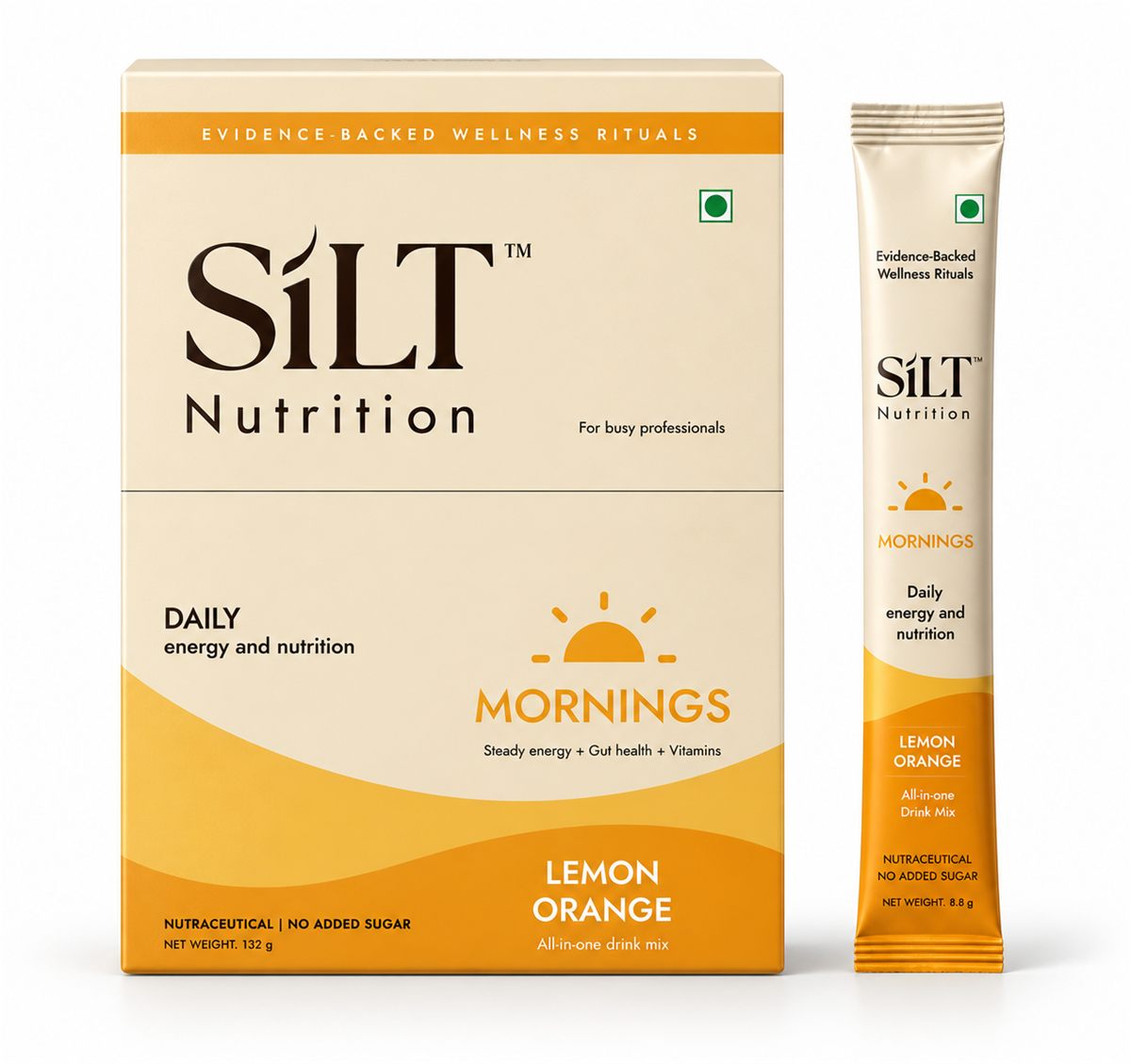
Each 8.8 g stick also has 80 mg caffeine, 200 mg L-theanine, 1.4 g taurine, 5 g Sunfiber® PHGG, 6 billion CFU from three spore-forming Bacillus species and 550 mg of digestive-herb extracts (saunf, jeera, ajwain, amla). It has a natural sweetener (stevia) and natural colour, with no added sugar, no maltodextrin and no gluten. Stir one stick into 200-250 ml of room-temperature or cold water (never boiling), any time in the morning, one stick a day.
The honest limits:
- It doesn't treat or prevent deficiency. If you have symptoms or a risk factor above, get tested and follow your doctor's dose.
- Tell your doctor you take it before a B12 test, because NICE notes that supplements can raise the result without fully treating a deficiency.
- Check with your doctor if you take regular medicines, especially for thyroid, blood pressure, blood sugar or sleep, and if you have a liver or thyroid condition or are pregnant. If you take a blood thinner such as warfarin, ask your doctor before using SILT Mornings, because it contains vitamin K2 (55 mcg). It contains 80 mg caffeine.
The pack itself says it is not for medicinal use and not a substitute for a varied diet. Supplier certificates of analysis for our ingredients are on our science page; what is still pending is the combined vitamin blend certificate and the finished-product NABL lab report, and we'll publish them when ready. The vitamin D side is covered in our vitamin D3 + K2 guide.
MRP ₹1,125 ₹900 · 15 sticks or ₹1,500 for 30 (MRP ₹2,250)
That's ₹60 a stick, or ₹50 in the 30-stick pack.
Shop SILT MorningsTest, don't guess
Vitamin B12 deficiency is common in India, easy to miss and easy to test for. If you're tired with tingling, a sore tongue or brain fog, and you're vegetarian, on metformin or a daily antacid, ask for a B12 test before you buy anything, and don't sit on nerve symptoms. For food sources, read vitamin B12 rich foods; for the other common Indian gap, see vitamin D deficiency symptoms and our vitamin D3 + K2 guide. Evidence, not hype.
- NHS. Vitamin B12 or folate deficiency anaemia: symptoms. nhs.uk/conditions/vitamin-b12-or-folate-deficiency-anaemia/symptoms
- NHS. Vitamin B12 or folate deficiency anaemia: causes. nhs.uk/conditions/vitamin-b12-or-folate-deficiency-anaemia/causes
- NHS. Vitamin B12 or folate deficiency anaemia: diagnosis. nhs.uk/conditions/vitamin-b12-or-folate-deficiency-anaemia/diagnosis
- NHS. Vitamin B12 or folate deficiency anaemia: treatment. nhs.uk/conditions/vitamin-b12-or-folate-deficiency-anaemia/treatment
- NHS. Vitamins and minerals: B vitamins and folic acid. nhs.uk/conditions/vitamins-and-minerals/vitamin-b
- NICE, 2024. Vitamin B12 deficiency in over 16s: diagnosis and management (NG239), recommendations. nice.org.uk/guidance/ng239
- MHRA, 2022. Metformin and reduced vitamin B12 levels: new advice for monitoring patients at risk. gov.uk/drug-safety-update
- MedlinePlus. Anemia due to B12 deficiency. medlineplus.gov/ency/article/000574.htm
- Aroda et al., 2016. Long-term metformin use and vitamin B12 deficiency in the Diabetes Prevention Program Outcomes Study. J Clin Endocrinol Metab. pubmed.ncbi.nlm.nih.gov/26900641
- Lam et al., 2013. Proton pump inhibitor and histamine 2 receptor antagonist use and vitamin B12 deficiency. JAMA. pubmed.ncbi.nlm.nih.gov/24327038
- Choudhury et al., 2023. Vitamin B12 deficiency and use of proton pump inhibitors: a systematic review and meta-analysis. Expert Rev Gastroenterol Hepatol. pubmed.ncbi.nlm.nih.gov/37060552
- Andrès et al., 2004. Vitamin B12 (cobalamin) deficiency in elderly patients. CMAJ. pubmed.ncbi.nlm.nih.gov/15289425
- Venkatesh et al., 2021. Micronutrient's deficiency in India: a systematic review and meta-analysis. J Nutr Sci. pubmed.ncbi.nlm.nih.gov/35059191
- Yajnik et al., 2006. Vitamin B12 deficiency and hyperhomocysteinemia in rural and urban Indians. J Assoc Physicians India. pubmed.ncbi.nlm.nih.gov/17214273
- Sivaprasad et al., 2019. Prevalence of vitamin deficiencies in an apparently healthy urban adult population. Nutrition. pubmed.ncbi.nlm.nih.gov/30954757