


Vitamin B12 rich foods are almost all animal foods: milk, curd, paneer and cheese, eggs, fish, meat and liver. The only other reliable sources are fortified foods and supplements. For Indian vegetarians, that makes dairy the main source, so this guide gives the micrograms per glass, katori and egg against India's RDA of 2.2 µg a day, explains why spirulina and fermented foods don't count, and covers when to get tested. Disclosure: we make a morning drink with added vitamins and keep it to one short section near the end; our vitamin D3 and K2 guide covers the vitamins in it.
Which foods have vitamin B12?
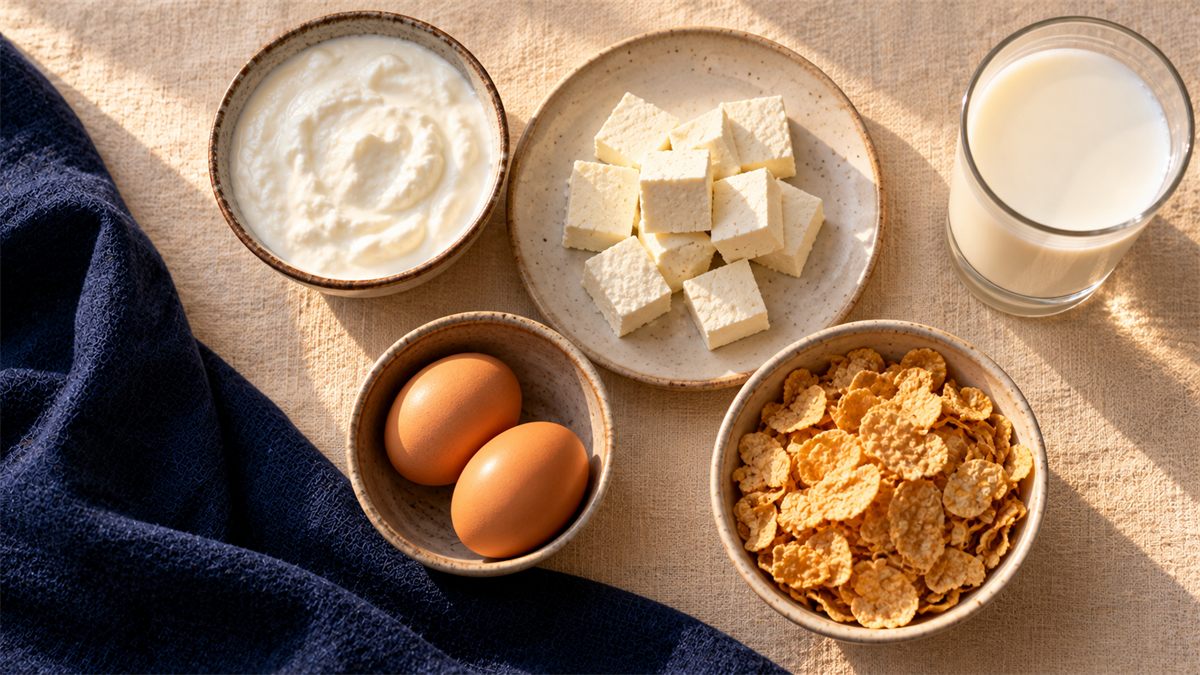
Vitamin B12 comes from animal foods and from foods with B12 added. The NHS lists meat, fish, milk, cheese, eggs and some fortified breakfast cereals as good sources, and notes that B12 isn't found naturally in fruit, vegetables or grains (NHS, B vitamins).
Ranked by micrograms per typical serving, the richest are liver, then fish such as salmon and tuna, then goat meat, then dairy and eggs. For vegetarians the practical list is short: milk, curd, chaas, paneer, cheese, eggs if you eat them, and fortified foods. B12 helps the body make red blood cells, keep the nervous system working and release energy from food (NHS, B vitamins).
Vitamin B12 per serving
Here's how much B12 common foods carry, with the share of the 2.2 µg adult RDA from ICMR-NIN 2020. Values are from the USDA FoodData Central entries named in the first column, worked out by us for the serving shown. Indian milk and home-made curd may differ from US samples, so treat these as good estimates, not label values.
| Food (USDA entry) | B12 per 100 g | Serving | B12 per serving | % of 2.2 µg RDA |
|---|---|---|---|---|
| Chicken liver, simmered | 16.8 µg | 50 g | 8.4 µg | 382% |
| Salmon, farmed, cooked | 2.80 µg | 100 g | 2.8 µg | 127% |
| Tuna, light, canned in water | 2.57 µg | 100 g | 2.6 µg | 117% |
| Goat meat, roasted | 1.19 µg | 100 g | 1.2 µg | 54% |
| Cow's milk, whole | 0.45 µg | 200 ml glass (about 206 g) | 0.93 µg | 42% |
| Buffalo milk | 0.36 µg | 200 ml glass (about 206 g) | 0.74 µg | 34% |
| Mozzarella, whole milk | 2.28 µg | 30 g | 0.68 µg | 31% |
| Curd (plain whole-milk yogurt) | 0.37 µg | 1 katori, 150 g | 0.56 µg | 25% |
| Egg, hard-boiled | 1.11 µg | 1 large egg, 50 g | 0.56 µg | 25% |
| Buttermilk (chaas), low-fat | 0.22 µg | 200 ml glass (about 207 g) | 0.46 µg | 21% |
| Chicken breast, roasted | 0.34 µg | 100 g | 0.34 µg | 15% |
| Cheddar | 1.06 µg | 30 g | 0.32 µg | 14% |
| Mushrooms, white, raw | 0.04 µg | 100 g | 0.04 µg | 2% |
| Spirulina, dried | 0 µg | 7 g (1 tbsp) | 0 µg | 0% |
Vegetarian B12 foods
For a lacto-vegetarian, dairy is the B12 plan. Eggs help if you eat them, and fortified foods fill the gap. Here's what each one realistically gives you.
Milk, curd and chaas
A 200 ml glass of whole cow's milk carries about 0.93 µg, roughly 42% of the RDA; buffalo milk about 0.74 µg. A katori of curd gives about 0.56 µg, and a glass of low-fat chaas about 0.46 µg (USDA FoodData Central). Milk in chai counts too, but a cup of chai usually holds far less than a full glass of milk.
Paneer and cheese
USDA has no paneer entry, and we found no measured paneer value from a source we'd cite, so we won't invent one. For scale, fresh and soft cheeses in USDA range from 0.43 µg (cottage cheese) and 0.85 µg (whole-milk ricotta) to 2.28 µg (whole-milk mozzarella) per 100 g (USDA FoodData Central). A 100 g serving of paneer is a fair contributor; it isn't a B12 fix on its own.
Eggs, for eggetarians
One large boiled egg has about 0.56 µg, almost all of it in the yolk (1.95 µg per 100 g of yolk vs 0.09 µg in the white) (USDA FoodData Central). The catch: a review of human absorption studies found B12 from eggs seems to be poorly absorbed, under 9%, compared with other animal foods (Watanabe, 2007). Eggs help, but count them for less than the table suggests.
Fortified foods: read the label
Under FSSAI's fortification rules, atta, maida and rice sold as fortified (the +F logo) must carry added B12 at 0.75-1.25 µg per kg, alongside iron and folic acid (FSSAI, Fortification of Foods Regulations compendium, version V, June 2022). That's about 0.08-0.13 µg in 100 g of raw rice or atta, roughly 3-6% of the RDA: useful at population scale, small on your plate. FSSAI also sets B12 levels for fortified breakfast cereals, pasta and noodles, so check the nutrition panel for the actual microgram figure. A review of B12 sources calls fortified breakfast cereals a particularly valuable source for vegans and older people (Watanabe, 2007).
A vegetarian day, on paper
A glass of milk (0.93 µg), a katori of curd (0.56 µg) and a glass of chaas (0.46 µg) add up to about 1.95 µg, close to the 2.2 µg RDA and just under the 2.0 µg average requirement (EAR) (ICMR-NIN 2020). So it's possible to get near the target from dairy alone. In practice, many Indian vegetarians don't: the next sections show how often levels run low.
Two practical points. Spread dairy across the day: the body's main B12 absorption route is estimated to saturate at about 1.5-2.0 µg per meal (Watanabe, 2007), so three small servings beat one large one. And if you're vegan, dairy is out, which leaves fortified foods and supplements; the NHS lists vegans who take neither among those at risk of deficiency (NHS, causes).
Count micrograms, not superfoods.
Plant foods that don't count
Spirulina, fermented foods and mushrooms are often sold as vegetarian B12 sources. The evidence doesn't back them as reliable sources.
- Spirulina. Spirulina tablets contain mostly pseudovitamin B12, a lookalike that is inactive in humans, so they aren't suitable as a B12 source for vegetarians (Watanabe et al., 2002; Watanabe et al., 2014). USDA lists 0 µg of B12 for dried spirulina (USDA FoodData Central).
- Fermented foods. B12 in fermented foods depends on which bacteria happen to be present. A review found tempeh ranged from 0.7 to 8.0 µg per 100 g, other fermented soy foods had only minute amounts, and Korean fermented vegetables had traces (Watanabe et al., 2014). For idli, dosa and dhokla, a PubMed search on 8 October 2026 found no study measuring their B12 (PubMed search).
- Mushrooms. Dried shiitake varied widely, and you'd need about 50 g of dried shiitake a day to meet the requirement, which the review authors note isn't realistic (Watanabe et al., 2014). White button mushrooms list 0.04 µg per 100 g (USDA FoodData Central).
- Nori. The same review rates dried purple laver (nori) as the most suitable plant source, at about 4 g a day (Watanabe et al., 2014). It isn't part of most Indian diets, so for most readers it isn't a practical plan.
The review authors declared no conflict of interest. Spinach, beetroot and potatoes, which some Indian lists mention, are covered by the NHS line above: fruit, vegetables and grains aren't natural B12 sources.
Non-veg B12 foods
Liver is the richest everyday source: 50 g of simmered chicken liver has about 8.4 µg. A 100 g portion of salmon or canned tuna covers the RDA, and 100 g of goat meat gives about half (USDA FoodData Central). Chicken breast is lower, at about 0.34 µg per 100 g.
Absorption differs too. Among study volunteers, average absorption was about 42% from fish, 56-89% from sheep meat and 61-66% from chicken (Watanabe, 2007). On these numbers, regular fish or meat makes the RDA much easier to reach than dairy alone.
How much B12 you need
The ICMR-NIN 2020 Recommended Dietary Allowance for vitamin B12 is 2.2 µg a day for adult men and women, with an Estimated Average Requirement of 2.0 µg. That's up from 1 µg in the 2010 recommendations (ICMR-NIN 2020). Some Indian articles still quote the old 1 µg figure.
Other bodies differ. The same ICMR-NIN tables list the US Institute of Medicine figure as 2.4 µg (ICMR-NIN 2020), and the NHS says adults aged 19 to 64 need about 1.5 µg (NHS, B vitamins). For an Indian reader, 2.2 µg is the number to plan around.
Who runs low in India
Low B12 is common in India, and vegetarians carry more of the risk.
- Adult men in Pune. In 441 men (mean age 39) from rural, slum and urban middle-class areas, 67% had low plasma B12 (under 150 pmol/L), rising to 81% in the urban middle class. Vegetarians had 4.4 times the risk of low B12 of men who often ate non-vegetarian food (Yajnik et al., 2006). This was one region and men only.
- Children and adolescents, nationally. The Comprehensive National Nutrition Survey (2016-18) measured serum B12 in 11,748 adolescents aged 10-19: 31.0% were deficient by WHO cut-offs, vs 17.3% of 5-9-year-olds and 13.8% of 1-4-year-olds (Shalini et al., 2023). Some authors advised on the survey's design and analysis, with consultancy support from UNICEF India.
- Vegetarians worldwide. A review of 18 studies that used sensitive markers found B12 depletion or deficiency among vegetarians in every age group, with higher rates in vegans and in people vegetarian since birth (Pawlak et al., 2013).
Diet isn't the only cause. The NHS lists pernicious anaemia (an autoimmune condition that blocks absorption), some stomach conditions and operations, Crohn's disease, and medicines including metformin and proton pump inhibitors (PPIs, common acidity tablets) (NHS, causes). B12 or folate deficiency is also more common with age, affecting around 1 in 10 people aged 75 or over (NHS, B12 or folate deficiency anaemia). Our guide to vitamin B12 deficiency covers symptoms and causes in full.
When to get tested
Ask a doctor for a B12 blood test if you have symptoms, or if you're vegetarian or vegan, take metformin or PPIs long term, or are older. Food lists can't tell you your level; a test can.
Symptoms the NHS lists include extreme tiredness, pins and needles, a sore and red tongue, muscle weakness and confusion. Don't wait on nerve symptoms: some problems caused by the deficiency can be irreversible if it isn't treated (NHS, B12 or folate deficiency anaemia).
Blood tests check haemoglobin, red-cell size and B12 and folate levels. Results aren't always clear-cut: the NHS notes that some people have symptoms with normal levels, and some have low levels without symptoms, so your doctor may order further tests (NHS, diagnosis). A diagnosed deficiency needs medical treatment, not just more curd. If you're simply always tired, our guide to why you might be always tired covers the other usual suspects.
A daily top-up, not a treatment
SILT™ Mornings is a morning drink mix with vitamin B12 (100% RDA), along with vitamins D3, K2 and C. The pack's own line for the four is "Helps fill everyday vitamin gaps". For a vegetarian, it's one easy, predictable B12 source alongside dairy. It isn't a treatment for deficiency, and it doesn't replace a blood test.
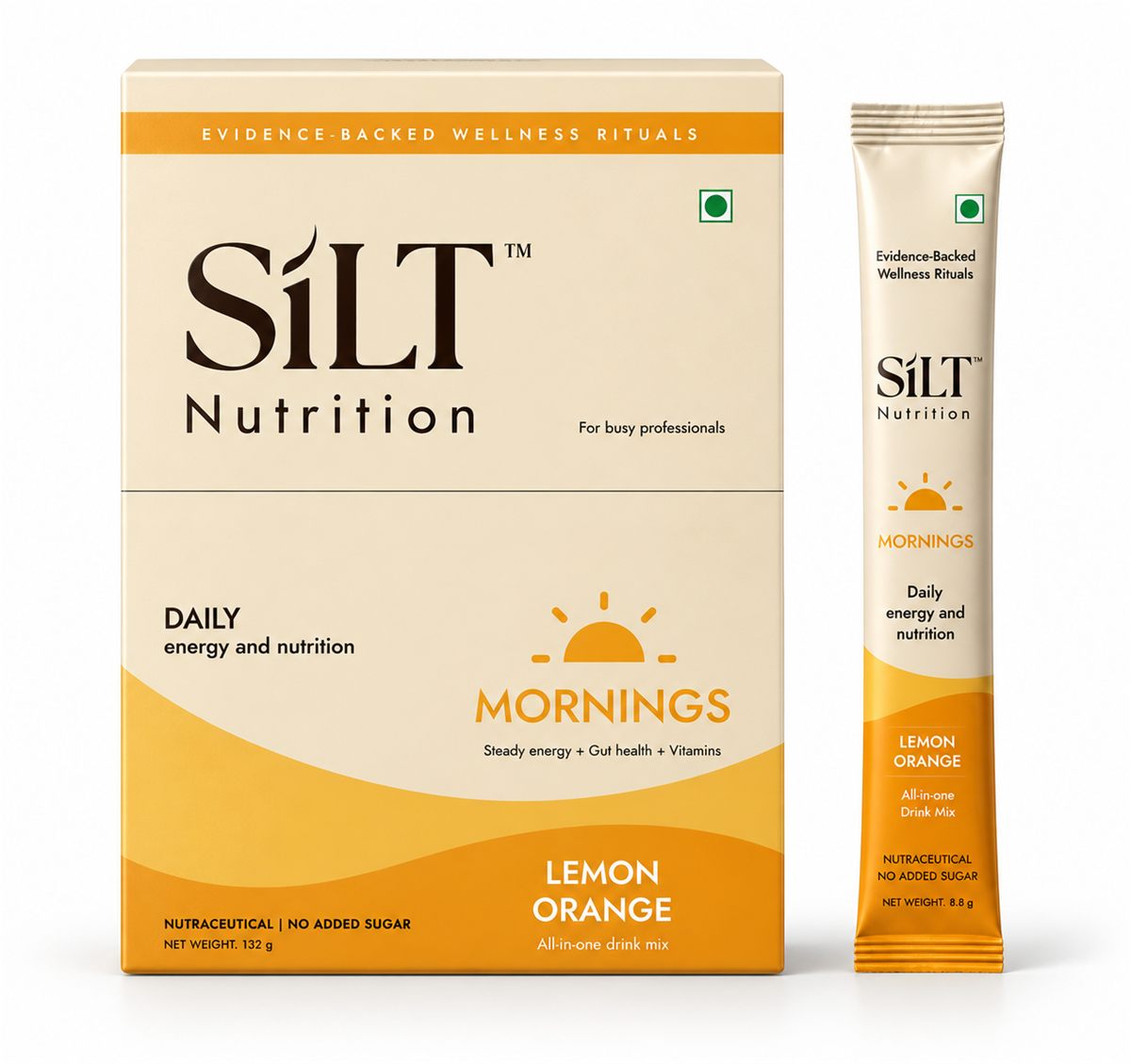
Each 8.8 g stick has vitamin D3 600 IU, K2 (menaquinone) 55 mcg, vitamin C 80 mg and vitamin B12, each at 100% RDA, plus 5 g Sunfiber® PHGG fibre, 6 billion CFU of three spore-forming Bacillus species, 550 mg digestive herb extracts (saunf, jeera, ajwain, amla), 200 mg L-theanine, 1.4 g taurine and 80 mg caffeine. Sweetened with stevia and coloured with natural beta-carotene; no added sugar, no maltodextrin, no gluten. The pack carries the green vegetarian mark, and SILT is FSSAI compliant (FSSAI Lic. No. 12826999000631) and made in India. Stir one stick into 200-250 ml of room-temperature or cold water, any time in the morning; the pack says one stick a day, and no boiling water because heat degrades sensitive actives.
The honest limits: it contains caffeine, so it may not suit you if you're sensitive to it. If you take regular medicines, especially for thyroid, blood pressure, blood sugar or sleep, ask your doctor first; the same goes if you have a liver or thyroid condition or are pregnant. The pack adds that it is not for medicinal use, not intended to treat, cure or prevent any disease and not a substitute for a varied diet, and says to contact your healthcare practitioner if you're nursing or have any medical condition. If you take a blood thinner such as warfarin, ask your doctor before using SILT Mornings, because it contains vitamin K2 (55 mcg). If you've been diagnosed with a deficiency, follow your doctor's treatment. Supplier certificates of analysis for our ingredients are on our science page; the vitamin blend certificate and a finished-product NABL lab report are pending, and we'll publish them when they're ready. More on the vitamins in our vitamin D3 and K2 guide.
MRP ₹1,125 ₹900 · 15 sticks or ₹1,500 for 30 (MRP ₹2,250)
That's ₹60 a stick, or ₹50 in the 30-stick pack.
Shop SILT MorningsDairy first, then test
Vitamin B12 rich foods are animal foods and fortified foods. Vegetarians can get close to the 2.2 µg RDA with milk, curd and chaas spread through the day, plus eggs if they eat them; spirulina, idli and mushrooms won't do it. Because low B12 is so common in India, a blood test beats guessing. For the rest of the vitamin picture, read our guides to vitamin D rich foods and vitamin C foods, or our vitamin D3 and K2 guide. Evidence, not hype.
- ICMR-NIN. A brief note on Nutrient Requirements for Indians, the RDA and EAR (ICMR-NIN 2020), Tables 3 and 4. nin.res.in/rdabook/brief_note.pdf
- USDA FoodData Central, SR Legacy entries 171061, 175168, 334194, 175304, 171265, 171280, 170845, 171284, 173424, 172184, 172183, 170874, 171477, 328637, 172179, 170851, 169251, 170495. fdc.nal.usda.gov
- FSSAI. Compendium, Food Safety and Standards (Fortification of Foods) Regulations, version V (01.06.2022). fssai.gov.in
- NHS. Vitamins and minerals: B vitamins and folic acid. nhs.uk/conditions/vitamins-and-minerals/vitamin-b
- NHS. Vitamin B12 or folate deficiency anaemia. nhs.uk/conditions/vitamin-b12-or-folate-deficiency-anaemia
- NHS. Vitamin B12 or folate deficiency anaemia: causes. nhs.uk/conditions/vitamin-b12-or-folate-deficiency-anaemia/causes
- NHS. Vitamin B12 or folate deficiency anaemia: diagnosis. nhs.uk/conditions/vitamin-b12-or-folate-deficiency-anaemia/diagnosis
- Watanabe, 2007. Vitamin B12 sources and bioavailability. Exp Biol Med. pubmed.ncbi.nlm.nih.gov/17959839
- Watanabe et al., 2014. Vitamin B12-containing plant food sources for vegetarians. Nutrients. pubmed.ncbi.nlm.nih.gov/24803097
- Watanabe et al., 2002. Characterization and bioavailability of vitamin B12-compounds from edible algae. J Nutr Sci Vitaminol. pubmed.ncbi.nlm.nih.gov/12656203
- Yajnik et al., 2006. Vitamin B12 deficiency and hyperhomocysteinemia in rural and urban Indians. J Assoc Physicians India. pubmed.ncbi.nlm.nih.gov/17214273
- Shalini et al., 2023. Prevalence of vitamin B12 and folate deficiencies in Indian children and adolescents. Nutrients. pubmed.ncbi.nlm.nih.gov/37447351
- Pawlak et al., 2013. How prevalent is vitamin B12 deficiency among vegetarians? Nutr Rev. pubmed.ncbi.nlm.nih.gov/23356638
- PubMed search, 8 October 2026: (idli OR dosa OR dhokla) AND (vitamin B12 OR cobalamin), 3 results, none measuring B12 in these foods. pubmed.ncbi.nlm.nih.gov