


Why am I always tired? Often the answer is short or broken sleep. When it isn't, the usual suspects are common and testable: low iron, low vitamin B12 or D, an underactive thyroid, high blood sugar, too little water, stress or low mood. This guide takes them in the order worth checking, with Indian data for each, and tells you when tiredness needs a doctor. It can't tell you which cause is yours; only a doctor and a few blood tests can. Disclosure: we make SILT™ Mornings, a morning drink with caffeine and L-theanine, and we keep it to one short section near the end.
Start with sleep, then test
Fix the easy things for two weeks; if you're still tired, get tested. In order:
- Count your real sleep. Adults need 7 or more hours a night on a regular basis (Watson et al., 2015). Time in bed scrolling doesn't count.
- Keep the same sleep and wake times, weekends included (NHS, Tiredness and fatigue).
- Move your last chai or coffee to the afternoon. Caffeine's effects can last up to 7 hours (NHS, Self-help tips to fight tiredness).
- Drink water through the day and walk for 15 minutes (NHS, Self-help tips).
- Still tired after a few weeks without a clear reason? See a doctor. The NHS says a GP may run blood tests to check for anaemia, diabetes or an overactive thyroid (hyperthyroidism) (NHS, Tiredness and fatigue).
9 causes at a glance
The table lists the common causes, the clues that point to each, and what to check. Clues overlap a lot, which is why tests matter more than guesses.
| Cause | Clues | What to check | Source |
|---|---|---|---|
| Short sleep | Under 7 hours most nights; better on holidays | A sleep diary for two weeks | Watson 2015; NHS |
| Poor-quality sleep (e.g. sleep apnoea) | Loud snoring, gasping or choking at night, tired despite enough hours | Ask a doctor; bring someone who has seen you sleep | NHS |
| Low iron or anaemia | Tiredness, breathlessness, palpitations, pale skin; heavy periods | Full blood count; ask about ferritin | NHS; Vaucher 2012 |
| Low vitamin B12 | Extreme tiredness, pins and needles, sore tongue; vegetarian diet | B12 blood test | NHS; Yajnik 2006 |
| Low vitamin D | Often no clear clues; little sun on skin | Vitamin D blood test | Aparna 2018; Nowak 2016 |
| Underactive thyroid | Feeling cold, weight gain, constipation, dry skin, low mood | TSH and T4 blood tests | NHS; Unnikrishnan 2013 |
| High blood sugar | Thirst, peeing more, weight loss without trying | Blood sugar test | NHS; Anjana 2023 |
| Mild dehydration | Low energy and headache on hot or busy days | A glass of water, then see | Armstrong 2012; NHS |
| Stress or low mood | Tired and flat, poor sleep, life feels heavy | Talk to a doctor or therapist | NHS |
Sleep: the first suspect
Too little sleep is the first thing to rule out. The American Academy of Sleep Medicine and the Sleep Research Society recommend at least 7 hours a night for adults, and link regularly sleeping less to impaired performance, more errors and a greater risk of accidents, among other harms (Watson et al., 2015). The NHS lists not getting enough sleep, or finding it hard to get to sleep, first among the common causes of tiredness (NHS, Tiredness and fatigue).
A practical test: write down when you actually fall asleep and wake up for two weeks. If the average is under 7 hours, you have your first answer. Our guide on how to sleep fast ranks the habits that help, from a fixed wake-up time to a six-hour caffeine cut-off.
Enough hours but still exhausted? Sleep quality may be the problem. See a GP if your breathing stops and starts while you sleep, you make gasping, snorting or choking noises, or you always feel very tired during the day. These are signs of sleep apnoea, which can be serious if it isn't diagnosed and managed (NHS, Sleep apnoea).
Tired after waking up
Some grogginess after waking is normal. It's called sleep inertia, and it fades the longer you're awake. A review found it is made worse by prior sleep loss and by the time of day you wake up (Hilditch & McHill, 2019). So feeling slow for the first stretch of the morning after a short night is expected.
What isn't expected is waking up tired every day after a full night. Three things to look at:
- Your total sleep. A 6 am alarm after a 1 am bedtime is 5 hours, whatever the alarm app says about "sleep quality".
- Your wake-up time. Keep it the same every day; the NHS recommends regular sleep and wake times and avoiding naps (NHS, Self-help tips).
- Alcohol and late caffeine. The NHS says alcohol disrupts sleep and that caffeine's effects can last up to 7 hours (NHS, Self-help tips).
If you're tired after waking up most days despite 7 or more hours, mention it to a doctor, along with any snoring or gasping someone has noticed.
Tired is a symptom, not a personality.
Low iron, B12 or vitamin D
These three are common in India and each shows up on a blood test. Don't guess and self-dose; test first.
Iron and anaemia
Iron deficiency anaemia causes tiredness and lack of energy, shortness of breath, heart palpitations and pale skin, and heavy periods are a main cause (NHS, Iron deficiency anaemia). In India it is very common: anaemia in women aged 15-49 rose from 53.1% in NFHS-4 (2015-16) to 57% in NFHS-5 (2019-21) (Gnanasekaran et al., 2026). Men aren't spared: in an NFHS-5 analysis of 61,481 rural men, three in ten were anaemic (Singh et al., 2022).
Low iron can matter even before it shows up as anaemia. In a French trial of 198 menstruating women aged 18-53 with unexplained fatigue, low ferritin (under 50 µg/L) and normal haemoglobin, 80 mg of elemental iron a day for 12 weeks cut fatigue scores by 47.7%, against 28.8% on placebo (Vaucher et al., 2012). That's one trial in one group, and iron is not something to take on a hunch: a GP diagnoses it with a full blood count, and the NHS warns that an iron overdose can be fatal for a young child, so keep tablets out of reach (NHS, Iron deficiency anaemia).
Vitamin B12
B12 deficiency can cause extreme tiredness, a lack of energy, pins and needles and a sore tongue; diet is one cause, and some effects can become permanent if it's picked up late (NHS, Vitamin B12 or folate deficiency anaemia). B12 comes mainly from animal foods, which matters in a country with many vegetarians. In a Pune study of 441 men, 67% had low B12, rising to 81% of urban middle-class men, and vegetarians had 4.4 times the risk of those who often ate non-vegetarian food (Yajnik et al., 2006). In 270 apparently well adults aged 30-70 in Hyderabad, 37% were B12 deficient on total B12 and 46% on active B12 (Sivaprasad et al., 2019).
Vitamin D
Vitamin D deficiency is widespread in India despite the sunshine. An AIIMS review found prevalence ranging from 40% to 99% across Indian studies, with most reporting 80-90% (Aparna et al., 2018); the Hyderabad study above found 29% (Sivaprasad et al., 2019). The range is wide partly because studies use different cut-offs.
Does low vitamin D make you tired? There's some trial evidence. In 120 otherwise healthy adults (mean age 29) with fatigue and low vitamin D (under 20 µg/L), a single 100,000-unit dose of vitamin D3 improved fatigue scores more than placebo after four weeks; 72% reported feeling better against 50% on placebo (Nowak et al., 2016). That was one high dose in people already shown to be deficient, so test first and let a doctor set the dose.
Thyroid and blood sugar
Both are common in Indian adults, both can make you tired, and both are often missed until someone tests.
Underactive thyroid
An underactive thyroid can cause extreme tiredness, feeling cold, weight gain, constipation, low mood, dry skin and heavy periods. Symptoms usually come on slowly, and the check is a blood test for TSH and T4 (NHS, Underactive thyroid). In a study of 5,360 adults across eight Indian cities, 10.95% had hypothyroidism, about 1 in 10, and 3.47% hadn't known they had it. It was three times as common in women (15.86%) as in men (5.02%) (Unnikrishnan et al., 2013).
High blood sugar
Feeling very tired is one of the main symptoms of diabetes, along with feeling thirsty all the time, peeing more than usual and losing weight without trying (NHS, Diabetes). The ICMR-INDIAB survey of 113,043 Indian adults found diabetes in 11.4% and prediabetes in 15.3% (Anjana et al., 2023). The NHS adds that some people have no symptoms and need testing if they're at higher risk.
A heavy, rice-rich lunch followed by a slump is a separate, everyday thing; we cover it in sleepy after lunch. Daily tiredness plus thirst and frequent urination is a reason to get your blood sugar checked.
Water, stress and mood
Sometimes the cause is simpler: too little water, or too much on your mind.
Water. The NHS notes that mild dehydration can leave you tired and that a glass of water often helps, especially after exercise (NHS, Self-help tips). In a lab trial in 25 young women, losing about 1.4% of body weight in fluid worsened fatigue, vigour, concentration and headache, though most measures of thinking were unaffected (Armstrong et al., 2012). In an Indian summer or an air-conditioned office, it's easy to drink less than you think.
Stress and low mood. The NHS lists stress, depression and dealing with life's challenges among the common causes of tiredness (NHS, Tiredness and fatigue), and says counselling or cognitive behavioural therapy may help with fatigue linked to stress, anxiety or low mood (NHS, Self-help tips). If you've felt flat and tired for weeks and lost interest in things, tell a doctor; it counts as much as a blood test.
How to increase energy
Once the medical causes are checked, how to increase energy comes down to a few unglamorous habits. The NHS self-help list (NHS, Self-help tips):
- Eat often. A meal or small snack every 3 to 4 hours rather than a few large meals.
- Move. Even one 15-minute walk can give you an energy boost; build towards 150 minutes of moderate activity a week.
- Sleep regularly. Same bed and wake times, no daytime naps.
- Cut caffeine late in the day, and cut down gradually rather than stopping suddenly, which can cause headaches.
- Drink less alcohol and more water.
How strong is the exercise evidence? A meta-analysis found regular exercise raised feelings of energy and lowered fatigue by a modest amount on average, but studies that used a placebo comparison found no effect (Puetz et al., 2006). Exercise is still worth doing; just don't expect it to override short sleep or low iron.
On caffeine: it hides tiredness rather than removing the cause, and a late cup can shorten tonight's sleep. Our guide to the caffeine crash covers timing and safe daily amounts, and coffee alternatives compares lower-caffeine swaps.
When to see a doctor
See a doctor if you've been tired for a few weeks and don't know why, if it's affecting your daily life, or if it comes with weight loss, mood changes, or gasping, snorting or choking noises while you sleep (NHS, Tiredness and fatigue).
The NHS says a GP may run blood tests to check for anaemia, diabetes or an overactive thyroid (hyperthyroidism), and may refer you to a specialist if the cause isn't clear. Mention your diet (vegetarian or not), your periods if you have them, your sleep hours, any snoring, and every medicine and supplement you take. Thirst with frequent urination, or feeling cold with weight gain, are worth raising specifically (NHS, Diabetes; NHS, Underactive thyroid).
A morning ritual, not a diagnosis
SILT Mornings is for the everyday part of feeling better: a steady start to the morning once the basics are covered. It won't fix short sleep, and it isn't a substitute for testing iron, B12, vitamin D, thyroid or blood sugar. Stir one stick into 200-250 ml of room-temperature or cold water (not boiling) any time in the morning, one stick a day. The pack says not to use boiling water, because heat degrades sensitive actives, and to use it consistently for at least 3 months (SILT pack).
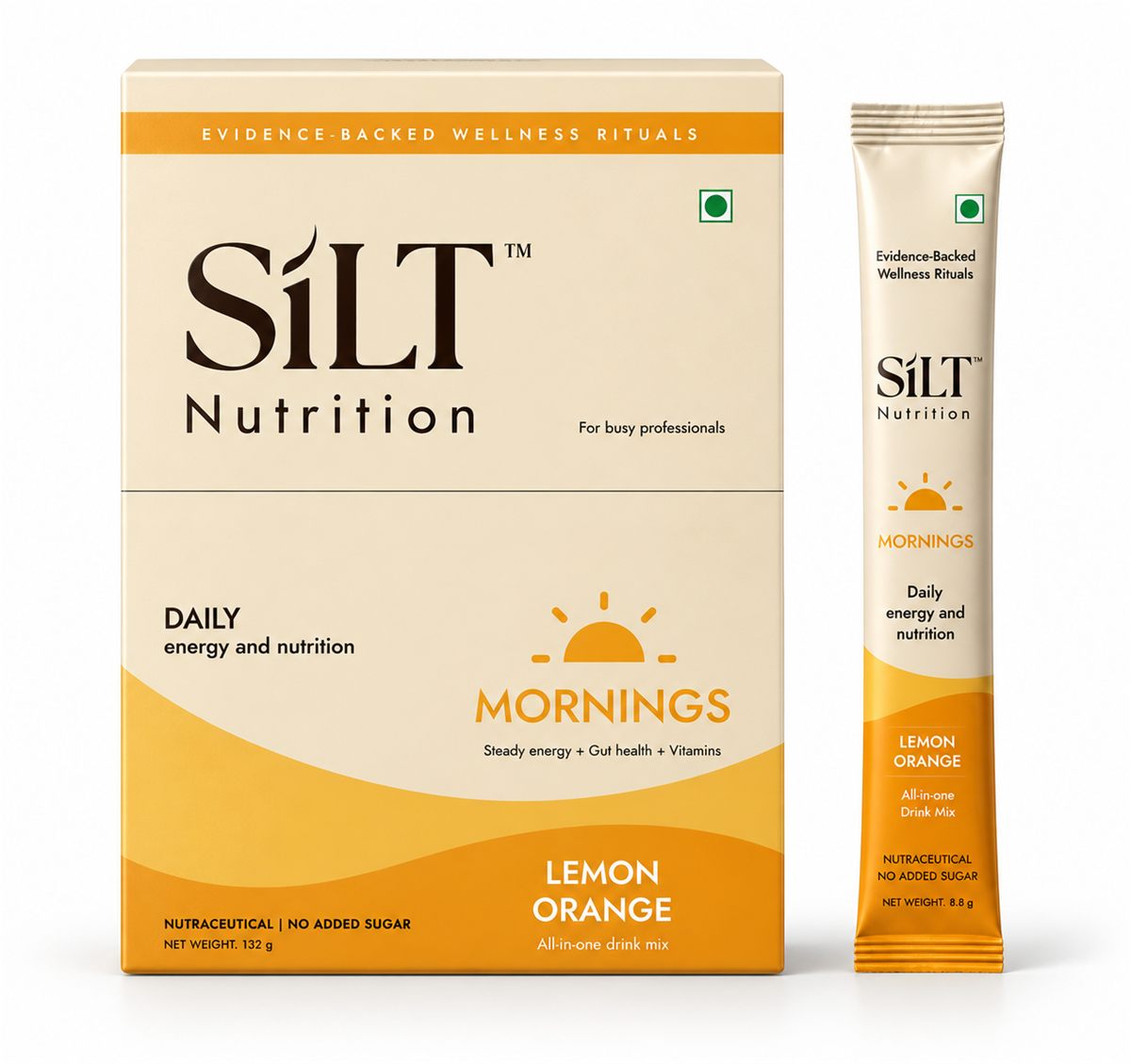
Every dose is printed on the back of the pack. Each stick has 80 mg caffeine with 200 mg L-theanine, 1.4 g taurine, 5 g Sunfiber® PHGG prebiotic fibre, 6 billion CFU of spore-forming Bacillus probiotics (three species, 2 billion each: B. subtilis, B. coagulans and B. clausii), 550 mg of digestive herb extracts (saunf, jeera, ajwain, amla), and vitamins at 100% RDA each: D3 600 IU, K2 (menaquinone) 55 mcg, vitamin C 80 mg and vitamin B12. The 100% RDA figures follow ICMR and FSSAI standards, so 600 IU of D3 is the everyday requirement, not a high-dose product. These are everyday amounts, not the doses a doctor would use for a confirmed deficiency. The pack's nutrition panel for one 8.8 g stick is below.
| Nutrient | Per stick | %RDA |
|---|---|---|
| Energy | 33.72 kcal | 1.69% |
| Protein | 1.21 g | 2.24% |
| Carbohydrate | 1.75 g | Not established |
| Total sugars | 1.13 g | Not established |
| Added sugars | 0 g | 0% |
| Dietary fibre (AI) | 4.95 g | 16.5% |
| Total fat | 0.67 g | 1.0% |
| Saturated fat | 0.47 g | 2.14% |
| Trans fat | <0.1 g | 0% |
| Cholesterol (NMT) | <1.0 mg | Not established |
| Sodium | 140.71 mg | 7.04% |
| Calcium | 6.16 mg | 0.62% |
%RDA basis printed on the pack: ICMR 2020 (men); FSS (Labelling and Display) Regulations 2020. AI = adequate intake; NMT = not more than.
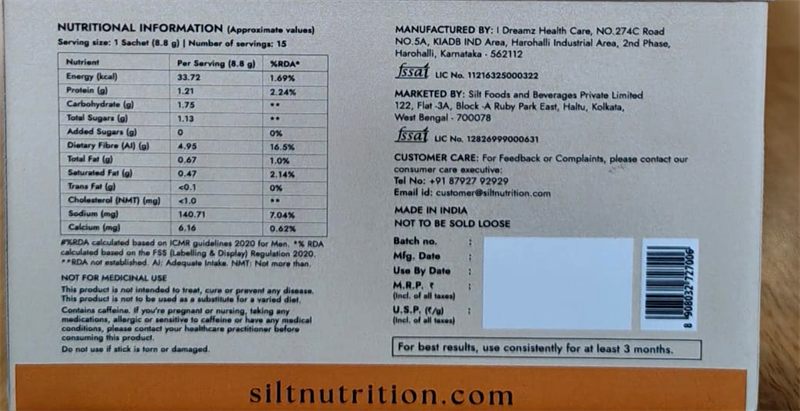
The pack shows 1.13 g total sugars and 0 g added sugars per stick (SILT pack), so we say "no added sugar" and show the total. It has no maltodextrin and no gluten, is sweetened with stevia (steviol glycosides) and coloured with natural beta-carotene. Supplier certificates of analysis are on our science page; the vitamin-blend certificate and a finished-product NABL lab report are pending, and we'll publish them when they're ready.
It contains 80 mg caffeine. "If you take regular medicines, especially for thyroid, blood pressure, blood sugar or sleep, ask your doctor first", and "If you have a liver or thyroid condition, are pregnant, or take regular medicines, check with your doctor first." If you take a blood thinner such as warfarin, ask your doctor before using SILT Mornings, because it contains vitamin K2 (55 mcg). The pack adds that it is not for medicinal use or a substitute for a varied diet, and to contact your healthcare practitioner if you're pregnant or nursing, taking any medications, sensitive to caffeine or have any medical condition. If sleep is your weak spot, our caffeine-free, melatonin-free SILT™ Nights is built for the wind-down instead.
MRP ₹1,125 ₹900 · 15 sticks or ₹1,500 for 30 (MRP ₹2,250)
That's ₹60 a stick, or ₹50 in the 30-stick pack.
Shop SILT MorningsFind the cause first
If you're always tired, count your sleep first, then fix the easy habits for two weeks. Still tired? Ask a doctor about blood tests for anaemia, B12, vitamin D, thyroid and blood sugar, all common in India. Once those are clear, a steady morning routine helps; if you want caffeine with L-theanine in it, read our L-theanine supplement guide or try SILT Mornings. Evidence, not hype.
- NHS. Tiredness and fatigue. nhs.uk/symptoms/tiredness-and-fatigue
- NHS. Self-help tips to fight tiredness. nhs.uk/live-well/sleep-and-tiredness/self-help-tips-to-fight-fatigue
- NHS. Sleep apnoea. nhs.uk/conditions/sleep-apnoea
- NHS. Iron deficiency anaemia. nhs.uk/conditions/iron-deficiency-anaemia
- NHS. Vitamin B12 or folate deficiency anaemia. nhs.uk/conditions/vitamin-b12-or-folate-deficiency-anaemia
- NHS. Underactive thyroid: symptoms. nhs.uk/conditions/underactive-thyroid-hypothyroidism/symptoms
- NHS. Diabetes. nhs.uk/conditions/diabetes
- Watson et al., 2015. AASM and SRS consensus statement, recommended amount of sleep for adults. Sleep. pubmed.ncbi.nlm.nih.gov/26039963
- Hilditch & McHill, 2019. Sleep inertia: current insights. Nat Sci Sleep. pubmed.ncbi.nlm.nih.gov/31692489
- Gnanasekaran et al., 2026. Anemia among reproductive-age women in India (NFHS-5). Indian J Community Med. pubmed.ncbi.nlm.nih.gov/42125576
- Singh et al., 2022. Anaemia among men in rural India (NFHS-5). PLOS Glob Public Health. pubmed.ncbi.nlm.nih.gov/36962811
- Vaucher et al., 2012. Iron supplementation and fatigue in nonanemic women with low ferritin, a randomized controlled trial. CMAJ. pubmed.ncbi.nlm.nih.gov/22777991
- Yajnik et al., 2006. Vitamin B12 deficiency and hyperhomocysteinemia in rural and urban Indians. J Assoc Physicians India. pubmed.ncbi.nlm.nih.gov/17214273
- Sivaprasad et al., 2019. Vitamin deficiencies in an urban Indian adult population. Nutrition. pubmed.ncbi.nlm.nih.gov/30954757
- Aparna et al., 2018. Vitamin D deficiency in India. J Family Med Prim Care. pubmed.ncbi.nlm.nih.gov/30090772
- Nowak et al., 2016. Vitamin D3 and self-perceived fatigue, a double-blind randomized placebo-controlled trial. Medicine (Baltimore). pubmed.ncbi.nlm.nih.gov/28033244
- Unnikrishnan et al., 2013. Prevalence of hypothyroidism in adults in eight cities of India. Indian J Endocrinol Metab. pubmed.ncbi.nlm.nih.gov/23961480
- Anjana et al., 2023. ICMR-INDIAB national cross-sectional study. Lancet Diabetes Endocrinol. pubmed.ncbi.nlm.nih.gov/37301218
- Armstrong et al., 2012. Mild dehydration and mood in young women. J Nutr. pubmed.ncbi.nlm.nih.gov/22190027
- Puetz et al., 2006. Effects of chronic exercise on feelings of energy and fatigue. Psychol Bull. pubmed.ncbi.nlm.nih.gov/17073524