


How to sleep fast, honestly: no trick reliably knocks you out in two minutes, but a short routine with real evidence behind it gets you there sooner. Keep one wake-up time, stop caffeine six hours before bed, put the phone away an hour early, keep the room cool and dark, and get out of bed if you're still awake after about 20 minutes. Below, every tip is ranked by the strength of its evidence, including the viral military method and 4-7-8 breathing. Disclosure: we make a melatonin-free sleep drink, SILT™ Nights, and we keep it to one short section near the end.
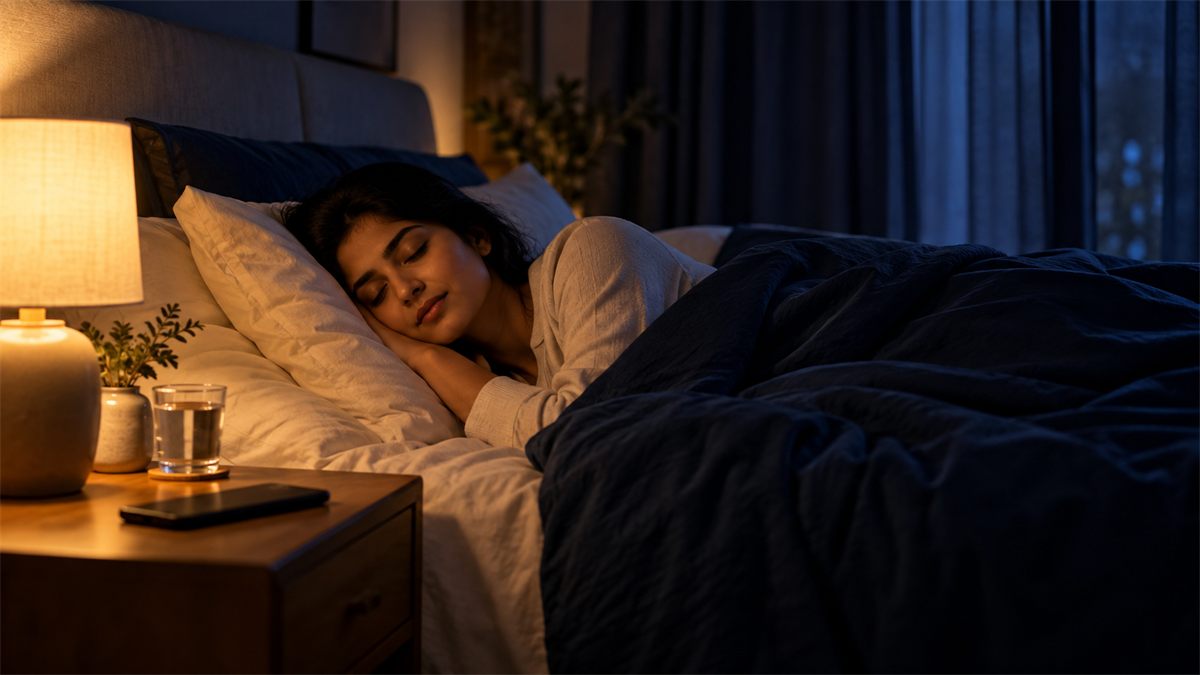
Do this tonight
Here's how to fall asleep fast, in the order to do it. Each step links to its evidence; the table below ranks them.
- Set tomorrow's alarm first. Same wake-up time as every other day, weekends included (NHS Every Mind Matters).
- Check when you had your last chai or coffee. If it was within six hours of bed, move it earlier tomorrow (Drake et al., 2013).
- Leave 3-4 hours between dinner and bed where you can, or make a late dinner the light meal (NHS, Heartburn).
- Phone face-down, an hour before bed (NHS Every Mind Matters).
- Make the room quiet, dark and cool. Curtains drawn, fan or AC on.
- Write tomorrow's to-do list for five minutes (Scullin et al., 2018).
- Lie down and relax rather than chase sleep. Slow breathing or muscle relaxation.
- Still awake after about 20 minutes? Get up, do something quiet in dim light, and come back when you feel sleepy (NHS Every Mind Matters).
If you've had trouble sleeping for months, or changing your habits hasn't helped, see a doctor (NHS, Insomnia).
Sleep tips ranked by evidence
Not all sleep tips are equal. The table puts the best-supported first. "Strength" is our editorial read of the sources linked here, not a clinical grade, and much of the guideline evidence comes from people with chronic insomnia rather than the occasional bad night.
| Technique | What to do | Strength of evidence | Source |
|---|---|---|---|
| CBT-I (for chronic insomnia) | A structured course with a trained therapist or a programme | Strongest: first-line treatment, strong recommendations from two guideline bodies | ACP 2016; AASM 2021 |
| Stimulus control (the 20-minute rule) | Get up if you can't sleep; return when sleepy | Guideline-backed (AASM, conditional) | AASM 2021; NHS |
| Relaxation and mindfulness | Muscle relaxation, slow breathing, meditation | Guideline-backed (AASM, conditional); one mindfulness trial in 54 adults | AASM 2021; Ong 2014 |
| No caffeine within 6 hours of bed | Last chai or coffee by late afternoon | One randomised trial; standard NHS advice | Drake 2013; NHS |
| Screens off an hour before bed | Phone away, printed book instead | One lab study; standard NHS advice | Chang 2015; NHS |
| Warm bath or shower 1-2 hours before bed | 40-42.5 °C water, 10 minutes or more | Meta-analysis, limited research | Haghayegh 2019 |
| Cool, dark, quiet room | Fan or AC, curtains, earplugs | Review of heat studies; standard NHS advice | Okamoto-Mizuno 2012; NHS |
| One wake-up time, no naps | Same alarm every day | Standard NHS advice | NHS |
| Five-minute to-do list | Write tomorrow's tasks, specifically | One lab trial, 57 young adults | Scullin 2018 |
| Imagery / cognitive shuffling | Picture a calm scene or random objects | One small study of imagery (41 people); no trial of shuffling found | Harvey & Payne 2002 |
| 4-7-8 breathing | Breathe in 4, hold 7, out 8 | Little: one small trial in tinnitus patients; neither study timed how fast people fall asleep | Marchant 2025; Kirazli 2026 |
| Military method | Relax head to toe, then picture a calm scene | No trial found | PubMed search, 7 Oct 2026 |
| Sleep hygiene alone, for chronic insomnia | Tips only, no therapy | AASM suggests not using it as the only treatment | AASM 2021 |
The 20-minute rule
If you're still awake after about 20 minutes, get out of bed. It feels backwards, but it has guideline backing. The NHS advises getting up after about 20 minutes awake and doing something relaxing, such as reading, until you feel sleepy (NHS Every Mind Matters). It's the everyday version of stimulus control, which the American Academy of Sleep Medicine (AASM) suggests as a treatment on its own for chronic insomnia in adults (Edinger et al., 2021).
The logic is simple: bed should be where you sleep, not where you lie awake replaying the day. Three ways to make it work:
- Don't watch the clock. Estimate the 20 minutes; checking the time only adds pressure.
- Have a spot ready. A chair outside the bedroom, a dim lamp, something dull to read.
- Keep the phone off. Getting up is not an invitation to scroll.
Keep one wake-up time
Fix the time you get up, every day, weekends included. Bedtime is hard to control on a bad night; the alarm is not. The NHS includes a consistent wake-up time in its insomnia self-help steps, and advises against daytime naps (NHS, Insomnia), with the same advice for weekends in its sleep tips (NHS Every Mind Matters).
After a short night, skip the Sunday lie-in and the post-lunch nap; you'll be sleepier at bedtime.
Stop chasing sleep. Make room for it.
Why sleep is not coming at night
For most people the answer sits in the last six hours of the day: caffeine, a late heavy dinner, a bright screen or a hot room. Fix these and you've covered most of how to sleep at night naturally.
Late chai and coffee
Tea and coffee both carry caffeine. NHS figures: about 75 mg in a cup of tea (black or green), 100 mg in a cup of instant coffee, and more in filter or coffee-shop coffee (NHS, Foods to avoid in pregnancy).
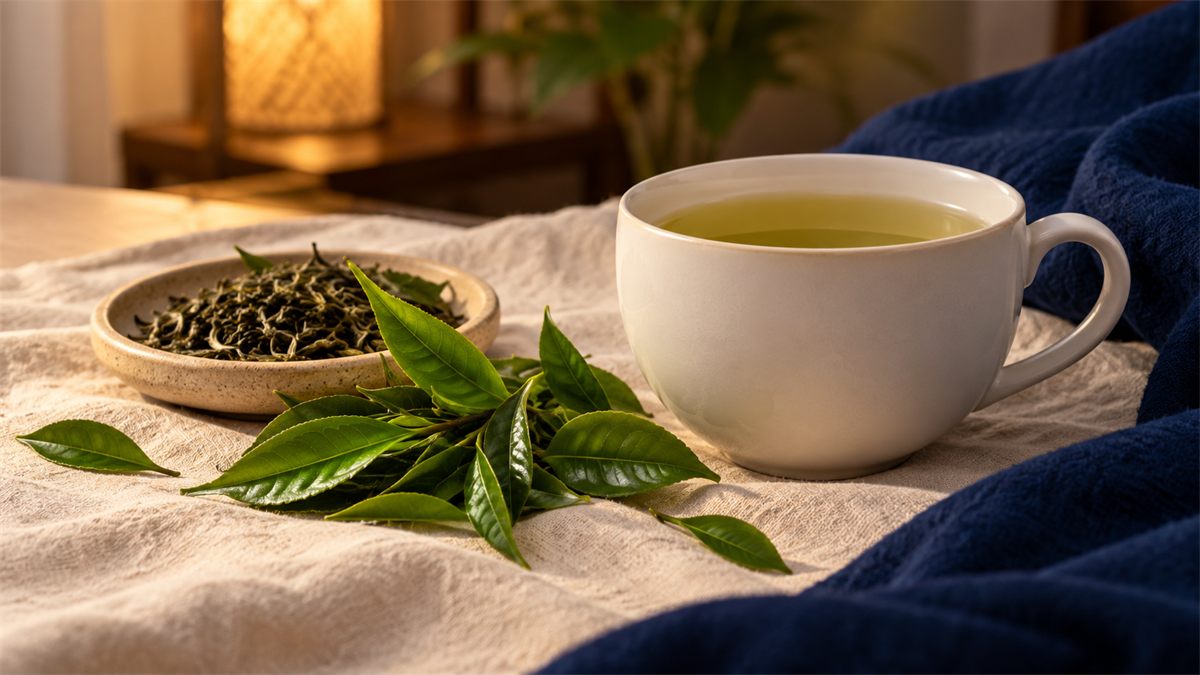
In a randomised trial, 400 mg of caffeine (roughly four cups of instant coffee by those figures) disrupted sleep whether it was taken at bedtime, 3 hours before or 6 hours before. The authors recommend avoiding substantial caffeine for at least six hours before bed (Drake et al., 2013). The trial didn't test smaller doses, but the NHS gives the same six-hour rule for caffeine, alcohol and nicotine (NHS, Insomnia). Bed at 11 pm? Last chai by 5 pm; swap the 6 pm office chai for warm milk or a caffeine-free herbal tea.
Late dinners
Dinner at 10 and bed at 11 is normal in many Indian homes. The NHS advises not eating within 3 or 4 hours of bed if you get heartburn, because reflux is often worse lying down (NHS, Heartburn), and lists large late meals among things to avoid for insomnia (NHS, Insomnia). In a Japanese case-control study, people who went to bed less than 3 hours after dinner had 7.45 times the odds of reflux disease of those who waited 4 hours or more (Fujiwara et al., 2005). That's an association, not proof. If an earlier dinner isn't realistic, make it the light meal.
Screens
The NHS advises no phones, tablets or computers for an hour before bed (NHS Every Mind Matters). In a sleep-lab study, people who read on a light-emitting e-reader before bed took longer to fall asleep, made less melatonin, had a later body clock and were less alert the next morning than when they read a printed book (Chang et al., 2015). Set the alarm, then put the phone face-down and out of reach.
Hot rooms
A review of thermal studies found that, with normal bedding, heat increases time awake and reduces deep and REM sleep, and humid heat adds to the load (Okamoto-Mizuno & Mizuno, 2012). The NHS asks for a bedroom that is quiet, dark and cool (NHS Every Mind Matters). In an Indian summer: fan or AC on a timer, cotton sheets, blackout curtains, earplugs for traffic.
The warm-bath trick
A warm bath helps you cool down. A meta-analysis found that a warm shower or bath at 40-42.5 °C, taken 1-2 hours before bed for as little as 10 minutes, shortened the time to fall asleep. The authors link it to heat loss through the hands and feet, and call the research limited (Haghayegh et al., 2019). If you already bathe in the evening, move it to 1-2 hours before bed.
Quiet a racing mind
Give your brain a different job: put tomorrow on paper, then occupy your mind with something neutral. This is how to sleep fast without overthinking.
Write a to-do list. In a sleep-lab trial, 57 healthy adults aged 18-30 wrote for five minutes before bed. Those who wrote a to-do list for the coming days fell asleep significantly faster than those who wrote about tasks already done, and the more specific the list, the faster they fell asleep (Scullin et al., 2018). One small study in young, healthy people, but it costs five minutes.
Shuffle your thoughts. Cognitive shuffling means picturing a stream of random, unrelated things (a mango, a scooter, a kettle) so the mind can't latch on to worries. PubMed lists no trial of it by that name (searched 7 October 2026). A related idea has some support: in 41 people with insomnia, those taught to distract themselves with an engaging imagery task fell asleep faster than those given no instructions (Harvey & Payne, 2002).
Practise relaxation, not just tonight. The AASM suggests relaxation therapy as a treatment on its own for chronic insomnia (Edinger et al., 2021). In a trial of 54 adults with chronic insomnia, eight-week mindfulness programmes cut time spent awake and insomnia severity more than self-monitoring did (Ong et al., 2014). These are skills built over weeks, not a one-night switch.
Military method and 4-7-8: honest verdict
Both are reasonable relaxation exercises. Neither has been shown to put you to sleep in two minutes.
The military sleep method
As usually described:
- Relax your face: forehead, jaw, tongue, the muscles around your eyes.
- Drop your shoulders and let your arms go loose, one side at a time.
- Breathe out and relax your chest.
- Relax your legs, from thighs to calves to feet.
- Clear your mind for about 10 seconds by picturing a calm scene.
Online, it's sold as working in two minutes. We searched PubMed for "military method" and sleep in titles and abstracts on 7 October 2026 and found no trial of it. Its parts fare better: relaxation therapy has a conditional AASM recommendation (Edinger et al., 2021) and imagery has the small study above (Harvey & Payne, 2002). Verdict: fine as a relaxation routine; ignore the stopwatch.
4-7-8 breathing
Breathe in quietly through your nose for a count of 4, hold for 7, breathe out through your mouth for 8, and repeat a few times. Researchers testing it alongside other patterns in 84 college students called 4-7-8 popular with therapists but short on evidence: breathing at six breaths a minute raised heart-rate variability more than 4-7-8 did, and none of the patterns meaningfully changed mood (Marchant et al., 2025). In a small trial of 48 people with tinnitus, six weeks of 4-7-8 practice lowered insomnia-severity scores compared with an information session alone (Kirazli et al., 2026). Neither study tested how fast healthy people fall asleep. Verdict: a fine relaxation exercise; if the 7-second hold makes you tense or light-headed, just breathe slowly instead.
Can you sleep in 2 or 5 minutes?
Not on command. If you searched how to sleep fast in 5 minutes or 2 minutes, here's the truth: no technique on this page has been shown to put people to sleep in a set number of minutes. Even melatonin, a hormone, shortens the time to fall asleep by only about 7 minutes on average (see supplements, below; Ferracioli-Oda et al., 2013). What you can control is how wound up you are when you lie down. Do the routine, relax, and let the 20-minute rule catch you if sleep doesn't come.
CBT-I for chronic insomnia
If poor sleep has lasted months, the first-line treatment isn't a trick or a pill. It's cognitive behavioural therapy for insomnia (CBT-I). The American College of Physicians recommends that all adults with chronic insomnia get CBT-I as the initial treatment (strong recommendation, moderate-quality evidence); adding a medicine is a shared decision if CBT-I alone hasn't worked (Qaseem et al., 2016).
The AASM makes a strong recommendation for multicomponent CBT-I. It gives conditional recommendations for stimulus control, sleep restriction and relaxation used on their own, and suggests not relying on sleep hygiene alone (Edinger et al., 2021).
In the UK, the NHS offers CBT for insomnia face-to-face or through online programmes, and says GPs now rarely prescribe sleeping pills (NHS, Insomnia). In India, ask your doctor for a referral to a sleep specialist or a clinical psychologist who offers CBT-I.
Do supplements help?
Modestly, at best, and only alongside the routine above. The melatonin figure above, about 7 minutes off the time to fall asleep, comes from a meta-analysis of 19 trials in adults and children with primary sleep disorders (Ferracioli-Oda et al., 2013), but the AASM makes a weak recommendation against using it for chronic insomnia (Sateia et al., 2017). Magnesium bisglycinate, at 250 mg elemental magnesium a day, gave a small improvement in insomnia scores over 4 weeks in 155 adults who slept poorly; one co-author runs a research firm funded by nutraceutical companies (Schuster et al., 2025).
For which ingredient suits which sleep problem, read our guide to the best sleep supplements in India. The two most-asked options go head to head in magnesium vs melatonin. There's more in our guide to magnesium for sleep and is melatonin safe every night?
When to see a doctor
See a doctor if changing your sleep habits hasn't helped, if you've had trouble sleeping for months, or if it's making daily life hard to cope with. Insomnia lasting three months or more counts as long-term (NHS, Insomnia).
Go sooner if your breathing stops and starts while you sleep, you make gasping, snorting or choking noises, or you always feel very tired during the day. Along with loud snoring, these are signs of sleep apnoea, which can be serious if it isn't diagnosed and treated. The NHS suggests taking along someone who has seen your symptoms (NHS, Sleep apnoea).
A wind-down drink, not a shortcut
SILT Nights is a drink for the wind-down part of the routine, not a replacement for it. Stir one stick into 200-250 ml of lukewarm or cold water (not boiling; the pack says heat degrades sensitive actives) 30-60 minutes before bed; it can also take the place of a late chai. The pack's direction is 1 stick a day, and "for best results, use consistently for at least 3 months", so think routine, not one-night fix.
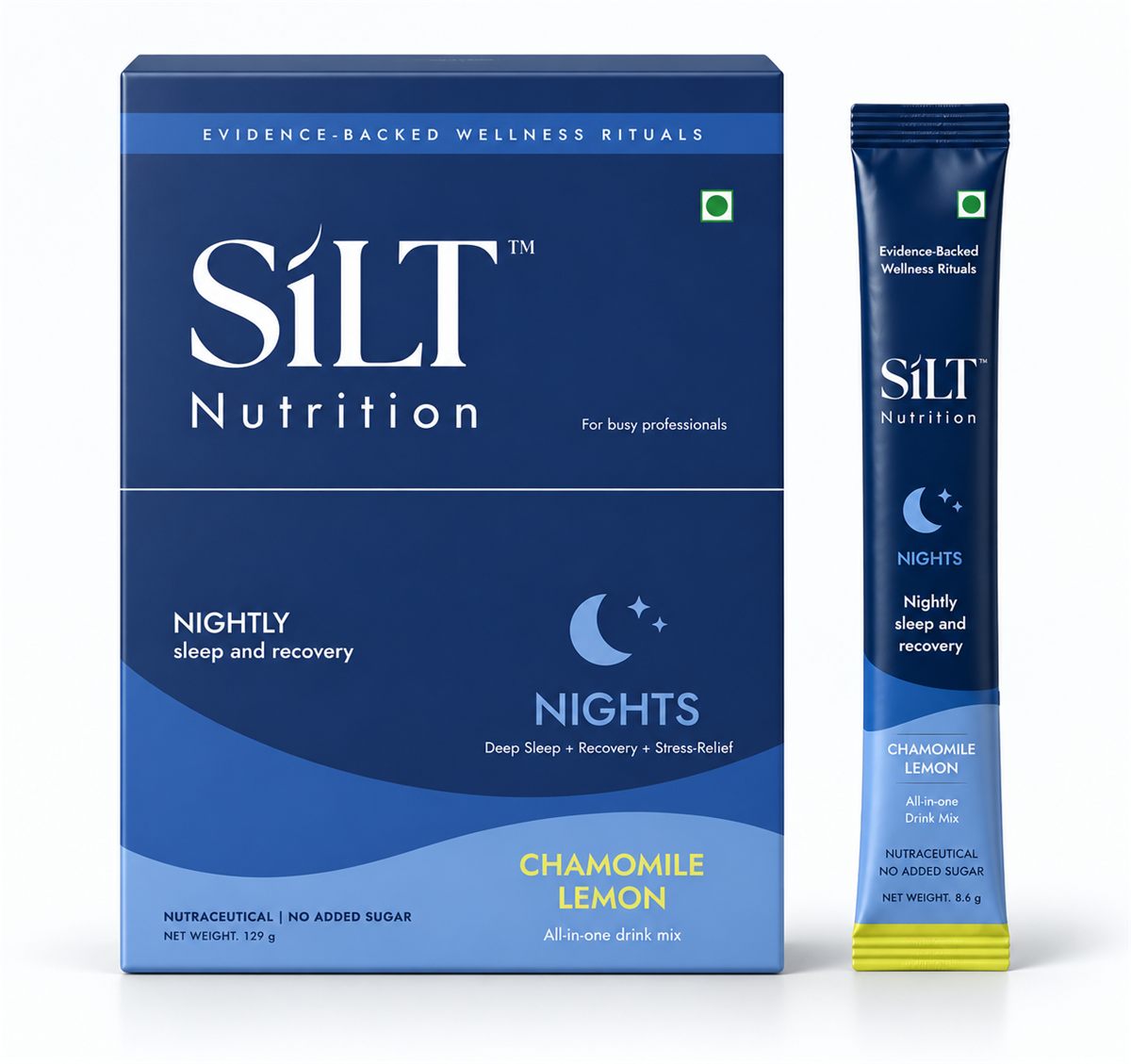
Each stick has 1.8 g magnesium bisglycinate (250 mg elemental magnesium), 3 g glycine, 200 mg L-theanine and 300 mg KSM-66® ashwagandha root extract. Every dose is printed on the back of the pack. The box prints "no melatonin", "no maltodextrin" and "no added sugar", the stick has no caffeine, and Chamomile Lemon is the flavour only. Every ingredient comes with a supplier certificate of analysis (on our science page); a finished-product NABL lab report is pending, and we'll publish it when it's ready. It isn't a sleeping pill or a substitute for CBT-I or a doctor. The pack says it is not intended to treat, cure or prevent any disease. If you have a liver or thyroid condition, are pregnant or nursing, or take regular medicines, check with your doctor first. SILT is FSSAI compliant (FSSAI Lic. No. 12826999000631), vegetarian and made in India. Want magnesium on its own? See our magnesium glycinate powder guide.
MRP ₹1,125 ₹900 · 15 sticks or ₹1,500 for 30 (MRP ₹2,250)
That's ₹60 a stick, or ₹50 in the 30-stick pack.
Shop SILT NightsSleep FAQs
What can I drink to sleep faster?
Something warm and caffeine-free. The NHS suggests warm milk or herbal tea in place of tea, coffee and caffeinated soft drinks (NHS Every Mind Matters). What you stop drinking matters more: no chai or coffee within six hours of bed.
How can I get 100% sleep?
There's no perfect score, and chasing one adds pressure. Aim for steady habits: the same wake-up time daily, an hour to relax before bed, a dark and quiet room, regular exercise and no daytime naps (NHS, Insomnia). If you're still tired after months of that, see a doctor.
Fast sleep is a routine
Anchor your wake-up time, stop caffeine six hours out, eat earlier, put the phone down, cool the room, write the list, relax, and get up after 20 minutes awake. If months go by, ask a doctor about CBT-I. If you want a melatonin-free drink for the wind-down, that's what we built SILT Nights for. Evidence, not hype.
- NHS Every Mind Matters. Fall asleep faster and sleep better. nhs.uk/every-mind-matters
- NHS. Insomnia. nhs.uk/conditions/insomnia
- NHS. Sleep apnoea. nhs.uk/conditions/sleep-apnoea
- NHS. Heartburn and acid reflux. nhs.uk/conditions/heartburn-and-acid-reflux
- NHS. Foods to avoid in pregnancy (caffeine content of drinks). nhs.uk/pregnancy/keeping-well/foods-to-avoid
- Edinger et al., 2021. AASM guideline, behavioral and psychological treatments for chronic insomnia. J Clin Sleep Med. pubmed.ncbi.nlm.nih.gov/33164742
- Qaseem et al., 2016. ACP guideline, management of chronic insomnia disorder in adults. Ann Intern Med. pubmed.ncbi.nlm.nih.gov/27136449
- Drake et al., 2013. J Clin Sleep Med. pubmed.ncbi.nlm.nih.gov/24235903
- Chang et al., 2015. PNAS. pubmed.ncbi.nlm.nih.gov/25535358
- Okamoto-Mizuno & Mizuno, 2012. J Physiol Anthropol. pubmed.ncbi.nlm.nih.gov/22738673
- Haghayegh et al., 2019. Sleep Med Rev. pubmed.ncbi.nlm.nih.gov/31102877
- Fujiwara et al., 2005. Am J Gastroenterol. pubmed.ncbi.nlm.nih.gov/16393212
- Scullin et al., 2018. J Exp Psychol Gen. pubmed.ncbi.nlm.nih.gov/29058942
- Harvey & Payne, 2002. Behav Res Ther. pubmed.ncbi.nlm.nih.gov/11863237
- Ong et al., 2014. Sleep. pubmed.ncbi.nlm.nih.gov/25142566
- Marchant et al., 2025. Appl Psychophysiol Biofeedback. pubmed.ncbi.nlm.nih.gov/39864026
- Kirazli et al., 2026. Brain Behav. pubmed.ncbi.nlm.nih.gov/41676854
- Ferracioli-Oda et al., 2013. PLoS One. pubmed.ncbi.nlm.nih.gov/23691095
- Sateia et al., 2017. AASM guideline, pharmacologic treatment of chronic insomnia. J Clin Sleep Med. pubmed.ncbi.nlm.nih.gov/27998379
- Schuster et al., 2025. Nat Sci Sleep. pmc.ncbi.nlm.nih.gov/articles/PMC12412596
- PubMed search, 7 October 2026: "military method"[tiab] AND sleep[tiab], 0 results. pubmed.ncbi.nlm.nih.gov