


Is melatonin safe to take every night? For most adults, short-term use appears safe. What nobody can tell you yet is whether it's safe for months or years of nightly use, because that research is thin. This guide sets out what's known and what isn't: side effects, long-term data, dependence, dose, label accuracy, who should check with a doctor first, and when melatonin is the right tool. If you're after something to take every night without the hormone, see SILT™ Nights, our melatonin-free sleep drink.
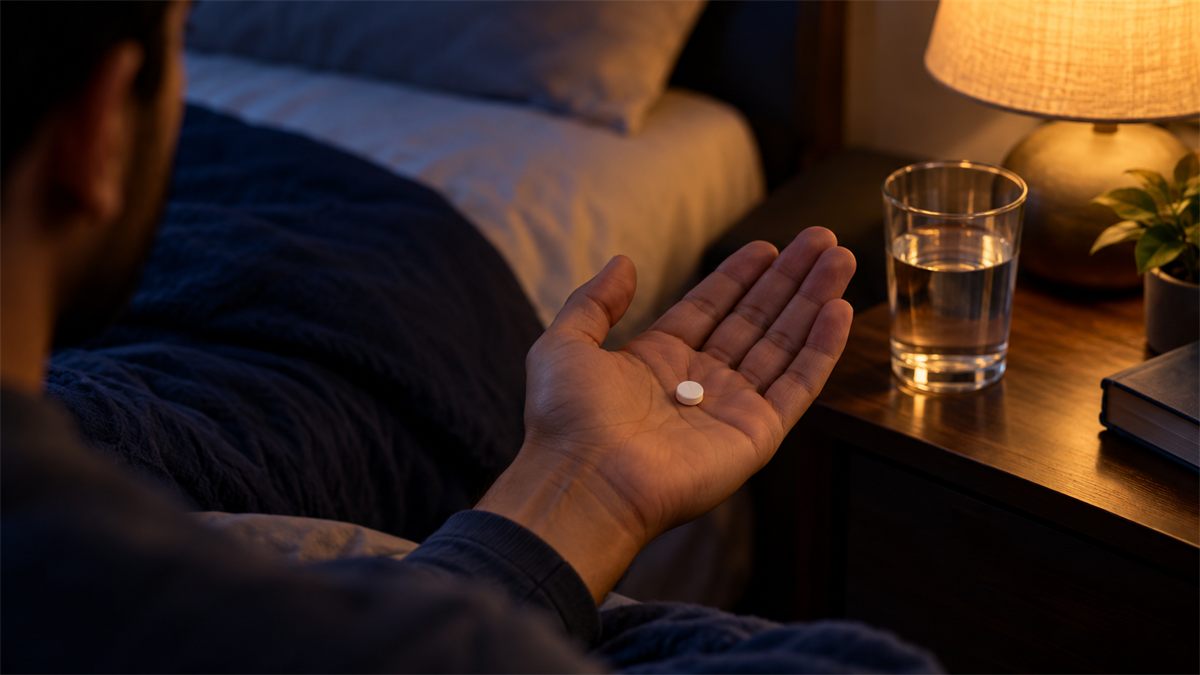
Is melatonin safe every night?
Short-term nightly use appears safe for most adults, but long-term safety hasn't been properly studied. That's the position of the US National Center for Complementary and Integrative Health (NCCIH), and a 2023 review reaches the same place: low to moderate doses (5 mg a day or less) appear safe, yet the long-term effects "have been insufficiently studied" (Givler et al., 2023).
- A few weeks: reasonable for most healthy adults, especially for jet lag or a shifted body clock.
- Up to 13 weeks: the longest course the UK licenses for its 2 mg prolonged-release tablet, for people aged 55+ (UK melatonin SmPC; NHS).
- Months to years, every night: unknown territory. If you need it that long, the sleep problem itself needs a look.
- Chronic insomnia: the American Academy of Sleep Medicine suggests clinicians not use melatonin for it (a weak recommendation) (Sateia et al., 2017).
- Check first if you're pregnant, have epilepsy, or take blood thinners, sedatives or fluvoxamine (details below).
Melatonin side effects
Melatonin's common side effects are mild: headache, dizziness, nausea and sleepiness (NCCIH). A 2016 safety review found the same list and no studies showing serious adverse effects from melatonin, with long-term trials reporting effects comparable to placebo (Andersen et al., 2016).
The UK licensed tablet gives the clearest numbers. Across its clinical trials (1,931 people on melatonin, 1,642 on placebo), 48.8% on melatonin reported an adverse reaction against 37.8% on placebo. The most common were headache, nasopharyngitis (a cold), back pain and joint pain, and these were common in both groups (UK melatonin SmPC).
Three practical points:
- Next-day drowsiness. The label warns melatonin may cause drowsiness and has a moderate effect on driving (UK melatonin SmPC). Don't drive if it leaves you sleepy, dizzy or unable to concentrate (NHS).
- Older adults. Melatonin may stay active longer in older people and cause daytime drowsiness (NCCIH).
- Alcohol. The NHS advises not drinking while taking it, because together they can make you sleep very deeply and breathe poorly (NHS). Alcohol also makes melatonin less effective (UK melatonin SmPC).
Long-term melatonin use: known vs unknown
We know melatonin keeps working over weeks of trials and that stopping didn't cause rebound in them. We don't know what years of nightly use do. Here's the evidence on one screen.
| Question | What the evidence shows | Source |
|---|---|---|
| Does it stop working with nightly use? | No sign of that during trials: the effects didn't fade with continued use | Ferracioli-Oda et al., 2013 (19 trials, 1,683 people) |
| Longest licensed course | Up to 13 weeks of 2 mg prolonged-release, age 55+ | UK melatonin SmPC |
| Six months of use | One 600-person trial: better sleep latency and quality, no withdrawal or rebound; the benefit held to 3 months, but it failed its main 6-month analysis | UK melatonin SmPC |
| Safe for years? | Not established. NCCIH calls long-term effects unclear; a 2023 review says they are "insufficiently studied" | NCCIH; Givler et al., 2023 |
| Heart | One 2025 observational abstract linked a year or more of use to heart failure; it can't show cause | AHA, 2025 (see FAQ) |
| Pregnancy, breastfeeding | Too little research to call it safe | NCCIH |
The 2013 meta-analysis is the best evidence against tolerance: across 19 trials, melatonin cut the time to fall asleep by about 7 minutes and added about 8 minutes of sleep, and trials that ran longer showed bigger effects, not smaller ones (Ferracioli-Oda et al., 2013). But those trials ran for weeks, not years. "No tolerance in trials" is not the same as "safe for a decade". Specialists do sometimes prescribe melatonin long-term for certain conditions (NHS); that's a supervised decision, not a default.
Safe for a few weeks isn't the same as safe for a few years.
Melatonin dependence and rebound
Melatonin doesn't appear to cause dependence or rebound insomnia. The NHS says you're unlikely to become addicted if you take it as prescribed (NHS).
The trial data agree. In one placebo-controlled study of the licensed tablet, people took melatonin for 3 weeks and then a placebo for 2. Their sleep "gradually returned to baseline" with no rebound and no increase in withdrawal symptoms (UK melatonin SmPC). The 600-person, six-month trial also reported no withdrawal symptoms or rebound insomnia. A 2023 review adds that withdrawal symptoms haven't been reported when people stop, and that taking melatonin doesn't appear to reduce the body's own production (Givler et al., 2023).
So if you stop, expect your sleep to go back to where it was before melatonin, not worse. If it was poor before, it will be poor again, and that's the problem worth solving.
Melatonin dosage: more isn't better
Above 5 mg, higher doses don't buy more benefit. In the Cochrane review of jet lag, doses from 0.5 to 5 mg worked similarly (though people fell asleep faster and slept better on 5 mg than on 0.5 mg), and doses above 5 mg appeared no more effective (Herxheimer & Petrie, 2002). The licensed UK products use 2 mg (prolonged-release, for insomnia in people aged 55+) and 3 mg (standard tablets, for jet lag) (NHS).

Indian listings go higher. On one online pharmacy's sleep-support page, checked on 7 October 2026, the melatonin products named a dose of 3 mg, 5 mg or 10 mg, sold as tablets, capsules, gummies and an oral strip. A 10 mg serve is twice the level above which the jet-lag review found no extra benefit.
| Use | Dose in the source | Source |
|---|---|---|
| Jet lag | 0.5-5 mg similar (5 mg better for sleep than 0.5 mg); no more effective above 5 mg | Herxheimer & Petrie, 2002 |
| Jet lag (UK NHS) | 3 mg at bedtime at your destination, up to 6 mg; up to 5 days | NHS |
| Insomnia, age 55+ (UK licence) | 2 mg prolonged-release, up to 13 weeks | UK melatonin SmPC |
| "Appears safe" range in a 2023 review | 5 mg a day or less | Givler et al., 2023 |
| Indian listings (as of October 2026) | 3, 5 and 10 mg | Online pharmacy sleep-support category |
If you use melatonin, start low and stay at or below 5 mg unless a doctor advises otherwise. More just means more to wear off by morning.
What's on the label isn't always in the pill
Supplement labels can be badly wrong. A test of 31 melatonin supplements found actual content ranging from 83% below to 478% above the label, and serotonin in 8 of them (Erland & Saxena, 2017). NCCIH reports that a 2023 analysis found 22 of 25 melatonin gummy products inaccurately labelled, with 74% to 347% of the stated amount (NCCIH). Those products were tested in North America; we found no equivalent test of Indian products. It's one more reason to take the lowest dose that works.
Who should avoid melatonin or check first
Talk to a doctor or pharmacist before taking melatonin if any of these apply. Each point comes from a medicines label or health agency.
- Pregnant or breastfeeding. There's too little research on safety (NCCIH); the UK label says it's not recommended in pregnancy or while breastfeeding (UK melatonin SmPC).
- Epilepsy, or taking blood thinners. Use only under medical supervision (NCCIH). The Cochrane review notes case reports of harm in people with epilepsy and people taking warfarin (Herxheimer & Petrie, 2002).
- Sleeping pills or sedatives (benzodiazepines and non-benzodiazepine hypnotics such as zolpidem): melatonin may add to their sedative effect, and with zolpidem, attention, memory and coordination were more impaired (UK melatonin SmPC).
- Fluvoxamine (an antidepressant): it raised melatonin exposure about 17-fold, and the label says to avoid the combination. Other CYP1A2 inhibitors, such as quinolone antibiotics, may also raise melatonin levels (UK melatonin SmPC).
- Autoimmune conditions such as rheumatoid arthritis, multiple sclerosis or lupus; liver or kidney problems (NHS; UK melatonin SmPC).
- Dementia. The AASM recommends against melatonin for people with dementia (NCCIH).
When to take melatonin
Timing matters more than dose, because melatonin is a body-clock signal. The Cochrane review warns that taken at the wrong time, early in the day, it can cause sleepiness and delay your adjustment to local time (Herxheimer & Petrie, 2002).
- For sleep (licensed 2 mg prolonged-release): 1-2 hours before bedtime, after food (UK melatonin SmPC).
- For jet lag: at your normal bedtime once you arrive, not before 8 pm or after 4 am, for up to 5 days (NHS).
- For a late body clock: the timing is set by a clinician (see below).
When melatonin makes sense, and when it doesn't
Melatonin earns its place for timing problems, not for everyday insomnia.

- Jet lag: makes sense. In the Cochrane review, 9 of 10 trials found melatonin taken near bedtime at the destination reduced jet lag after flights across five or more time zones. The authors call occasional short-term use apparently safe (Herxheimer & Petrie, 2002).
- A late body clock (delayed sleep-wake phase disorder): makes sense, with a doctor. The AASM endorses strategically timed melatonin for diagnosed cases (Auger et al., 2015).
- Chronic insomnia: usually not. The AASM makes a weak recommendation against it (Sateia et al., 2017), and the average gain across trials in primary sleep disorders was modest: about 7 minutes faster to sleep (Ferracioli-Oda et al., 2013).
If you've been lying awake most nights for weeks with a normal bedtime, that's the third row. Melatonin is the wrong tool, and a doctor is the right first stop.
Is melatonin legal in India?
We couldn't verify melatonin's legal or regulatory status in India from an official source. We searched for a CDSCO or FSSAI document that states it on 7 October 2026 and didn't find one, so we won't tell you it's over-the-counter, prescription-only or anything else.
What we can verify: melatonin is sold openly online in India as tablets, capsules, gummies and oral strips (online pharmacy listing, checked 7 October 2026). In the UK, by contrast, it's a prescription-only medicine (NHS). Easy to buy is not the same as checked for your situation, so ask your pharmacist or doctor, especially if anything in the check-first list applies to you.
The melatonin-free route
If you want something you can take as part of a nightly routine, a non-hormone option is worth considering. Magnesium is one that has been studied. In a 2025 trial, 155 adults reporting poor sleep took 250 mg of elemental magnesium as bisglycinate or a placebo daily. After 4 weeks, insomnia-severity scores fell by 3.9 points with magnesium and 2.3 with placebo, a small effect (Cohen's d = 0.2) (Schuster et al., 2025). One co-author has received funding from nutraceutical companies.
Melatonin and magnesium do different jobs: one shifts when you sleep, the other is a mineral studied for winding down. Our magnesium vs melatonin guide compares them head to head, our magnesium for sleep guide covers the evidence, dose and mechanism, and magnesium glycinate powder explains the label maths. To compare products, see the best sleep supplements in India. And before any supplement, try the basics in how to fall asleep faster.
Why SILT Nights has zero melatonin
SILT Nights is built for a nightly routine, so we left melatonin out. Its strongest evidence is for timing problems, and nobody can yet say what years of nightly use do. If your problem is jet lag or a late body clock, SILT Nights isn't a melatonin substitute; the evidence above, and your doctor, are the better guide.
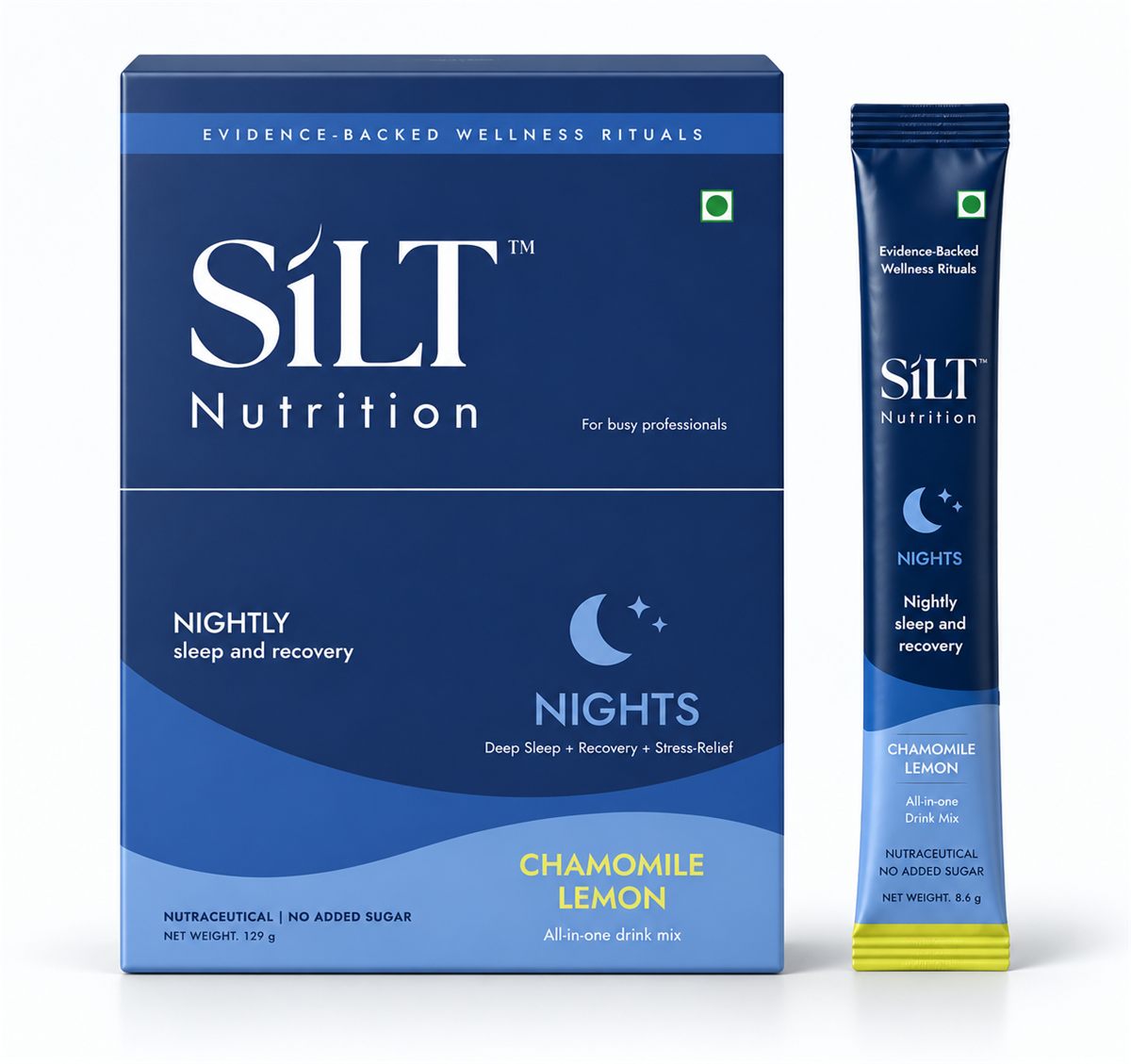
Each stick has 1.8 g magnesium bisglycinate (250 mg elemental magnesium, the form and dose of the 2025 trial above), 3 g glycine, 200 mg L-theanine and 300 mg KSM-66® ashwagandha root extract. Every dose is printed on the back of the pack. The box prints "no melatonin", "no maltodextrin" and "no added sugar", and the stick has no caffeine. You stir one stick into 200-250 ml of lukewarm or cold water (not boiling; the pack says heat degrades sensitive actives) 30-60 minutes before bed. For a nightly routine, the pack's direction is 1 stick a day, not to exceed the recommended usage level, and "for best results, use consistently for at least 3 months". It's a food supplement, not a medicine, and the pack says it isn't intended to treat, cure or prevent any disease: if you have a liver or thyroid condition, are pregnant or nursing, or take regular medicines, check with your doctor first. Since label accuracy matters (see above), here is what we can show: every ingredient comes with a supplier certificate of analysis (on our science page), including glycine at 99.4% purity, USP pharma grade (supplier certificate). That is a raw-material figure, not a finished-product test; a finished-product NABL lab report is pending, and we'll publish it when it's ready. SILT is FSSAI compliant (FSSAI Lic. No. 12826999000631), vegetarian and made in India.
MRP ₹1,125 ₹900 · 15 sticks or ₹1,500 for 30 (MRP ₹2,250)
That's ₹60 a stick, or ₹50 in the 30-stick pack.
Shop SILT NightsMelatonin questions
What is the new warning about melatonin?
It's an observational study abstract presented at the American Heart Association's Scientific Sessions in November 2025, not yet published in a peer-reviewed journal. Using health records from 130,828 adults with chronic insomnia, it found that people with a year or more of recorded melatonin use had a higher rate of heart failure over five years (4.6% vs 2.7%) (AHA, 2025). The authors say it can't prove cause and effect, and the findings are preliminary until published in a peer-reviewed journal. Treat it as a reason for caution about years of nightly use, not proof of harm.
Is melatonin better than sleeping pills?
They aren't interchangeable, and the choice of a prescription sleeping pill is your doctor's. Melatonin's effect on sleep is modest, about 7 minutes faster to fall asleep on average (Ferracioli-Oda et al., 2013), but taken as prescribed you're unlikely to become addicted to it (NHS). Don't combine the two without advice: melatonin can add to a sleeping pill's sedative effect (UK melatonin SmPC).
The bottom line
Melatonin is a reasonable short-term tool: low dose, right timing, for jet lag or a shifted body clock. As an every-night habit for months, it's a bet on data that doesn't exist yet. If you need help most nights, see a doctor about the cause, and if you want a nightly wind-down without the hormone, that's what we built SILT Nights for. Evidence, not hype.
MRP ₹1,125 ₹900 · 15 sticks or ₹1,500 for 30 (MRP ₹2,250)
- NCCIH. Melatonin: What You Need To Know (updated May 2024). nccih.nih.gov/health/melatonin-what-you-need-to-know
- Givler et al., 2023. Neurol Int. pmc.ncbi.nlm.nih.gov/articles/PMC10053496
- Melatonin 2 mg prolonged-release tablets (UK licensed product), Summary of Product Characteristics, emc (UK). medicines.org.uk/emc/product/2809/smpc
- NHS. How and when to take melatonin. nhs.uk/medicines/melatonin/how-and-when-to-take-melatonin
- Sateia et al., 2017. AASM chronic insomnia guideline, J Clin Sleep Med. pubmed.ncbi.nlm.nih.gov/27998379
- Andersen et al., 2016. Clin Drug Investig. pubmed.ncbi.nlm.nih.gov/26692007
- NHS. Common questions about melatonin. nhs.uk/medicines/melatonin/common-questions-about-melatonin
- Ferracioli-Oda et al., 2013. PLoS One. pubmed.ncbi.nlm.nih.gov/23691095
- American Heart Association newsroom, 3 November 2025 (Scientific Sessions 2025 abstract). newsroom.heart.org
- Herxheimer & Petrie, 2002. Cochrane Database Syst Rev. pubmed.ncbi.nlm.nih.gov/12076414
- Erland & Saxena, 2017. J Clin Sleep Med. pubmed.ncbi.nlm.nih.gov/27855744
- NHS. Who can and cannot take melatonin. nhs.uk/medicines/melatonin/who-can-and-cannot-take-melatonin
- Auger et al., 2015. AASM circadian rhythm sleep-wake disorders guideline, J Clin Sleep Med. pubmed.ncbi.nlm.nih.gov/26414986
- Schuster et al., 2025. Nat Sci Sleep. pubmed.ncbi.nlm.nih.gov/40918053
- Online pharmacy, sleep-support supplements category, opened 7 October 2026.