


Magnesium Glycinate Powder: 250 mg Elemental
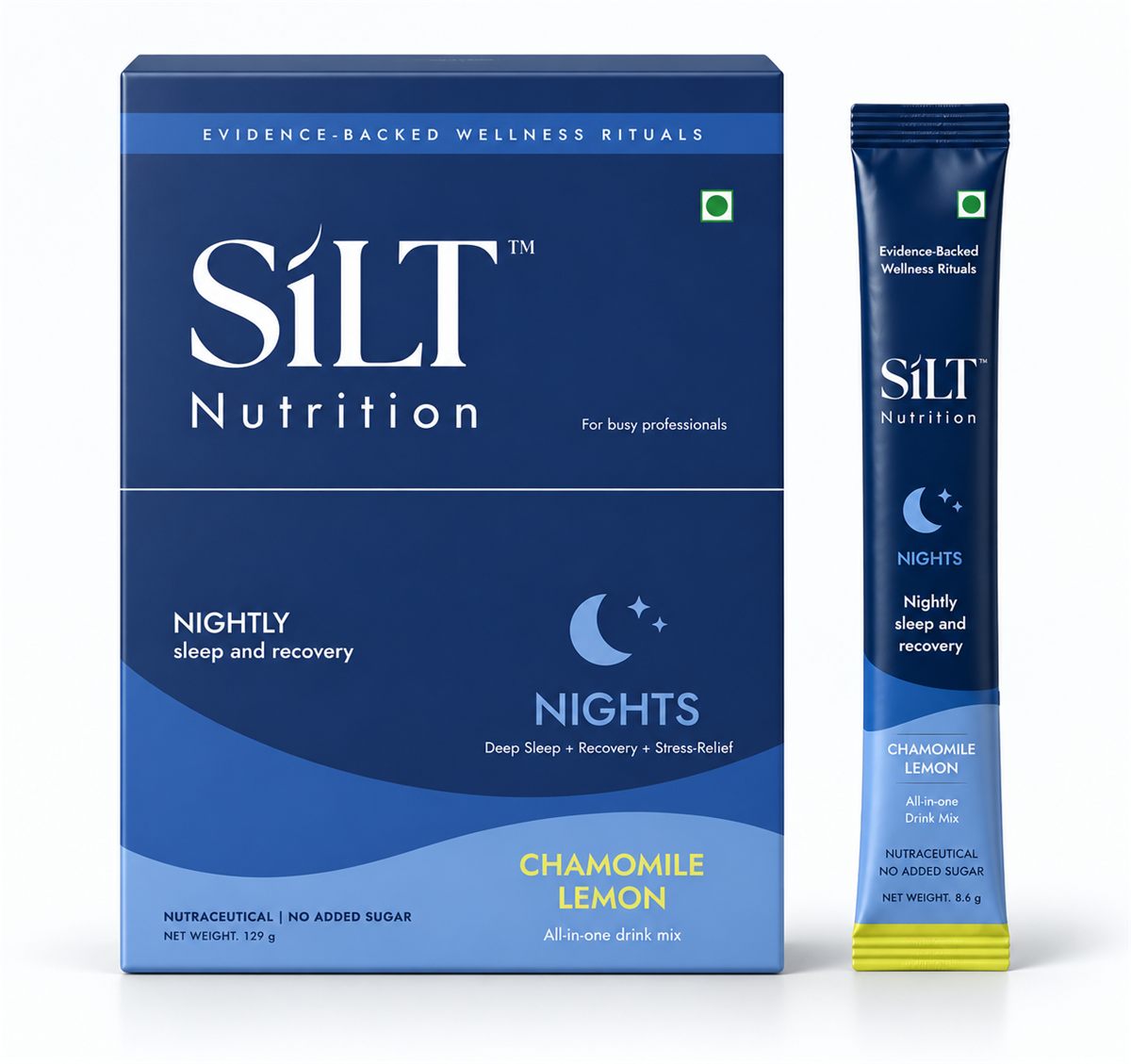
SILT™ Nights is a magnesium glycinate powder blend you stir into water before bed. Each 8.6 g stick has 1.8 g of magnesium bisglycinate, which is 250 mg of elemental magnesium. Every dose is printed on the pack.
One thing to say up front: SILT Nights is not a single-ingredient magnesium powder. It's a blend of four actives at printed doses:
- magnesium bisglycinate 1.8 g (250 mg elemental magnesium)
- glycine 3 g
- KSM-66 ashwagandha 300 mg
- L-theanine 200 mg
It has no melatonin, no caffeine, no maltodextrin and no added sugar. It's sweetened with stevia, and the Chamomile Lemon is flavour only. (If you're weighing the two approaches, here's magnesium vs melatonin for sleep.) If you want magnesium and nothing else, this isn't that product. If you want magnesium glycinate in a nightly ritual alongside three other studied ingredients, with every dose disclosed, read on.
MRP ₹1,125 ₹900 · 15 sticks or ₹1,500 for 30 (MRP ₹2,250)
That's ₹60 a stick in the 15-stick pack, or ₹50 a stick in the 30.
Shop SILT NightsSee the SILT Nights sleep drink
Every dose, next to the study
Every active in SILT Nights is listed below next to a dose used in the human research we cite.
| Ingredient | Per stick | Dose in the study we cite |
|---|---|---|
| Magnesium bisglycinate | 1.8 g = 250 mg elemental magnesium | 1,786 mg bisglycinate = 250 mg elemental, daily for 4 weeks (Schuster et al., 2025) |
| Glycine | 3 g | 3 g before bed (Bannai et al., 2012) |
| L-theanine | 200 mg | 200 mg/day for 4 weeks (Hidese et al., 2019) |
| Ashwagandha (KSM-66) | 300 mg (root extract; supplier CoA reads 5.30% withanolides) | 250 mg/day of ashwagandha root extract for 8 weeks in stressed adults (Salve et al., 2019) |
| Chamomile Lemon flavour, stevia | Flavour and sweetener only | Not dosed actives |
| Other ingredients on the pack | Black salt, iodised salt, cumin powder, citric and malic acid, silicon dioxide | Taste and processing. Not actives; no dose stated |
Many magnesium glycinate supplement listings in India print one big number. We print the compound weight, the elemental weight and the study dose next to each other, so you can check our work.
Every dose printed. Nothing hidden behind a blend.
Why magnesium bisglycinate
We use magnesium bisglycinate for two reasons. It's the form, at the dose, used in the most relevant recent sleep trial. And unlike magnesium oxide, it isn't the form that performed like a placebo in a head-to-head absorption study.
The trial is Schuster et al. (2025). It was a randomised, double-blind, placebo-controlled study of 155 adults aged 18-65 who reported poor sleep. They took 250 mg elemental magnesium as bisglycinate, or a placebo, daily for 4 weeks. Insomnia Severity Index scores fell by 3.9 points on magnesium and 2.3 on placebo (p = 0.049). That's an effect the authors called small (Cohen's d = 0.2). Other sleep, stress and fatigue scales showed no significant difference between groups. The result was modest, real and short-term, which is exactly how we'll describe it. There's more on the study in what the research says about magnesium glycinate for sleep.
On absorption, the honest picture is this. A 60-day randomised trial compared 300 mg elemental magnesium as an amino-acid chelate (the family bisglycinate belongs to), as citrate and as oxide (Walker et al., 2003):
- Both organic forms, the chelate and citrate, were absorbed better than oxide.
- Oxide showed no difference from placebo.
- Citrate gave the highest serum magnesium.
An earlier study found oxide "virtually insoluble in water", with citrate far more soluble (Lindberg et al., 1990).
So we won't claim bisglycinate is the best-absorbed form. Citrate holds up well too. We chose bisglycinate because it matches the sleep trial's form and dose, and because it carries glycine, which we wanted at bedtime anyway. For the wider evidence beyond sleep, read our summary of magnesium glycinate benefits.
250 mg elemental, explained
Elemental magnesium is the weight of the mineral itself. Compound weight is the mineral plus whatever it's bound to. In magnesium bisglycinate, glycine makes up most of the weight. So a big number on the front of a pack can mean much less actual magnesium.
The 14.1% rule
Magnesium glycinate (bisglycinate) is one magnesium atom bound to two glycine molecules, formula C4H8MgN2O4. Its molar mass is 172.42 g/mol (PubChem CID 84645). Magnesium's atomic mass is 24.305. Divide one by the other:
24.305 ÷ 172.42 = about 14.1% magnesium by weight
That's the ceiling for pure magnesium bisglycinate. SILT's pack prints it as "magnesium bisglycinate (13.8% elemental), 1.8 g = 250 mg magnesium" (SILT pack). Check it: 1,800 mg of bisglycinate gives 250 mg of magnesium, and 13.8% sits just under the ceiling. The 2025 trial used the same ratio: 1,786 mg of bisglycinate for 250 mg of magnesium (Schuster et al., 2025).
Worked example: three labels you might see
| What the front says | Maximum elemental magnesium if it's pure bisglycinate | What to check |
|---|---|---|
| "Magnesium Glycinate 2,000 mg" | 2,000 × 14.1% = 282 mg | Is 2,000 mg per tablet or per serving of two? |
| "Magnesium Glycinate 600 mg" | 600 × 14.1% = 85 mg | Under a third of SILT's 250 mg |
| "550 mg glycinate, 22% elemental (121 mg)" | 550 × 14.1% = 78 mg | 22% is above the 14.1% ceiling, so something else is in there |
That last row is the one to watch. If a "glycinate" product claims more than about 14% elemental magnesium, it must contain another magnesium compound as well. Usually that's a "buffer" such as magnesium hydroxide or oxide. That's legal, and some brands disclose it on their own labels. But it means part of your dose isn't glycinate. Ask the brand what the rest is. It's the same problem as a proprietary blend: you can't check what isn't listed. Our science page lists every ingredient and dose in SILT Nights.
How much compound gives you 250 mg of magnesium?
| Form | Magnesium by weight | Compound needed for 250 mg elemental |
|---|---|---|
| Magnesium oxide (MgO) | 60.3% (PubChem CID 14792) | ~415 mg |
| Magnesium citrate (anhydrous trimagnesium dicitrate) | 16.2% (PubChem CID 6099959) | ~1,550 mg |
| Magnesium bisglycinate | 14.1% (PubChem CID 84645) | ~1,770 mg |
This is why oxide tablets look small and glycinate doses look huge. Neither number tells you the dose until you convert it. We walk through more labels in how we'd compare the best magnesium supplements in India.
Read the elemental number, not the front of the pack.
What 250 mg means against Indian requirements
Indian RDA for magnesium (ICMR-NIN, 2020): 440 mg a day for adult men and 370 mg a day for adult women (ICMR-NIN, 2020). One stick's 250 mg covers about 57% of the men's figure (250 ÷ 440) and 68% of the women's (250 ÷ 370). Food supplies the rest. If you're wondering whether you're low, start with our guide to magnesium deficiency symptoms and talk to your doctor.
The US Institute of Medicine set the upper limit for magnesium from supplements at 350 mg a day for adults. Diarrhoea was the limiting effect, and the limit doesn't apply to magnesium in food (Advances in Nutrition, 2023). SILT Nights' 250 mg sits under that limit. Count it if you're already taking another magnesium product.
Magnesium drink vs tablets
The difference between a magnesium drink and tablets or capsules is mostly dose size and habit, not absorption. For the same form and dose, the elemental magnesium on the label matters more than whether it comes as a powder or a capsule.
What a powder does change is how much fits in one serving. Because bisglycinate is only about 14% magnesium, 250 mg elemental needs roughly 1.8 g of compound. That's a lot to fit into capsules, which is why many capsule products land well below 250 mg per piece.
| SILT Nights (powder drink) | Typical glycinate tablets | Typical glycinate capsules | |
|---|---|---|---|
| Elemental magnesium per serve | 250 mg, stated | Varies. Often only the compound weight is on the front | Varies. Check the elemental mg per capsule |
| Units per dose | 1 stick | Often 2 | Often 2 or more |
| Magnesium sources listed | Magnesium bisglycinate only | Check the label (some are buffered) | Check the label |
| Other actives | Glycine, KSM-66, L-theanine | Usually none | Usually none |
| Format | 200-250 ml lukewarm or cold water, 30-60 min before bed | Swallow | Swallow |
The "typical" columns describe what to check, not any one brand. Compare products by elemental magnesium per serving.
Four pillars. One ritual.
Magnesium alone showed a small effect in the 2025 trial. So we added three ingredients that have their own human research at night-time or for stress, each at a printed dose.
- Glycine, 3 g. Bisglycinate already carries some glycine, and we add 3 g more (supplier CoA: 99.4% pure, USP pharma grade). In a randomised study, 3 g of glycine at bedtime reduced daytime fatigue during sleep restriction (Bannai et al., 2012). The same paper reviews earlier work showing 3 g improved subjective sleep quality.
- L-theanine, 200 mg. In a 4-week randomised, placebo-controlled crossover trial of 30 healthy adults, Pittsburgh Sleep Quality Index scores fell after 200 mg a day of L-theanine (p = 0.013 versus baseline), and the sleep latency, sleep disturbance and sleep medication subscales improved compared with placebo (Hidese et al., 2019).
- KSM-66 ashwagandha, 300 mg. KSM-66 is an ashwagandha root extract, standardised to at least 5% withanolides per our supplier's certificate of analysis; the current batch certificate reads 5.30% from roots only. Ashwagandha root extract has been studied in human trials for stress and sleep, at doses including 250 mg/day. In an 8-week double-blind trial of 60 stressed but otherwise healthy adults, perceived-stress scores and serum cortisol fell significantly at 250 mg/day, and participants taking ashwagandha reported better sleep quality than those on placebo (Salve et al., 2019). Root extract has also been studied in adults with insomnia (Langade et al., 2019) and in adults with chronic stress (Chandrasekhar et al., 2012). We don't claim a stick of SILT Nights reproduces any single trial's results.
Chamomile Lemon is the flavour and stevia is the sweetener. We don't claim any effect from either. None of these ingredients is a treatment for insomnia or anxiety. If sleep problems are persistent, see a doctor. The full formula, with each ingredient explained, is on the SILT Nights magnesium sleep drink page.
When to take magnesium glycinate
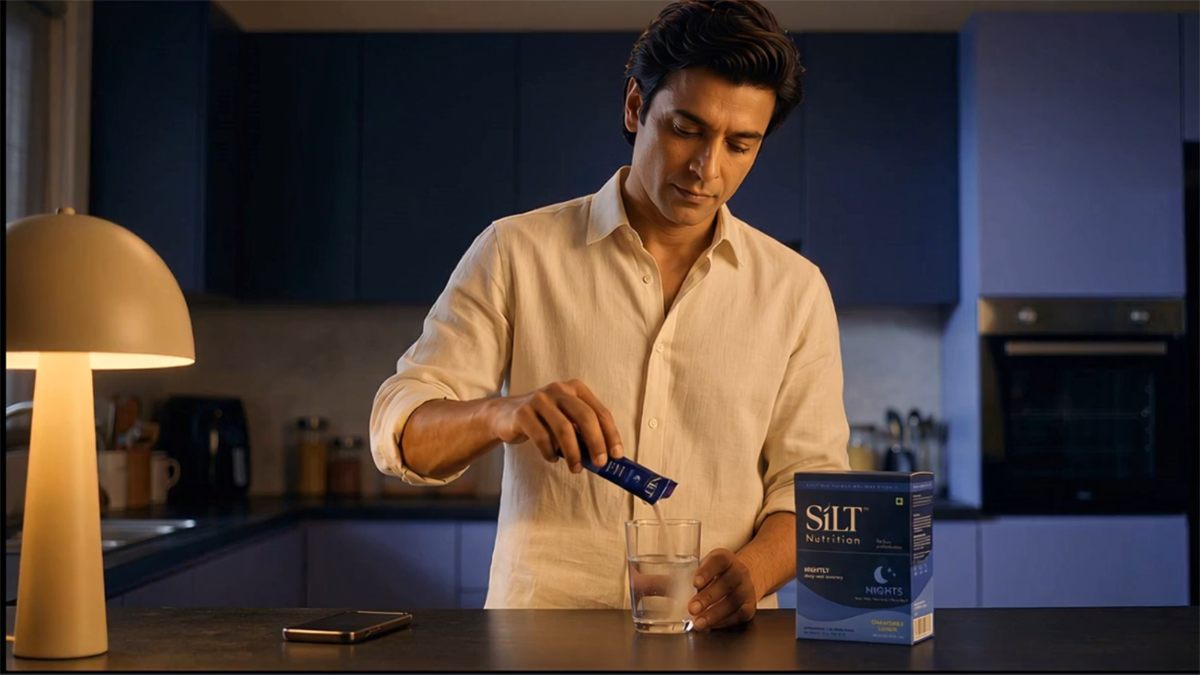
Stir one stick of SILT Nights into 200-250 ml of lukewarm or cold water (not boiling) and drink it 30-60 minutes before bed. That's the timing we recommend, and it fits glycine, which was studied as a bedtime dose (Bannai et al., 2012).
Magnesium itself doesn't have a proven best hour. In the 2025 trial, participants took their capsules 30-60 minutes before bedtime, the same window (Schuster et al., 2025). Consistency matters more than the clock: the trial's measured change came after 4 weeks. The pack's own direction is one stick a day, not to exceed the recommended usage level, no boiling water because heat degrades sensitive actives, and "For best results, use consistently for at least 3 months" (SILT pack), which is about consistency, not a promised result. If you take medicines that interact with magnesium, the timing of those matters more (see below). There's more detail in when to take magnesium glycinate.
Check with a doctor first
If you have a liver or thyroid condition, are pregnant, or take regular medicines, check with your doctor first. That's the standing caution on SILT Nights. The pack adds that it is not a substitute for a varied diet, and that if you're pregnant or nursing, taking any medications or have any medical conditions, you should contact your healthcare practitioner. Because it contains magnesium, also talk to your doctor if any of these apply:
- Breastfeeding.
- Kidney disease. OTC magnesium labels carry an "ask a doctor if you have kidney disease" warning (US OTC magnesium oxide label).
- Thyroid medicine (levothyroxine). Its label lists magnesium-containing antacids among products that can reduce its absorption (levothyroxine label). Ask your doctor or pharmacist how far apart to take them.
- Quinolone antibiotics (e.g. ciprofloxacin). The ciprofloxacin label says to take it at least 2 hours before or 6 hours after magnesium-containing products (ciprofloxacin label).
- Tetracycline antibiotics (e.g. doxycycline). Magnesium reduces their absorption (doxycycline label). Ask your pharmacist how far apart to take them.
- Bisphosphonates for bone (e.g. alendronate). Minerals like magnesium interfere with their absorption, so follow the spacing on your prescription (alendronate label).
- Other magnesium supplements, or magnesium antacids or laxatives. Add them up against the 350 mg supplemental limit.
The most common complaint with magnesium is loose stools, especially at higher doses. In the 2025 trial, 93% of all participants (both groups together) reported no adverse events. Read more on magnesium glycinate side effects.
Lab testing, ingredient by ingredient
Every ingredient in SILT Nights comes with a supplier certificate of analysis (CoA). Three figures from those certificates: the KSM-66 CoA reads 5.30% withanolides from roots only (batch made in 2025, expiry December 2027), the glycine CoA reads 99.4% purity to a USP pharma-grade standard, and the L-theanine CoA reads an assay of 100.0%. A finished-product report from an NABL-accredited lab is pending, and we'll publish it when it's ready. SILT is FSSAI compliant (FSSAI Lic. No. 12826999000631), vegetarian and made in India; SILT Nights is made by I Dreamz Health Care in Harohalli, Karnataka (FSSAI Lic. No. 11216325000322). The box prints "no added sugar, no maltodextrin, no melatonin", and there are zero proprietary blends.
The full ingredient list, as printed. L-Glycine, Magnesium Bisglycinate, Natural flavouring substances (Chamomile Lemon), Acidity Regulators [Citric Acid (INS 330), Malic Acid (INS 296)], KSM-66 Ashwagandha® (Root Extract), Cumin powder, L-Theanine, Black salt, Anti-caking agent [Silicon dioxide, (INS 551)], Iodized Salt, Steviol glycosides (Natural sweetener, INS 960). Cumin powder, black salt and iodised salt are taste ingredients with no dose stated, not actives (SILT pack).
The nutrition panel. The pack prints this panel per 8.6 g stick.
| Nutrient | Per stick | %RDA |
|---|---|---|
| Energy | 33.10 kcal | 1.66% |
| Protein | 5.00 g | 9.26% |
| Carbohydrate | 1.75 g | Not established |
| Total sugars | 0.63 g | Not established |
| Added sugars | 0 g | 0% |
| Dietary fibre (AI) | 0.65 g | 2.2% |
| Total fat | 0.66 g | 1.0% |
| Saturated fat | 0.47 g | 2.14% |
| Trans fat | <0.1 g | 0% |
| Cholesterol (NMT) | <1.0 mg | Not established |
| Sodium | 88.75 mg | 4.44% |
| Calcium | 6.48 mg | 0.65% |
%RDA basis printed on the pack: ICMR 2020 (men); FSS (Labelling and Display) Regulations 2020. AI = adequate intake; NMT = not more than.
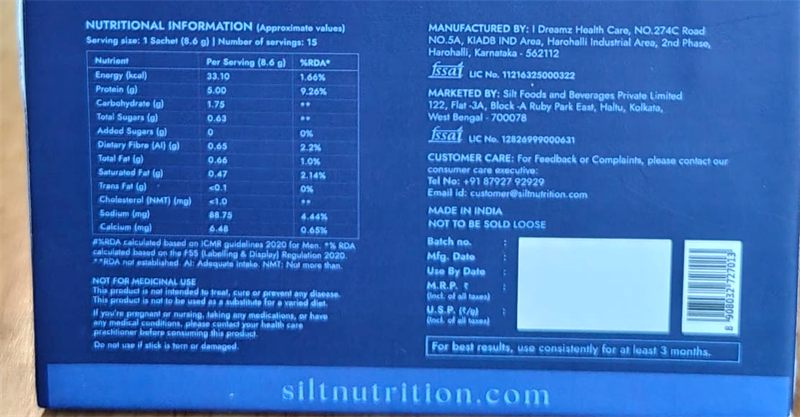
The 0.63 g of total sugars is why we say "no added sugar" and show the total.
A label is only as good as the testing behind it. That's why we publish doses to the milligram rather than hiding them behind a "blend" total. You can see every supplier certificate on our science page.
What it costs per stick
SILT Nights costs ₹60 a stick in the 15-stick pack and ₹50 a stick in the 30-stick pack. Each stick gives you 250 mg elemental magnesium as bisglycinate, plus 3 g glycine, 200 mg L-theanine and 300 mg KSM-66.
| Price (MRP) | Per stick (= per 250 mg elemental magnesium) | |
|---|---|---|
| 15 sticks | ₹900 (₹1,125) | ₹60 |
| 30 sticks | ₹1,500 (₹2,250) | ₹50 |
When you compare magnesium glycinate in India, work out the cost per 250 mg of elemental magnesium, not per gram of powder or per tablet. A cheaper jar can carry far less magnesium per rupee once you do the 14.1% maths.
To be fair to everyone else: SILT Nights is a four-ingredient blend, so it isn't a like-for-like comparison with plain magnesium. Part of each stick's price pays for the glycine, L-theanine and KSM-66. If magnesium is all you want, compare plain products on their elemental cost alone. If you'd otherwise buy the four separately, compare the total.
Magnesium glycinate, answered
Is magnesium glycinate the same as magnesium bisglycinate?
In practice, yes. "Magnesium glycinate" on supplement labels usually means magnesium bound to two glycine molecules, which is bisglycinate (PubChem lists magnesium glycinate as C4H8MgN2O4). Either way, check the elemental magnesium figure, because that's your actual dose.
Is it good to take magnesium glycinate every day?
For most healthy adults, a daily dose within the 350 mg supplemental limit was well tolerated in trials: in a 4-week trial of 250 mg a day against placebo, 93% of all participants (both groups together) reported no adverse events (Schuster et al., 2025). Whether it's useful for you depends on your diet against the ICMR-NIN requirement of 370-440 mg a day from all sources. If you take thyroid medicine, antibiotics or bone medicines, or have kidney disease, ask your doctor first.
What are the signs of low magnesium?
We don't diagnose from a symptom checklist on a product page. If you think you're low, ask your doctor, who can test for it and look at your diet against the ICMR-NIN RDA. Our guide to signs of magnesium deficiency covers the symptoms in detail.
Shop SILT Nights
SILT Nights: 250 mg elemental magnesium as bisglycinate, 3 g glycine, 200 mg L-theanine, 300 mg KSM-66. Every dose printed. Zero melatonin.
MRP ₹1,125 ₹900 · 15 sticks or ₹1,500 for 30 (MRP ₹2,250)
₹60 a stick in the 15, ₹50 a stick in the 30.
Shop SILT Nights- Schuster et al. (2025). Magnesium bisglycinate supplementation in adults with poor sleep: randomised, double-blind, placebo-controlled trial. PMC12412596
- Bannai et al. (2012). Glycine and daytime fatigue during sleep restriction. PubMed 22529837
- Hidese et al. (2019). L-theanine and sleep quality in healthy adults. PubMed 31623400
- Salve et al. (2019). Ashwagandha root extract in stressed healthy adults. PubMed 32021735
- Langade et al. (2019). Ashwagandha root extract in insomnia. PubMed 31728244
- Chandrasekhar et al. (2012). Ashwagandha root extract in adults with chronic stress. PubMed 23439798
- Walker et al. (2003). Bioavailability of magnesium chelate, citrate and oxide. PubMed 14596323
- Lindberg et al. (1990). Solubility of magnesium oxide and citrate. PubMed 2407766
- PubChem. Magnesium glycinate, CID 84645. pubchem.ncbi.nlm.nih.gov/compound/84645
- PubChem. Magnesium oxide, CID 14792. pubchem.ncbi.nlm.nih.gov/compound/14792
- PubChem. Trimagnesium dicitrate, CID 6099959. pubchem.ncbi.nlm.nih.gov/compound/6099959
- ICMR-NIN (2020). Nutrient Requirements for Indians: brief note (RDA tables 3 and 4). nin.res.in/rdabook/brief_note.pdf
- Advances in Nutrition (2023). Tolerable upper intake level for supplemental magnesium. PMC10509448
- US FDA (openFDA). OTC magnesium oxide label, kidney warning. api.fda.gov
- US FDA (openFDA). Levothyroxine label, drug interactions. api.fda.gov
- US FDA (openFDA). Ciprofloxacin label, dosage and administration. api.fda.gov
- US FDA (openFDA). Doxycycline label, drug interactions. api.fda.gov
- US FDA (openFDA). Alendronate label, drug interactions. api.fda.gov