


Feeling sleepy after lunch is normal, and it's only partly about lunch. Your body clock has a built-in dip in the early afternoon; a big meal and a short night make it deeper. What helps: a smaller plate, a 10-minute walk, a 10-minute nap if you can take one, and caffeine timed so it doesn't cost you tonight's sleep. Every tip below links to its evidence. Disclosure: we make SILT™ Mornings, a morning drink mix with caffeine and L-theanine (more in our L-theanine supplement guide), and we keep it to one short section near the end.
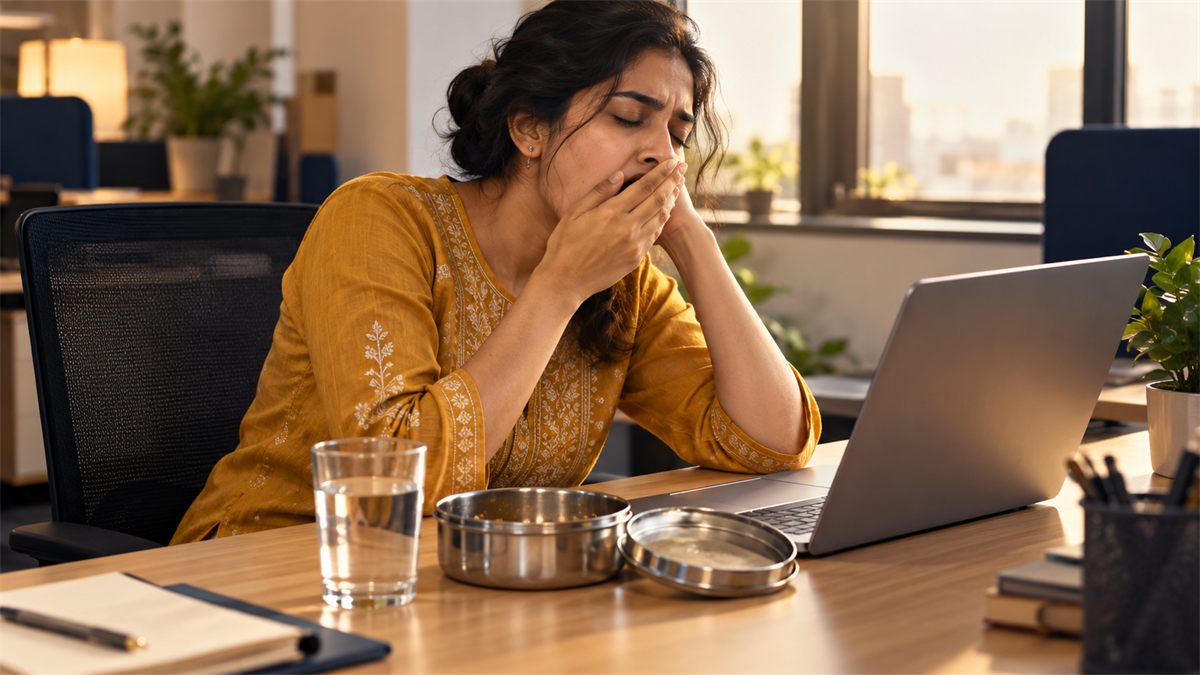
Beat the afternoon slump: the short list
You can't delete the afternoon slump, but you can make it shallower. In order of effort:
- Eat a smaller lunch. In a driving-simulator trial, a heavy lunch made sleepiness worse than a light one (Reyner et al., 2012).
- Walk for 10 minutes soon after eating. Walking soon after a meal blunts the blood-sugar rise more than walking before it or not at all (Engeroff et al., 2023).
- If you can nap, keep it to about 10 minutes and set an alarm (Brooks & Lack, 2006).
- Have your caffeine after lunch, not at 5 pm. Stop at least six hours before bed (Drake et al., 2013; NHS, Insomnia).
- Fix the night before. Short sleep makes the dip deeper (Reyner et al., 2012).
Why you get sleepy after lunch
Mostly because of the time of day, not the food. The post-lunch dip is a real dip in performance in the mid-afternoon, seen on some tasks and in some people, and linked to a rise in sleepiness at that hour, and it can happen even when people have eaten no lunch and don't know what time it is (Monk, 2005). Sleep researchers describe it as a body-clock rhythm "largely unrelated to lunch" and made worse by a poor night's sleep (Reyner et al., 2012).
A model of sleep propensity across 24 hours shows the same shape: a big peak at night and a smaller, secondary rise that peaks after noon. In the model, the size of this afternoon "nap zone" shifts with when you sleep at night (Bes et al., 2009).
Food does add something. In a study of 19 adults, eating a meal shortened the time it took to fall asleep about an hour later, compared with chewing the same meal and spitting it out, which points to an effect from the gut itself (Harnish et al., 1998).
So there are two layers: a dip you'll get anyway, and a meal and a short night that can deepen it.
What's on your plate
Size matters more than the carbs-versus-fat debate. Here's what the trials show, and where they disagree.
- A solid meal vs water. In 10 healthy men, a solid meal made them fall asleep faster in early-evening nap tests than the same volume of water. A liquid meal didn't, and high-fat, high-carbohydrate and mixed meals made no difference to each other (Orr et al., 1997).
- Fat vs carbohydrate. In 18 volunteers, a high-fat, low-carbohydrate meal left people more fatigued three hours later than a low-fat, high-carbohydrate one (Wells et al., 1997). A review, on the other hand, says the dip is worsened by a high-carbohydrate lunch (Monk, 2005). The honest summary: mixed.
- Big vs small. Twelve young men slept 5 hours, then ate either a 305-calorie or a 922-calorie lunch before a two-hour monotonous simulated drive. After the first 30 minutes, the heavy lunch led to more sleepiness-related lane drifting and more sleepiness on EEG (Reyner et al., 2012).
A 2025 scoping review of workplace studies found only nine that qualified. It concluded that diet affects sleepiness, but that the link with blood-sugar swings is still unclear (Kaneda et al., 2025).
The Indian lunch
A typical office lunch here is a mound of rice or a stack of rotis with a little dal and sabzi. In the national ICMR-INDIAB survey of 18,090 adults, Indian diets were high in low-quality carbohydrates (white rice, milled grains and added sugar) and low in protein (Anjana et al., 2025). Commercial white rice tested as high-GI, at 79, in a Chennai glycaemic-index trial (Mohan et al., 2016).
None of this proves that rice is what makes you drowsy. But since meal size is the most consistent finding, the practical move is to make rice a portion, not the plate: one fist of rice or two rotis, then fill up on dal, sabzi, salad and a bowl of curd. You eat a smaller load of fast carbohydrate, and you still leave full.
Sleep debt makes it worse
A short night is the easiest way to turn a small dip into a desk-side struggle. In a lab study of 48 healthy adults, limiting sleep to 6 hours or less a night for two weeks caused thinking and reaction deficits equal to up to two nights without any sleep, and people largely failed to notice how impaired they were (Van Dongen et al., 2003). The heavy-lunch driving study above deliberately used 5-hour nights, because that is when afternoon sleepiness bites (Reyner et al., 2012).
If you're sleepy every afternoon, look at your nights first. Our guide to how to sleep fast ranks the habits that help by evidence. If you're tired all day, not just after lunch, read why am I always tired?
The dip is built in. How deep it goes is up to you.
Walk it off, briefly
A short walk after lunch is the cheapest fix with decent evidence behind it. A meta-analysis of 8 randomised crossover trials (116 people, some with type 2 diabetes) found that exercise after a meal, mostly walking, reduced the blood-sugar rise compared with sitting, and the sooner after eating the better (Engeroff et al., 2023). That review measured glucose, not sleepiness, so treat it as a sensible bonus.
Energy has been measured directly in another way. In a trial of 30 sedentary adults, six hourly 5-minute walks during a 6-hour sitting day raised self-rated energy and vigour, and lowered fatigue by the end of the day, compared with sitting throughout (Bergouignan et al., 2016).
Take the stairs to the canteen, walk one lap of the building after eating, or take your next call standing up.
What about bright light?
The evidence is mixed. In 20 volunteers, blue-enriched or red-enriched office light changed EEG signs of alertness during the post-lunch dip, but not their performance or how sleepy they felt (Askaripoor et al., 2019). In 17 students who usually napped, bright light eased sleepiness on days they skipped the nap (Zhou et al., 2021). If your walk takes you outdoors into daylight, that won't hurt.
Caffeine: get the timing right
Caffeine does work on the afternoon slump; the risk is what it does to tonight. NHS figures: about 75 mg in a cup of tea (black or green), 100 mg in a cup of instant coffee, and more in filter or coffee-shop coffee (NHS, Foods to avoid in pregnancy).
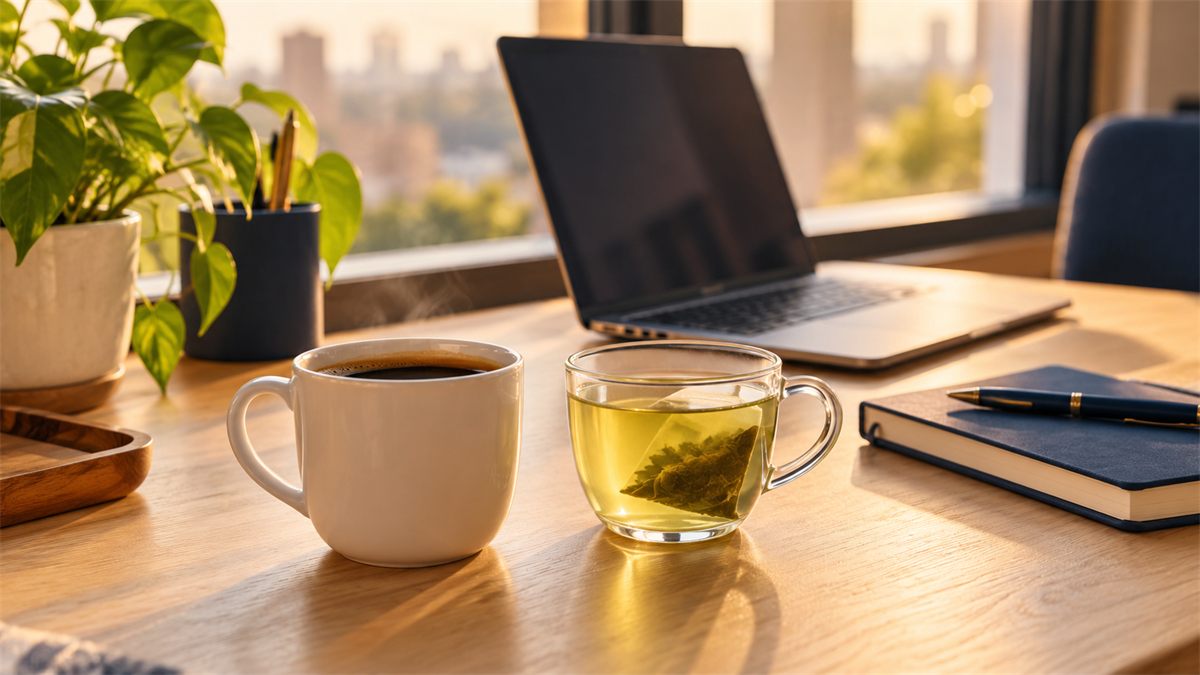
In a placebo-controlled study, 400 mg of caffeine disrupted sleep whether it was taken at bedtime, 3 hours before or 6 hours before; the authors recommend avoiding substantial caffeine for at least six hours before bed (Drake et al., 2013). The NHS gives the same six-hour rule for tea and coffee (NHS, Insomnia). EFSA, the European food safety agency, says up to 400 mg a day and single doses up to 200 mg raise no safety concerns for healthy adults, but that even 100 mg close to bedtime may affect sleep in some people (EFSA, Caffeine).
The practical rule: bed at 11 pm means your last chai by 5 pm. If the slump hits at 3, a cup straight after lunch is better than one at 4:30. If you drink caffeine all day and still crash, read caffeine crash; if you want to cut back, see coffee alternatives.
The coffee nap
In a small study of 10 young adults, taking 200 mg of caffeine and then a 20-minute nap at 12:40 pm worked better against afternoon sleepiness than the nap alone, with the effect lasting through the hour of testing. Bright light or washing the face straight after the nap also helped, less strongly (Hayashi et al., 2003). Caffeine takes a while to act, so you drink it just before lying down. That's about two cups of instant coffee by NHS figures, so it counts towards your daily total.
Should you nap at work?
If you can, a short one helps; a long one backfires. In a trial of 24 young adults who had slept about 5 hours, a 10-minute afternoon nap brought immediate gains in alertness, fatigue and performance, some lasting up to 155 minutes. A 5-minute nap did little, the benefit of a 20-minute nap took about 35 minutes to appear, and a 30-minute nap caused a spell of grogginess (sleep inertia) before the benefits arrived (Brooks & Lack, 2006).
Keep it short for another reason. A meta-analysis of 20 cohort studies (313,651 people) linked long daytime naps with higher rates of heart disease and death, with heart-disease risk rising sharply beyond about 25 minutes of napping a day (Pan et al., 2020). That's an association, not proof that naps cause harm; long naps may be a sign of poor health or poor sleep.
One exception: if you struggle to sleep at night, skip daytime naps altogether, as the NHS advises for insomnia (NHS, Insomnia).
When it's more than a slump
A mild dip that a walk or a short nap fixes is normal. See a doctor if you always feel very tired during the day, or if someone has noticed your breathing stop and start at night, or you gasp, snort or choke in your sleep. Along with loud snoring, these are signs of sleep apnoea. The NHS says that if sleep apnoea with excessive sleepiness is confirmed, you must not drive until the tiredness is under control (NHS, Sleep apnoea).
Never push through an afternoon drive when you're fighting to stay awake: in the simulator study, lane drifting rose as the drive went on (Reyner et al., 2012). For tiredness that lasts all day, read why am I always tired?
Morning caffeine, well before the cut-off
SILT Mornings fits the morning end of this guide, not the afternoon. It won't cancel the post-lunch dip, a heavy lunch or a short night. What it does is put your caffeine early: one stick in 200-250 ml of room-temperature or cold water (not boiling), any time in the morning, once a day (the pack says 1 stick per day, and no boiling water because heat degrades sensitive actives).
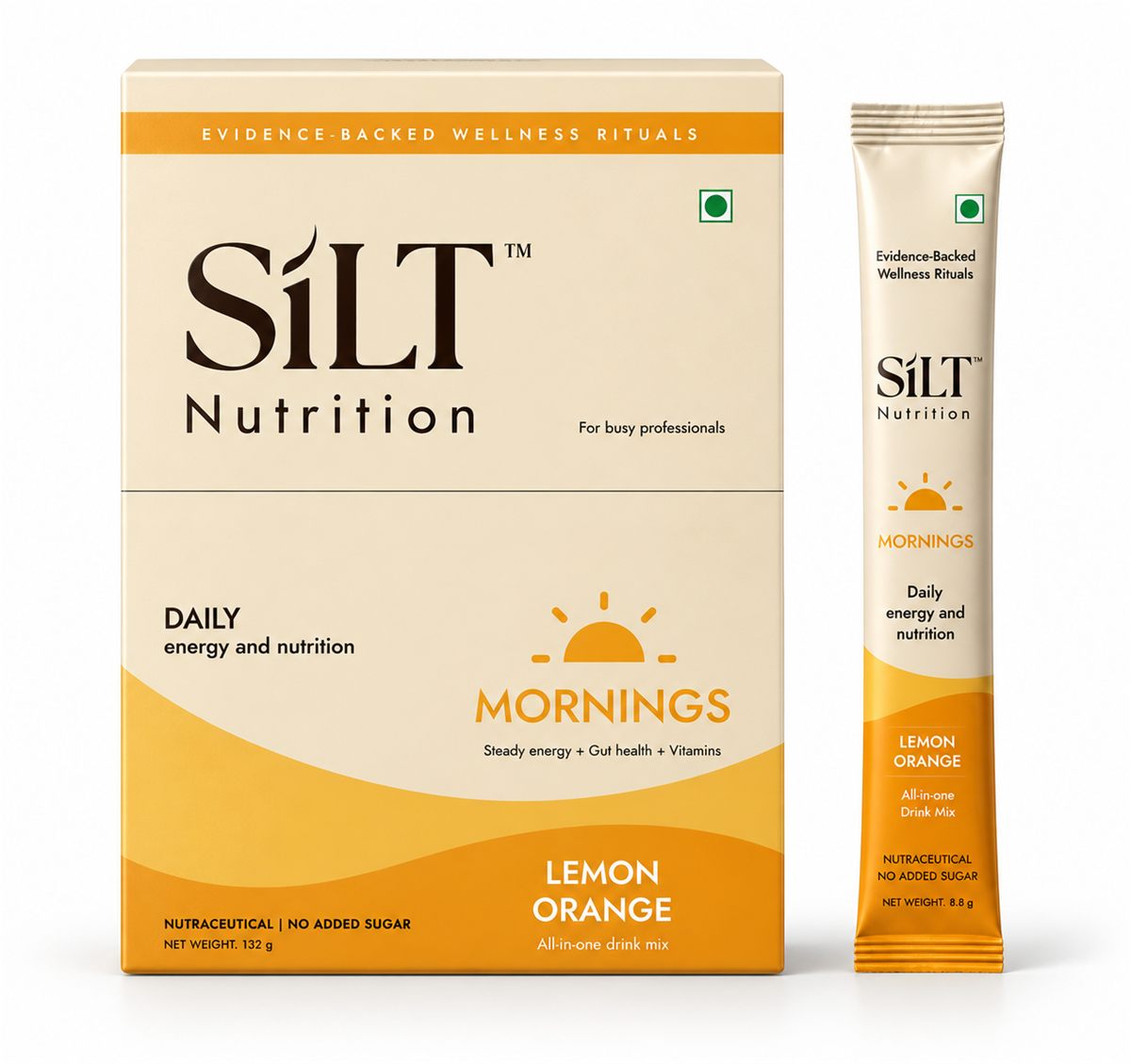
Each 8.8 g stick has 80 mg caffeine with 200 mg L-theanine, 1.4 g taurine, 5 g Sunfiber® PHGG (prebiotic fibre), 6 billion CFU from three spore-forming Bacillus species (B. subtilis, B. coagulans and B. clausii), 550 mg of digestive herb extracts (saunf, jeera, ajwain, amla), and vitamins D3, K2 (menaquinone), C and B12 at 100% RDA each. Lemon Orange and stevia-sweetened; the pack says no added sugar, no maltodextrin and no gluten. Why caffeine and L-theanine together? See our L-theanine supplement guide.
For scale against the NHS figures above, one stick's 80 mg is about a cup of tea (75 mg) and a little under a cup of instant coffee (100 mg). The pack's two caffeine-related lines are "Supports energy and alertness" (caffeine with taurine) and "Supports calm focus" (L-theanine). Take it by 9 am and an 11 pm bed is 14 hours away, far outside the six-hour cut-off; the post-lunch dip, though, is still yours to manage with the plate, the walk and the nap.
Supplier certificates of analysis are on our science page; the vitamin-blend certificate and a finished-product NABL lab report are pending, and we'll publish them when they're ready. If you take regular medicines, especially for thyroid, blood pressure, blood sugar or sleep, ask your doctor first. If you take a blood thinner such as warfarin, ask your doctor before using SILT Mornings, because it contains vitamin K2 (55 mcg). If you have a liver or thyroid condition, are pregnant, or take regular medicines, check with your doctor first. The pack adds that if you're pregnant or nursing, taking any medications, sensitive to caffeine or have any medical conditions, you should contact your healthcare practitioner before use.
MRP ₹1,125 ₹900 · 15 sticks or ₹1,500 for 30 (MRP ₹2,250)
That's ₹60 a stick, or ₹50 in the 30-stick pack.
Shop SILT MorningsA dip you can manage
Feeling sleepy after lunch is mostly your body clock, deepened by a big plate and a short night. Eat a smaller lunch, walk for 10 minutes, nap for 10 if you can, have caffeine early and stop six hours before bed. If you're tired all day or your breathing is disturbed at night, see a doctor. If you'd like your caffeine in the morning with L-theanine, that's what SILT Mornings is for; the science is on our L-theanine supplement page. Evidence, not hype.
- Monk, 2005. The post-lunch dip in performance. Clin Sports Med. pubmed.ncbi.nlm.nih.gov/15892914
- Reyner et al., 2012. 'Post-lunch' sleepiness during prolonged, monotonous driving: effects of meal size. Physiol Behav. pubmed.ncbi.nlm.nih.gov/22155490
- Bes et al., 2009. Modeling napping, post-lunch dip, and other variations in human sleep propensity. Sleep. pubmed.ncbi.nlm.nih.gov/19294959
- Harnish et al., 1998. A comparison of feeding to cephalic stimulation on postprandial sleepiness. Physiol Behav. pubmed.ncbi.nlm.nih.gov/9661987
- Orr et al., 1997. Meal composition and its effect on postprandial sleepiness. Physiol Behav. pubmed.ncbi.nlm.nih.gov/9284488
- Wells et al., 1997. Influences of fat and carbohydrate on postprandial sleepiness, mood, and hormones. Physiol Behav. pubmed.ncbi.nlm.nih.gov/9145937
- Kaneda et al., 2025. The influence of food intake and blood glucose on postprandial sleepiness and work productivity: a scoping review. Nutrients. pubmed.ncbi.nlm.nih.gov/41156470
- Anjana et al., 2025. Dietary profiles and associated metabolic risk factors in India from the ICMR-INDIAB survey-21. Nat Med. pubmed.ncbi.nlm.nih.gov/41028544
- Mohan et al., 2016. Glycemic index of a novel high-fiber white rice variety developed in India: a randomized control trial study. Diabetes Technol Ther. pubmed.ncbi.nlm.nih.gov/26741823
- Van Dongen et al., 2003. The cumulative cost of additional wakefulness. Sleep. pubmed.ncbi.nlm.nih.gov/12683469
- Engeroff et al., 2023. After dinner rest a while, after supper walk a mile? Systematic review with meta-analysis. Sports Med. pubmed.ncbi.nlm.nih.gov/36715875
- Bergouignan et al., 2016. Effect of frequent interruptions of prolonged sitting on self-perceived levels of energy, mood, food cravings and cognitive function. Int J Behav Nutr Phys Act. pubmed.ncbi.nlm.nih.gov/27809874
- Askaripoor et al., 2019. Effects of light intervention on alertness and mental performance during the post-lunch dip. Ind Health. pubmed.ncbi.nlm.nih.gov/30369519
- Zhou et al., 2021. Does bright light counteract the post-lunch dip in subjective states and cognitive performance among undergraduate students? Front Public Health. pubmed.ncbi.nlm.nih.gov/34164367
- NHS. Foods to avoid in pregnancy (caffeine content of drinks). nhs.uk/pregnancy/keeping-well/foods-to-avoid
- Drake et al., 2013. Caffeine effects on sleep taken 0, 3, or 6 hours before going to bed. J Clin Sleep Med. pubmed.ncbi.nlm.nih.gov/24235903
- NHS. Insomnia. nhs.uk/conditions/insomnia
- EFSA. Caffeine. efsa.europa.eu/en/topics/topic/caffeine
- Hayashi et al., 2003. The alerting effects of caffeine, bright light and face washing after a short daytime nap. Clin Neurophysiol. pubmed.ncbi.nlm.nih.gov/14652086
- Brooks & Lack, 2006. A brief afternoon nap following nocturnal sleep restriction: which nap duration is most recuperative? Sleep. pubmed.ncbi.nlm.nih.gov/16796222
- Pan et al., 2020. Association of napping and all-cause mortality and incident cardiovascular diseases: a dose-response meta-analysis of cohort studies. Sleep Med. pubmed.ncbi.nlm.nih.gov/32858276
- NHS. Sleep apnoea. nhs.uk/conditions/sleep-apnoea