


An afternoon energy crash at work is rarely one thing. It's a built-in dip in alertness after midday, plus whatever you have stacked on top: a short or late night, hours of sitting, too little water, caffeine at the wrong time, a big lunch. Most of it can be changed at your desk. Below: the evidence for each cause, a 2 pm plan and when to see a doctor. Disclosure: we make a morning drink mix with caffeine and L-theanine (see our L-theanine supplement guide), and we keep it to one short section near the end.
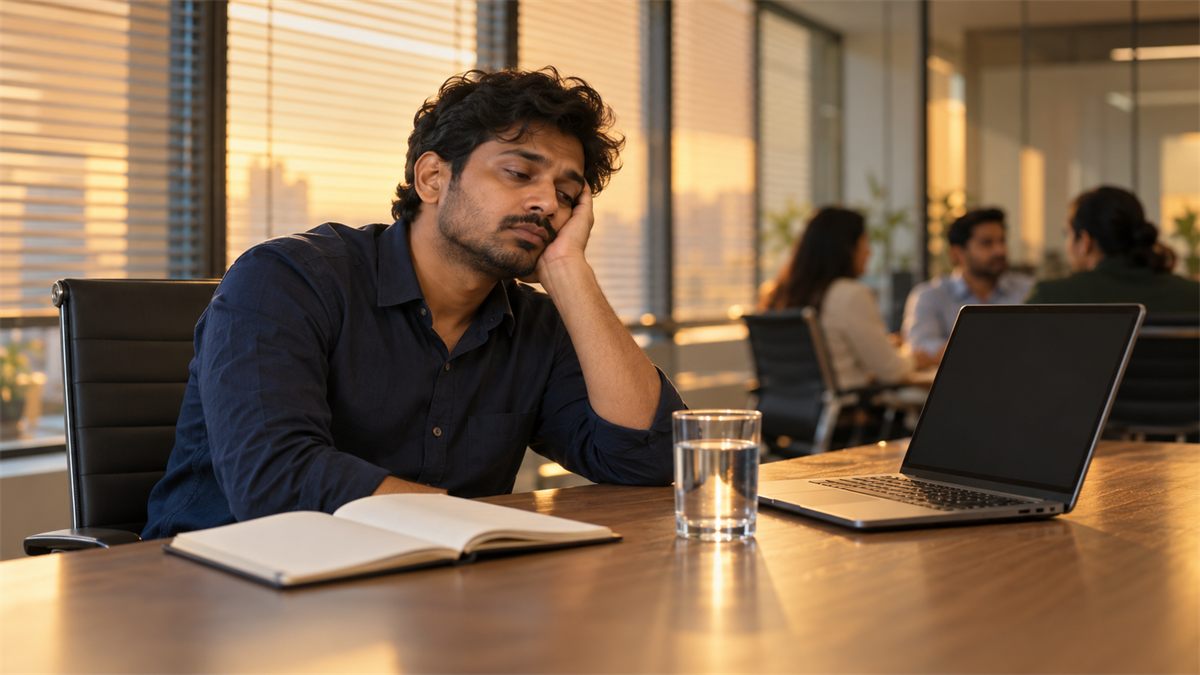
Eight causes, one list
The 2 pm crash is a dip you will always get, deepened by how you slept, sat, drank, ate and caffeinated. In the order we cover them:
- Your body clock. Alertness dips after midday even if you skip lunch (Monk, 2005).
- Sleep debt and late screens. Six hours a night or less adds up without you noticing (Van Dongen et al., 2003).
- Long sitting and back-to-back meetings. Short walking breaks lifted energy and cut fatigue in trials (Bergouignan et al., 2016).
- Mild dehydration. Fatigue rose at about 1.6% body-mass loss (Ganio et al., 2011).
- Caffeine timing. 400 mg of caffeine six hours before bed still cut sleep (Drake et al., 2013).
- Skipped breakfast and heavy lunches. A 922-calorie lunch worsened sleepiness against a 305-calorie one (Reyner et al., 2012).
- A dim desk. Windowless workers reported lower vitality (Boubekri et al., 2014).
- Stress. Chronic work stress that isn't managed can show up as exhaustion (WHO).
The dip is built in
Your alertness falls in the early afternoon for biological reasons, not only because of lunch. A review describes the post-lunch dip as real, linked to a rise in sleep propensity at that time of day, and able to occur when a person has had no lunch and doesn't know the time (Monk, 2005). Sleep researchers call it a twice-daily rhythm "largely unrelated to lunch" that a disturbed night makes worse (Reyner et al., 2012).
A model of sleep propensity over 24 hours shows the same shape: a big peak at night and a smaller rise after noon. In the model, how big that afternoon rise is depends on when you sleep at night (Bes et al., 2009). That is a simulation, not a measurement of office workers, but it matches what most people feel.
So you can't delete the dip. Everything below is about how deep it gets. If your slump arrives right after you eat, our guide to feeling sleepy after lunch covers the food side in detail.
Sleep debt and late screens
A short night is the quickest way to turn a normal dip into a crash. In a lab study of 48 healthy adults aged 21 to 38, sleeping 6 hours or less a night for 14 nights produced thinking and attention deficits equal to up to two nights without any sleep. Their own sleepiness ratings rose early and then barely moved, so the deficit grew without feeling worse (Van Dongen et al., 2003).
Late screens can cost you the next day. In a 14-day inpatient crossover trial of 12 young adults, reading on a light-emitting tablet for about four hours before bed on five evenings, instead of a printed book in the same dim light, meant taking about 10 minutes longer to fall asleep (25.7 against 15.8 minutes), a later body clock and lower alertness the next morning. Four hours of tablet reading is more than most evenings, and the group was small. The study was funded by NIH and NASA grants; the senior author discloses paid advisory roles and equity ties with pharmaceutical and technology companies (Chang et al., 2015).
The problem looks common among office workers here. In an online survey of 200 IT professionals aged 23 to 40, run from a physiology department at AIIMS Kalyani, 70% had poor sleep quality on the Pittsburgh Sleep Quality Index, and more daily caffeine went with poorer sleep and more daytime sleepiness. It is a cross-sectional survey, so it can't say which causes which (Raju et al., 2025). The NHS advice for tiredness is plain: keep regular sleep times and avoid screens in the hour before sleep (NHS, Tiredness and fatigue). Our how to sleep fast guide ranks the habits by evidence.
A dip is normal. A crash is usually a dip with a debt on top.
Long sitting and back-to-back meetings
Sitting for hours without a break goes with more fatigue, and short breaks to walk or stand help. In a randomised crossover trial of 30 sedentary adults, six hourly 5-minute treadmill walks across a 6-hour sitting day raised self-rated energy and vigour, and by the end of the day lowered fatigue and food cravings, compared with sitting throughout. Thinking tests did not change. The trial was funded by an unrestricted grant from a healthcare company, and some authors work for the company (Bergouignan et al., 2016).
A pilot trial of 19 overweight or obese adults aged 45 to 75 (average age about 60) found lower fatigue after a 5-hour sitting spell when they took a 3-minute light walk every 30 minutes, compared with sitting without interruption. Funding came from Swedish and Australian public bodies; one author's lab reports research funding from device and drug companies (Wennberg et al., 2016).
A meta-analysis of 22 study samples (2,335 people) found small effects of micro-breaks: more vigour (d = 0.36) and less fatigue (d = 0.35), but no significant effect on overall performance. The authors report no competing interests (Albulescu et al., 2022).
None of these trials tested meetings. They tested long sitting and short breaks, which is exactly what a day of back-to-back calls gives you, minus the breaks. That link is our inference. The practical version: stand for calls, walk to the next room rather than dialling in, and use the five minutes between meetings to move.
Dehydration, even a little
Mild dehydration can make you feel more tired before you feel thirsty. In a randomised trial of 26 young men (average age 20), losing about 1.6% of body mass through exercise in a warm room (with or without a diuretic) increased errors on a vigilance task, slowed working-memory responses and raised fatigue and tension at rest. The study was supported by a food and drinks company's research arm, and several authors work for or advise the company (Ganio et al., 2011).
The limits matter: the dehydration came from exercise in a heated room, so it doesn't tell you how much an air-conditioned desk costs you. The sensible, low-risk step is to keep a bottle in sight and finish a glass with lunch and another around 2 pm.
Caffeine timing and the late-morning second cup
Caffeine can lift a flat afternoon, but caffeine late in the day can cost you the night, and a poor night feeds tomorrow's crash. NHS figures: about 75 mg in a cup of tea, 100 mg in a cup of instant coffee, and more in filter coffee (NHS, Foods to avoid in pregnancy).
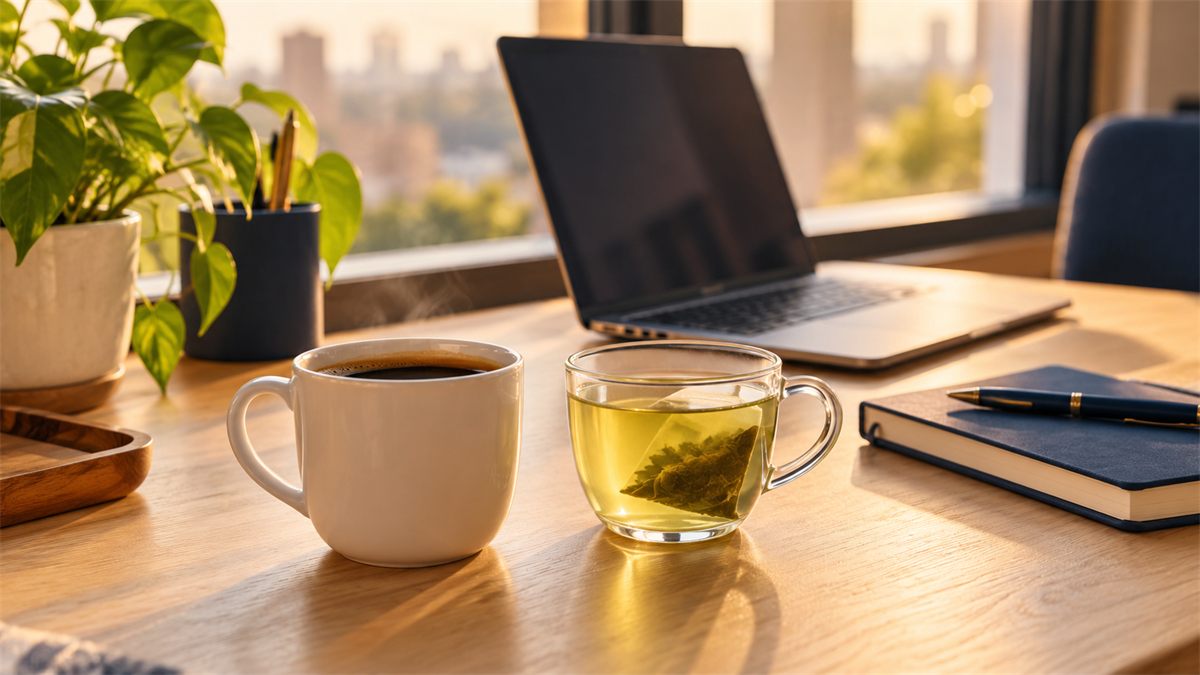
In a placebo-controlled home study of 12 adults aged 19 to 48, 400 mg of caffeine taken at bedtime, 3 hours before or 6 hours before bed each disturbed sleep; an objective sleep monitor showed about an hour less sleep. The authors suggest avoiding substantial caffeine for at least six hours before bed. The sample was small, and the study was funded by a grant from the maker of the sleep monitor, with several authors reporting drug-company ties (Drake et al., 2013). EFSA says up to 400 mg a day and single doses up to 200 mg raise no safety concerns for healthy adults, but that even 100 mg close to bedtime may affect sleep in some people (EFSA, Caffeine).
The arithmetic, as a cautious rule rather than a measured threshold (the trial used 400 mg, far more than one cup): bedtime minus six hours is your last cup. Bed at 11 pm means 5 pm; bed at 10 pm means 4 pm. A second cup at 11:30 am is well clear of that line, so it isn't the late cup that breaks your night. The risk is using caffeine to cover a sleep debt, a loop the survey above hints at (Raju et al., 2025, an association only). If caffeine itself leaves you flat when it wears off, read caffeine crash; if you want to cut back, see coffee alternatives.
Skipped breakfast and heavy lunches
Lunch size is the one food factor here with a direct trial. Twelve young men restricted to 5 hours of sleep ate either a 305-calorie or a 922-calorie lunch before a two-hour monotonous simulated drive. After the first 30 minutes the heavy lunch led to more sleepiness-related lane drifting and more sleepiness on EEG. Funding is not stated in the abstract (Reyner et al., 2012).
On blood sugar the evidence is thinner than the internet suggests. A 2025 scoping review of workplace studies found only nine that met its criteria. It concluded that diet affects sleepiness but that few studies have directly tested blood-glucose swings and work productivity. The declared conflicts are research donations from non-food companies (Kaneda et al., 2025).
Skipped breakfast is a common explanation for a mid-morning or afternoon slump. On 10 October 2026 we searched PubMed for trials of skipping breakfast and energy or alertness in working adults and found none that measured it, so we won't tell you breakfast fixes the 3 pm slump. If you notice you crash on the days you skip it, treat that as a pattern to test for yourself.
Indian office lunches often lean on rice or rotis. In the ICMR-INDIAB survey of 18,090 adults, Indian diets were high in low-quality carbohydrates (white rice, milled grains, added sugar) and low in protein (Anjana et al., 2025). That does not prove rice makes you drowsy; it is a reason to make rice a portion rather than the plate, with dal, sabzi, curd or eggs filling the rest. Our sleepy after lunch guide goes through the trials on plate size and composition.
A dim desk and no daylight
Daylight at work may help both vitality and sleep. In a pilot case-control study of 49 office workers, the 27 in windowless offices reported poorer vitality and poorer sleep quality than the 22 with more daylight. In a subset of 21 who wore activity monitors, workers with windows got more light during the week and slept about 46 minutes longer on workweek nights. Volunteers were a convenience sample and groups weren't assigned, so this shows an association, not a cause. Funding was non-industry (a university research board and NIH), though some authors disclose sleep-device and drug-company ties (Boubekri et al., 2014).
If you can, sit near a window and take your 2 pm walk outside. It costs nothing, and the study gives you a reason to try it.
Stress and burnout
Constant pressure is tiring in its own right. The WHO defines burn-out as a syndrome resulting from chronic workplace stress that has not been successfully managed, with three parts: feelings of energy depletion or exhaustion, mental distance or cynicism about your job, and reduced professional efficacy (WHO). We did not find a trial linking everyday work stress to the 2 pm dip itself, so treat stress as a plausible contributor rather than a proven one.
What helps in the short term is the same as above: breaks. Micro-breaks are meant to let strain recover before it accumulates, and the meta-analysis found small gains in vigour and fatigue (Albulescu et al., 2022). If exhaustion lasts all day and comes with dread of work, talk to your doctor; our guide to high cortisol symptoms covers the stress side.
Three causes with their own guides
- Sleepy right after lunch. The food-coma side: plate size, a short walk, a 10-minute nap. See sleepy after lunch.
- Flat after your coffee. Withdrawal, dose and genetics. See caffeine crash.
- Tired all day, every day. Sleep, iron, B12, vitamin D, thyroid and blood sugar. See why am I always tired?
A 2 pm plan at your desk
Only one step below involves caffeine, and it is about when to stop, which makes this a plan for an afternoon energy boost without caffeine. Each step is tied to the evidence above.
| When | What to do | Why |
|---|---|---|
| At lunch | Keep the plate balanced: a fist of rice or two rotis, then dal, sabzi and curd. Finish a glass of water. | A bigger lunch raised sleepiness in a small trial (Reyner et al., 2012); mild dehydration raised fatigue (Ganio et al., 2011). |
| 1:30 pm | Stand for your next call. | Breaking up sitting lowered fatigue (Wennberg et al., 2016). |
| 2:00 pm | Walk for 5 minutes, outdoors or past a window. | Five-minute walks raised energy and vigour (Bergouignan et al., 2016); daylight went with better vitality (Boubekri et al., 2014). |
| 2:30 pm | If you can, nap for 10 minutes with an alarm. Keep it short. | After 5-hour nights, a 10-minute nap helped most; a 30-minute nap caused grogginess first (Brooks & Lack, 2006). |
| By 3 pm | Decide on your last caffeine: bedtime minus six hours. | 400 mg of caffeine six hours before bed still disturbed sleep (Drake et al., 2013). |
| Between meetings | Move for 3 to 5 minutes rather than check your phone. | Micro-breaks gave small gains in vigour and fatigue (Albulescu et al., 2022). |
| Tonight | Same bedtime, phone down an hour before bed. | NHS advice; evening tablet reading delayed sleep and cut next-morning alertness (Chang et al., 2015). |
The nap trial used 24 young adults who were good sleepers after a night limited to about 5 hours; results in other people may differ. Pick one or two steps for a week and see which moves your 3 pm.
When it's more than a slump
See a doctor if you have been tired for a few weeks and can't work out why, if it affects your daily life, or if you also have other symptoms such as weight loss or mood changes. The NHS also says to see a GP if you have been told you gasp, snort or choke in your sleep (NHS, Tiredness and fatigue).
Breathing that stops and starts at night, loud snoring and heavy daytime tiredness are signs of sleep apnoea, which the NHS says can be serious if it isn't diagnosed and treated (NHS, Sleep apnoea). Never push through a drive home while fighting to stay awake; in the simulator study, lane drifting rose as the drive went on (Reyner et al., 2012). For tiredness that lasts all day, read why am I always tired?
A morning stick, not an afternoon fix
SILT Mornings belongs at the start of the day. It won't cancel the built-in dip, a short night, a long meeting or a heavy lunch. What it does is put 80 mg of caffeine, with 200 mg of L-theanine, in the morning, well before any afternoon cut-off: one stick in 200-250 ml of room-temperature or cold water (not boiling), any time in the morning, once a day (the pack says 1 stick per day, and no boiling water because heat degrades sensitive actives).
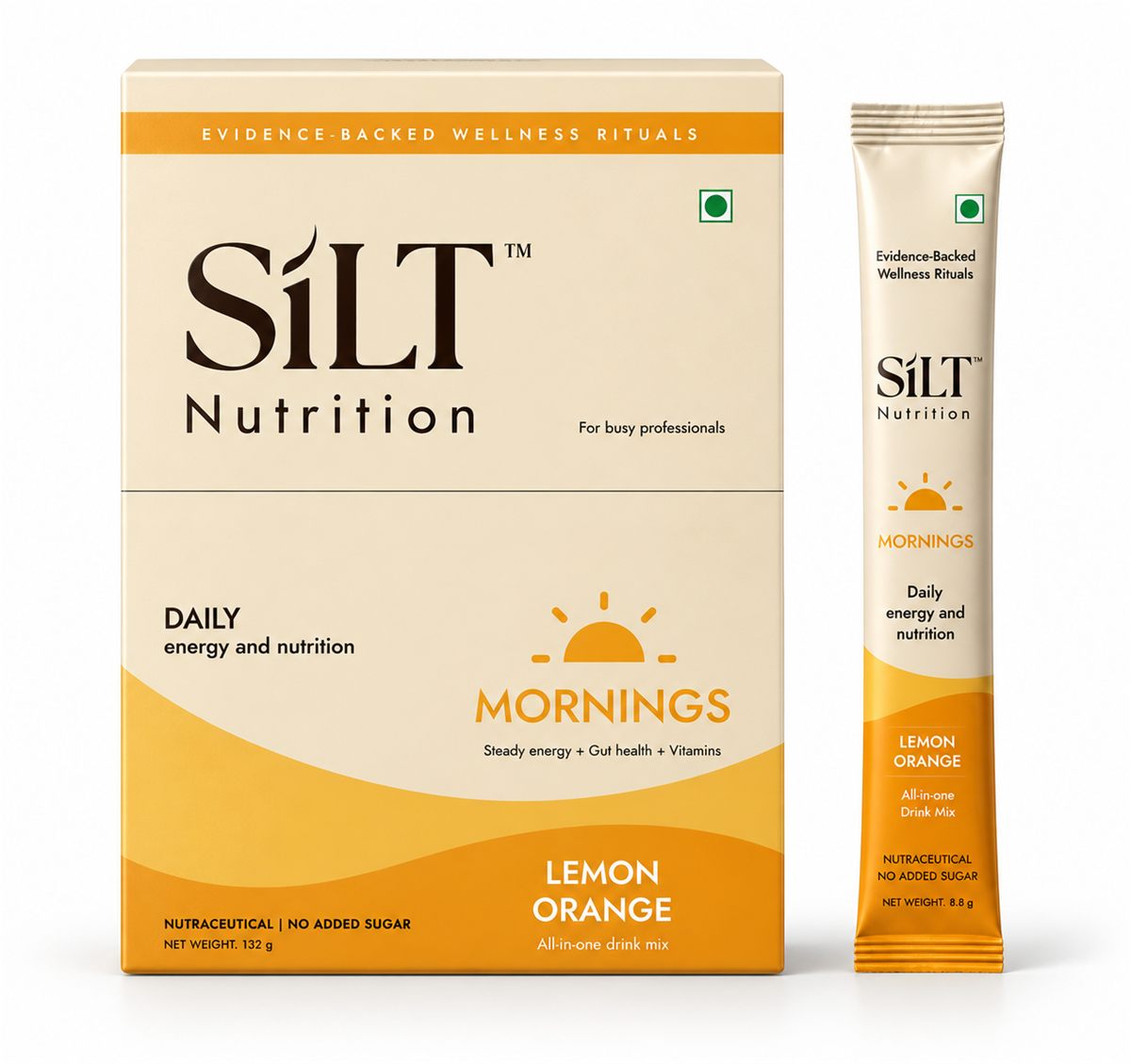
Each 8.8 g stick has 80 mg caffeine with 200 mg L-theanine, 1.4 g taurine, 5 g Sunfiber® PHGG (prebiotic fibre), 6 billion CFU from three spore-forming Bacillus species (B. subtilis, B. coagulans and B. clausii), 550 mg of digestive herb extracts (saunf, jeera, ajwain, amla), and vitamins D3, K2 (menaquinone), C and B12 at 100% RDA each. Lemon Orange and stevia-sweetened; the pack says no added sugar, no maltodextrin and no gluten. For scale against the NHS figures above, 80 mg is about a cup of tea (75 mg) and a little under a cup of instant coffee (100 mg). The pack's two caffeine-related lines are "Supports energy and alertness" and "Supports calm focus". Why caffeine and L-theanine together? See our L-theanine supplement guide.
Supplier certificates of analysis are on our science page; the vitamin-blend certificate and a finished-product NABL lab report are pending, and we'll publish them when they're ready. If you take regular medicines, especially for thyroid, blood pressure, blood sugar or sleep, ask your doctor first. If you take a blood thinner such as warfarin, ask your doctor before using SILT Mornings, because it contains vitamin K2 (55 mcg). If you have a liver or thyroid condition, are pregnant, or take regular medicines, check with your doctor first. The pack adds that if you're pregnant or nursing, taking any medications, sensitive to caffeine or have any medical conditions, you should contact your healthcare practitioner before use.
MRP ₹1,125 ₹900 · 15 sticks or ₹1,500 for 30 (MRP ₹2,250)
That's ₹60 a stick, or ₹50 in the 30-stick pack.
Shop SILT MorningsA dip you can shape
The afternoon energy crash is a built-in dip made deeper by a short night, long sitting, too little water, late caffeine and a heavy plate. Move every hour, drink water, take your walk in daylight, nap for 10 minutes if you can, and set your last cup at bedtime minus six hours. If you're tired for weeks or your breathing is disturbed at night, see a doctor. If you'd like your caffeine early, with L-theanine, we make a morning stick for that. Evidence, not hype.
- Monk, 2005. The post-lunch dip in performance. Clin Sports Med. pubmed.ncbi.nlm.nih.gov/15892914
- Van Dongen et al., 2003. The cumulative cost of additional wakefulness. Sleep. pubmed.ncbi.nlm.nih.gov/12683469
- Bergouignan et al., 2016. Effect of frequent interruptions of prolonged sitting on self-perceived levels of energy, mood, food cravings and cognitive function. Int J Behav Nutr Phys Act. pubmed.ncbi.nlm.nih.gov/27809874
- Ganio et al., 2011. Mild dehydration impairs cognitive performance and mood of men. Br J Nutr. pubmed.ncbi.nlm.nih.gov/21736786
- Drake et al., 2013. Caffeine effects on sleep taken 0, 3, or 6 hours before going to bed. J Clin Sleep Med. pubmed.ncbi.nlm.nih.gov/24235903
- Reyner et al., 2012. 'Post-lunch' sleepiness during prolonged, monotonous driving: effects of meal size. Physiol Behav. pubmed.ncbi.nlm.nih.gov/22155490
- Boubekri et al., 2014. Impact of windows and daylight exposure on overall health and sleep quality of office workers: a case-control pilot study. J Clin Sleep Med. pubmed.ncbi.nlm.nih.gov/24932139
- WHO, 2019. Burn-out an "occupational phenomenon": International Classification of Diseases. who.int
- Bes et al., 2009. Modeling napping, post-lunch dip, and other variations in human sleep propensity. Sleep. pubmed.ncbi.nlm.nih.gov/19294959
- Chang et al., 2015. Evening use of light-emitting eReaders negatively affects sleep, circadian timing, and next-morning alertness. Proc Natl Acad Sci USA. pubmed.ncbi.nlm.nih.gov/25535358
- Raju et al., 2025. Excessive day time sleepiness, poor sleep quality, and their association to caffeine consumption among young Informational Technology professionals. Ind Psychiatry J. pubmed.ncbi.nlm.nih.gov/40861136
- NHS. Tiredness and fatigue. nhs.uk/symptoms/tiredness-and-fatigue
- Wennberg et al., 2016. Acute effects of breaking up prolonged sitting on fatigue and cognition: a pilot study. BMJ Open. pubmed.ncbi.nlm.nih.gov/26920441
- Albulescu et al., 2022. "Give me a break!" A systematic review and meta-analysis on the efficacy of micro-breaks for increasing well-being and performance. PLoS One. pubmed.ncbi.nlm.nih.gov/36044424
- NHS. Foods to avoid in pregnancy (caffeine content of drinks). nhs.uk/pregnancy/keeping-well/foods-to-avoid
- EFSA. Caffeine. efsa.europa.eu/en/topics/topic/caffeine
- Kaneda et al., 2025. The influence of food intake and blood glucose on postprandial sleepiness and work productivity: a scoping review. Nutrients. pubmed.ncbi.nlm.nih.gov/41156470
- Anjana et al., 2025. Dietary profiles and associated metabolic risk factors in India from the ICMR-INDIAB survey-21. Nat Med. pubmed.ncbi.nlm.nih.gov/41028544
- Brooks & Lack, 2006. A brief afternoon nap following nocturnal sleep restriction: which nap duration is most recuperative? Sleep. pubmed.ncbi.nlm.nih.gov/16796222
- NHS. Sleep apnoea. nhs.uk/conditions/sleep-apnoea