


L-theanine side effects are uncommon and usually mild. Across 31 randomised trials with 1,168 people, no serious adverse events were reported (Gerolymos et al., 2026). The real questions are narrower: a possible headache or slower reactions, extra drowsiness if you take sleep medicines, blood pressure if you're on BP tablets, the lack of data in pregnancy, and the caffeine that usually comes with it. Below is what the evidence says on each. Disclosure: we sell drinks with 200 mg L-theanine, and our L-theanine and caffeine page explains why; the product gets one short section near the end.

Is L-theanine safe?
For most healthy adults, the trial evidence says yes, at the doses studied. A 2026 meta-analysis of 31 placebo-controlled trials judged it safe and found no serious adverse events; it also compared drop-out rates between L-theanine and placebo groups (Gerolymos et al., 2026). One of its authors founded a supplement company, which the paper discloses.
What "safe" doesn't cover:
- Sleep medicines. Taking L-theanine with lorazepam, diazepam or zolpidem may add to drowsiness (MSK Cancer Center).
- Pregnancy and breastfeeding. There are no human safety studies, and Memorial Sloan Kettering says it may not be safe.
- Long-term use. The trials we opened lasted from a single dose to eight weeks.
- Caffeine. Most L-theanine "focus" products add caffeine, and caffeine has the better-known side effects.
L-theanine side effects, ranked
The effects people report online are mostly mild, and several aren't backed by trials at all. "Our read" is an editorial summary of the sources linked here, not a clinical grade.
| Effect | What the evidence shows | Our read |
|---|---|---|
| Headache | A single 250 mg dose raised "headache" ratings in a crossover trial; taken with 150 mg caffeine, headache ratings fell (Haskell et al., 2008) | Possible, mild; one trial |
| Slower reactions or drowsiness | 200 mg slowed overall reaction time on one task (Rogers et al., 2008); more drowsiness flagged with sleep medicines (MSK) | Possible; more likely alongside sedatives |
| Nausea, stomach pain, irritability | MSK lists these for drinking too much tea, and says no side effects have been reported for L-theanine itself | Not shown for supplements in the sources we opened |
| Lower blood pressure | Blunted the blood-pressure rise from caffeine (Rogers et al., 2008) and from mental stress in the high responders of a 14-person trial (Yoto et al., 2012) | Not a problem on its own in these trials; relevant if you take BP medicines |
| Serious adverse events | None reported across 31 trials, 1,168 people (Gerolymos et al., 2026) | Rare |
What the longer trials found
Side-effect reports from multi-week trials are reassuring, though small. In 60 adults with schizophrenia taking antipsychotics, adding 400 mg a day for eight weeks did not change side-effect measures, and the authors called it well tolerated (Ritsner et al., 2011). In 98 boys aged 8-12 with ADHD, 400 mg a day for six weeks was well tolerated with no significant adverse events (Lyon et al., 2011). Both were supervised studies in specific groups, not proof that self-dosing is risk-free.
In rats, the brand Suntheanine showed no consistent dose-related harm over 13 weeks at up to 4,000 mg per kg of body weight a day, the highest dose tested (Borzelleca et al., 2006). Animal data is a floor for safety work, not a human dose guide.
Caffeine, BP medicines and sedatives
The interactions that matter are with sleep medicines (more drowsiness), blood-pressure medicines (a possible added effect) and caffeine (they partly offset each other). None of them is dramatic, but each is a reason to check with your doctor first.
Sedatives and sleep medicines
Memorial Sloan Kettering advises talking to your healthcare provider if you take sleep medicines such as lorazepam, diazepam or zolpidem, because the combination may increase drowsiness (MSK). The same logic applies to anything else that makes you sleepy, including other calming supplements. Don't drive or operate machinery until you know how the pair affects you.
Blood-pressure medicines
We found no study of L-theanine combined with blood-pressure tablets. The concern is theoretical: in trials, L-theanine damped blood-pressure rises caused by caffeine (Rogers et al., 2008) and, in people whose blood pressure rose most, by stressful mental tasks (Yoto et al., 2012). If you already take medicine to lower your blood pressure, ask your doctor before adding a daily L-theanine supplement, and mention it if you feel light-headed.
Caffeine
L-theanine and caffeine partly cancel each other out. In 48 healthy adults, 200 mg L-theanine counteracted the blood-pressure rise from 250 mg caffeine, but did not significantly reduce caffeine's jitteriness (Rogers et al., 2008). MSK notes the same offsetting effect on mood and cognition. So L-theanine doesn't make extra caffeine safe; count the caffeine as if the L-theanine weren't there. More on that below.
Psychiatric medicines and chemotherapy
L-theanine has been tested as an add-on to antidepressants in 46 people with generalised anxiety disorder (450-900 mg a day for eight weeks), where it didn't beat placebo for anxiety (Sarris et al., 2019), and to antipsychotics in the schizophrenia trial above. Those were doctor-supervised studies; if you take psychiatric medicines, don't add it on your own. MSK also advises talking to your doctor before using L-theanine during chemotherapy, noting that EGCG, a different green-tea compound, reduces the activity of the cancer drug bortezomib (MSK).
Count the caffeine. L-theanine doesn't cancel it.
Pregnancy, breastfeeding and children
Skip L-theanine supplements in pregnancy and while breastfeeding unless your doctor says otherwise. Memorial Sloan Kettering says L-theanine may not be safe for you if you're pregnant or breastfeeding (MSK). The reason is missing evidence, not a known harm: a PubMed search for theanine in the title plus "pregnancy" returned four studies on 7 October 2026, all in animals or cells (PubMed search). If you're pregnant or breastfeeding, caffeine also matters: EFSA's safe level is up to 200 mg a day from all sources (EFSA).
For children, the main trial used 400 mg a day in boys with ADHD under medical supervision (Lyon et al., 2011). That's not a reason to give children supplements, and products that pair L-theanine with caffeine aren't for them: MedlinePlus advises children and teens to limit caffeine (MedlinePlus).
Can you take L-theanine every day?
The trials say daily use for weeks is well tolerated; nobody has tested years. Daily doses in the studies we opened:
- 200 mg a day for 4 weeks in 30 healthy adults, studied for stress, sleep and thinking scores (Hidese et al., 2019; two authors work for the company that supplied the L-theanine).
- 400 mg a day for 6 weeks in boys with ADHD (Lyon et al., 2011).
- 400 mg a day for 8 weeks in adults with schizophrenia (Ritsner et al., 2011).
- 450-900 mg a day for 8 weeks in adults with generalised anxiety disorder (Sarris et al., 2019).
L-theanine is also part of the everyday diet: it occurs naturally in tea (Haskell et al., 2008), so regular chai drinkers already take some daily, at far lower amounts than a supplement. If you plan to take it for months, it's reasonable to take breaks and review whether it's doing anything for you. What it may help with, and how strong that evidence is, is covered in our guide to L-theanine for calm by night and focus by day.
How much L-theanine is too much?
There's no agreed upper limit, so stay within the doses that have been studied: 200-400 mg a day for most purposes. A systematic review of nine trials found that 200-400 mg a day may help people under stressful conditions (Williams et al., 2020), and the attention benefit in the 2026 meta-analysis came from a single 200 mg dose (Gerolymos et al., 2026).
For food use in the US, the FDA raised no questions about a GRAS notice for L-theanine as an ingredient at up to 250 mg per serving (GRN 209, closed 2007, with a "no questions" letter) (US FDA). We didn't find an Indian or EU upper limit. The highest daily amount in a trial we opened was 900 mg, in a supervised study (Sarris et al., 2019). More than that buys you no proven benefit and moves you outside the evidence.
Add up every source: a capsule, a "calm" gummy and a focus drink can each carry L-theanine.
L-theanine with caffeine
If a product pairs L-theanine with caffeine, the caffeine is the part with known side effects. Too much caffeine can cause restlessness and shakiness, trouble sleeping, headaches, dizziness, a fast heart rate and anxiety (MedlinePlus). EFSA says up to 400 mg a day, and up to 200 mg in a single dose, raises no safety concerns for healthy adults, and a 100 mg dose close to bedtime may affect sleep in some adults (EFSA).

For scale, EFSA puts a 220 ml cup of black tea at about 50 mg of caffeine, a 200 ml filter coffee at 90 mg and a 60 ml espresso at 80 mg (EFSA). Three filter coffees (270 mg) plus a caffeine-and-L-theanine capsule can take you close to, or past, 400 mg without you noticing. MedlinePlus also says to check with your doctor about caffeine if you have high blood pressure, heart rhythm problems, anxiety, sleep problems, migraines or GERD, or if you take stimulants, certain antibiotics, asthma or heart medicines (MedlinePlus).
Two practical rules: keep caffeinated L-theanine products to the morning, and if you're cutting back, see our guides to the caffeine crash and coffee alternatives.
When to stop and see a doctor
Stop taking L-theanine and talk to a doctor if you feel faint or light-headed, unusually drowsy during the day, or have headaches that started with the supplement. Check with a doctor before you start if you:
- take sleep medicines or other sedatives (MSK);
- take blood-pressure, psychiatric or cancer medicines;
- are pregnant or breastfeeding;
- are choosing a product that also contains caffeine and have a heart, blood-pressure, anxiety or sleep condition (MedlinePlus).
L-theanine is a food supplement ingredient. It isn't a substitute for medical care for anxiety, sleep or blood pressure.
Two drinks, one printed dose
We put 200 mg L-theanine in both our drinks, and print it on the pack. SILT™ Mornings pairs it with 80 mg caffeine, about one espresso by EFSA's figure, for any time in the morning. SILT™ Nights carries the same 200 mg with zero caffeine, for the evening. Take one of each and that's 400 mg of L-theanine a day, so count both when you add up your sources. The Mornings pack line is "Supports calm focus"; the Nights line is "Supports evening calm". Same amino acid, a day job and a night job.
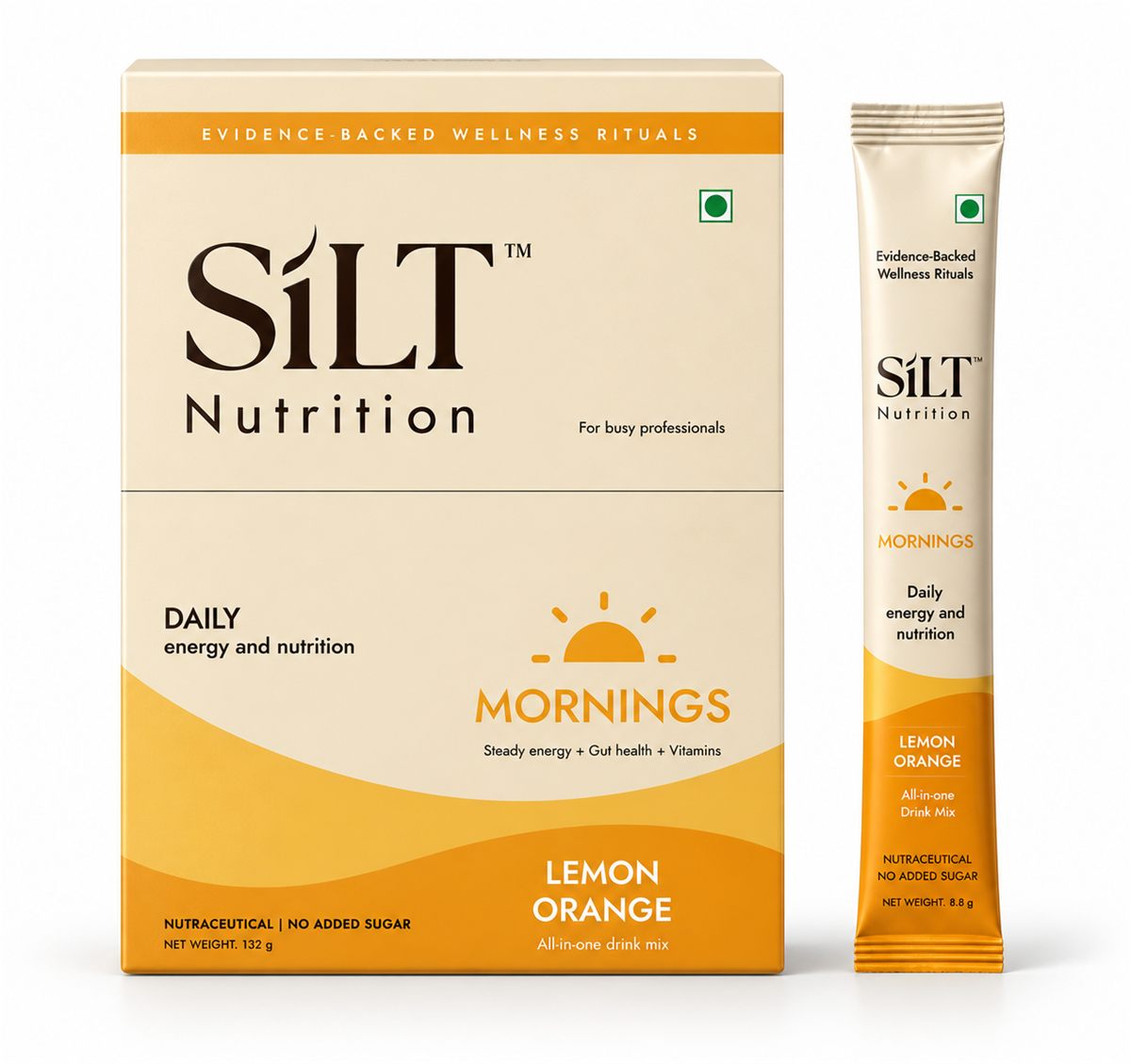
Each Mornings stick also has 5 g Sunfiber® PHGG prebiotic fibre, 6 billion CFU from three spore-forming Bacillus species, 1.4 g taurine, 550 mg of digestive herb extracts (saunf, jeera, ajwain, amla) and vitamins D3, K2 (menaquinone), C and B12 at 100% RDA each. The pack says no added sugar, no maltodextrin and no gluten. Our own caution, from the product page: "If you take regular medicines, especially for thyroid, blood pressure, blood sugar or sleep, ask your doctor first." If you take a blood thinner such as warfarin, ask your doctor before using SILT Mornings, because it contains vitamin K2 (55 mcg). The same goes if you have a liver or thyroid condition or are pregnant. Supplier certificates of analysis are on our science page; our L-theanine's reads an assay of 100.0%. The vitamin-blend certificate and a finished-product NABL lab report are pending, and we'll publish them when they're ready.
Our Nights stick has no caffeine, no melatonin and no maltodextrin. Besides L-theanine it holds glycine, magnesium bisglycinate and KSM-66® ashwagandha root extract, so the sedative caution above applies to it too: if you take sleep medicines, ask your doctor first. Mix one stick in 200-250 ml of lukewarm or cold water; the pack says not to use boiling water and not to exceed one stick a day. Both packs say that if you're pregnant or nursing, taking any medications or have any medical conditions, you should contact your healthcare practitioner first.
MRP ₹1,125 ₹900 · 15 sticks or ₹1,500 for 30 (MRP ₹2,250)
That's ₹60 a stick, or ₹50 in the 30-stick pack.
Shop SILT MorningsMild, rare, but not nothing
L-theanine has a clean record in trials of up to eight weeks: the side effects are mild and uncommon, mostly headache or feeling slower. Take more care with sleep medicines, blood-pressure tablets, pregnancy and any caffeine that comes with it, and stay within 200-400 mg a day. If you want the doses and the trials behind pairing it with caffeine, read our L-theanine and caffeine guide. Evidence, not hype.
- Gerolymos et al., 2026. Systematic review and meta-analysis of 31 randomized trials of L-theanine. Mol Psychiatry. pubmed.ncbi.nlm.nih.gov/42410082
- Williams et al., 2020. L-theanine and stress and anxiety: a systematic review. Plant Foods Hum Nutr. pubmed.ncbi.nlm.nih.gov/31758301
- Haskell et al., 2008. Biol Psychol. pubmed.ncbi.nlm.nih.gov/18006208
- Rogers et al., 2008. Psychopharmacology. pubmed.ncbi.nlm.nih.gov/17891480
- Yoto et al., 2012. J Physiol Anthropol. pubmed.ncbi.nlm.nih.gov/23107346
- Ritsner et al., 2011. J Clin Psychiatry. pubmed.ncbi.nlm.nih.gov/21208586
- Lyon et al., 2011. Altern Med Rev. pubmed.ncbi.nlm.nih.gov/22214254
- Sarris et al., 2019. J Psychiatr Res. pubmed.ncbi.nlm.nih.gov/30580081
- Hidese et al., 2019. Nutrients. pubmed.ncbi.nlm.nih.gov/31623400
- Borzelleca et al., 2006. 13-week dietary toxicity study with L-theanine in rats. Food Chem Toxicol. pubmed.ncbi.nlm.nih.gov/16759779
- Memorial Sloan Kettering Cancer Center. L-Theanine (About Herbs), updated 14 July 2026. mskcc.org
- US FDA. GRAS Notice GRN 209, L-theanine. fda.gov
- EFSA. Caffeine. efsa.europa.eu/en/topics/topic/caffeine
- MedlinePlus (US National Library of Medicine). Caffeine. medlineplus.gov/caffeine.html
- PubMed search, 7 October 2026: theanine[ti] AND pregnancy, 4 results, all animal or cell studies. pubmed.ncbi.nlm.nih.gov