


Taurine benefits are real but narrower than the label hype. The best human evidence shows a small lift in endurance exercise and modest drops in blood pressure, blood sugar and triglycerides in trials of 0.5-6 g a day. The anti-ageing story rests mostly on animal studies. In energy drinks, it's the caffeine, not the taurine, that wakes you up. Below: what taurine is, where it comes from (vegetarian diets supply almost none), each use graded by evidence, side effects and dose. Disclosure: our morning drink, SILT™ Mornings, contains 1.4 g taurine, and it gets one short section near the end. If you came for calm focus with caffeine, read our L-theanine supplement guide.
What is taurine?
Taurine is a sulphur-containing amino acid (chemically, 2-aminoethanesulfonic acid). People get most of it from food, and the liver makes smaller amounts from two other amino acids, methionine and cysteine (Wójcik et al., 2010). It is especially abundant in skeletal muscle (Kurtz et al., 2021).
Mechanistic and animal studies point to three main jobs: binding bile acids, helping regulate blood pressure and acting as an antioxidant. Human data are much more limited (Wójcik et al., 2010). That gap between lab promise and human proof runs through every benefit below.
Taurine uses, graded by evidence
Here's how the main taurine uses stack up in human research. "Strength" is our editorial read of the sources linked on this page, not a clinical grade.
| Use | What human studies found | Strength | Source |
|---|---|---|---|
| Endurance exercise | Small-to-moderate improvement with 1-6 g, as a single dose or for up to two weeks | Moderate: one meta-analysis of 10 studies | Waldron 2018 |
| Strength, power, recovery | Some positive trials, mixed overall | Limited: review of 19 small studies | Kurtz 2021 |
| Energy and focus | Caffeine drove the gains; taurine alone didn't match them | Taurine alone: weak | Giles 2012 |
| Blood pressure | About 4 mmHg lower systolic on average | Moderate: several meta-analyses of small trials | Tzang 2024; Nie 2025 |
| Blood sugar and triglycerides | Modest drops, mostly in people with metabolic problems | Moderate: meta-analyses, varied trials | Tzang 2024; Nie 2025; Tao 2022; Guan 2020 |
| Heart function in heart failure | Better pumping-function scores in patient trials | Small trials; medical care, not self-care | Tzang 2024 (Nutr J) |
| Slower ageing | Longer life and health span in animals; human levels don't consistently fall with age | Animal only; human data conflict | Singh 2023; Fernandez 2025 |
Taurine in food: why vegetarians get little
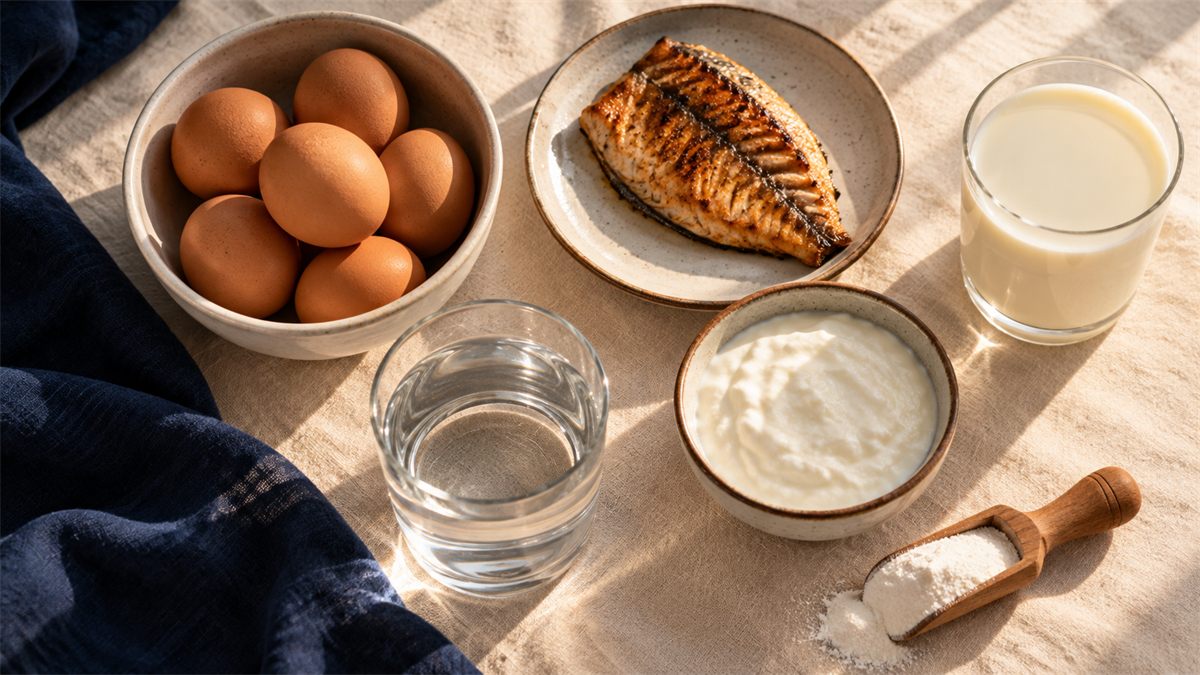
Taurine comes almost entirely from animal foods. When researchers measured 48 plant foods (vegetables, nuts, seeds, fruits and legumes), they found none in any of them. Meats and dairy did contain it (Laidlaw et al., 1990). Shellfish and dark poultry meat are the richest sources; milk and curd carry only traces (Wójcik et al., 2010, Table 2, drawing on Laidlaw 1990):
| Food | Taurine, mg per 100 g |
|---|---|
| Scallops | 828 |
| Mussels | 655 |
| Clams | 521 |
| Squid | 357 |
| Turkey dark meat, roasted | 300 |
| Chicken dark meat, broiled | 199 |
| White fish, cooked | 172 |
| Pork loin, roasted | 57 |
| Beef, raw | 46 |
| Yoghurt, low-fat plain | 3.3 |
| Cow's milk, 3.5% fat | 2.4 |
| Plant foods (48 tested) | None detected |
Omnivores typically take in 40-400 mg a day, usually nearer the low end (Wójcik et al., 2010).
A vegetarian Indian day, worked out. Our own arithmetic from the table: half a litre of milk (about 12 mg) plus a 200 g bowl of curd (about 7 mg, using the low-fat yoghurt value) gives roughly 19 mg of taurine. Using the table's higher pasteurised-milk value (6 mg per 100 g), it's still only about 37 mg. One 100 g serving of chicken dark meat gives about 200 mg. Dal, rice, roti and sabzi add nothing.
Does low intake matter? Your body makes some taurine, but not enough to fully make up the gap. In 12 vegan men, plasma taurine was lower than in meat-eaters (45 vs 58 µmol/L), and urinary taurine was far lower (Laidlaw et al., 1988). A UK study found taurine absent from vegan diets but only slightly lower plasma levels (Rana & Sanders, 1986). None of the studies we opened shows that this lower level harms vegetarian adults in good health. It is simply a gap, and whether filling it does anything is the question the rest of this page answers.
Interesting molecule. Modest supplement.
Taurine for exercise
This is taurine's best-supported benefit, and the effect is modest. A 2018 meta-analysis pooled 10 studies of taurine taken on its own, at 1-6 g, either as a single dose or for up to two weeks. Endurance performance improved by a small-to-moderate amount (Hedges' g 0.40). Neither the dose nor taking it for longer changed the size of the effect (Waldron et al., 2018).
A 2021 review of 19 studies in adults under 50 found some improvements in time to exhaustion, power, muscle soreness and markers such as lactate and creatine kinase. The doses that seemed to work were about 1-3 g, taken 1-3 hours before exercise. Still, the authors concluded that "limited and varied findings" rule out firm conclusions (Kurtz et al., 2021).
Verdict: if you run, cycle or train hard, taurine may give a small edge. It won't replace training, sleep or food.
Does taurine give you energy?
Not in the way the can implies. In a randomised, double-blind trial, 48 regular caffeine users, kept off caffeine for 24 hours beforehand, were tested on four separate days with 200 mg caffeine, 2,000 mg taurine, both, or neither. Caffeine improved working memory and reaction time and reduced fatigue. Taurine on its own had mixed effects: it slowed choice reaction time but sped up responses on the working-memory tasks. It also cancelled caffeine's boost to feelings of vigour. The authors concluded that caffeine, not taurine or glucose, is likely responsible for the cognitive effects people report after energy drinks, especially in caffeine-deprived regular users (Giles et al., 2012).
Energy drinks usually carry about 4,000 mg of taurine per litre (Rubio et al., 2022). That's roughly 1,000 mg in a 250 ml can by our arithmetic. The lift you feel comes from the caffeine. To manage that, read our guide to the caffeine crash or compare coffee alternatives. L-theanine, the tea amino acid that's often paired with caffeine, has its own evidence, covered in L-theanine: calm by night, focus by day. If you're tired every day, taurine isn't the answer; start with why am I always tired?
Heart and metabolic health
Across many small trials, taurine nudges blood pressure, blood sugar and blood fats in the right direction, by small amounts. The largest analyses:
- Blood pressure, sugar and triglycerides. A 2024 meta-analysis of 25 randomised trials (1,024 people, 0.5-6 g a day for 5 to 365 days) found lower systolic blood pressure (about 4.0 mmHg), diastolic pressure (about 1.5 mmHg), fasting blood sugar (about 5.9 mg/dL) and triglycerides (about 18 mg/dL), with no change in HDL cholesterol. There were no significant adverse effects compared with control groups (Tzang et al., 2024, Nutr Diabetes).
- Dose. A meta-analysis of 34 trials found similar falls in blood sugar, blood fats and blood pressure, and saw the best results at 1.5-3 g a day (Nie et al., 2025).
- Diabetes. In 5 trials with 209 people with diabetes, taurine lowered HbA1c and fasting sugar but not blood fats or blood pressure (Tao et al., 2022).
- Heart failure. In a pooled analysis of 20 trials (808 people), taurine lowered heart rate and blood pressure. In people with heart failure it also improved heart-pumping measures (Tzang et al., 2024, Nutr J).
Read these with care. Many trials were small. Many enrolled people with liver or metabolic problems, such as diabetes, fatty liver or obesity, rather than the general population (Guan & Miao, 2020), and others enrolled people with heart failure. A 4 mmHg average is useful at population level, but it's no substitute for prescribed medicine. If you take medicine for blood pressure or blood sugar, talk to your doctor before adding taurine.
The anti-ageing claim
The ageing story comes from a 2023 paper in Science, with co-authors at the National Institute of Immunology in New Delhi. It reported that blood taurine falls with age in mice, monkeys and humans. Taurine supplements extended life span in mice and worms and improved health span in mice and monkeys. In humans, the evidence was correlation only: lower taurine went with several age-related diseases. The authors said human trials "seem warranted" (Singh et al., 2023).
Two years later, a US National Institute on Aging team, also writing in Science, measured taurine in three human cohorts, in monkeys and in mice. Levels rose or stayed the same with age, and links to health outcomes varied a lot. Their conclusion: falling taurine is not a universal feature of ageing (Fernandez et al., 2025).
Verdict: an open research question. No human trial has shown that taurine slows ageing.
Taurine side effects and safety
At normal supplement doses, taurine has a good safety record, and the side effects people blame on taurine drinks usually come from the caffeine.
- Observed safe level: 3 g a day. A 2008 risk assessment found no consistent pattern of adverse effects in human trials. It called the evidence of safety strong up to 3 g a day of supplemental taurine; higher doses have been tested, but there isn't enough data to be sure about long-term use (Shao & Hathcock, 2008).
- Stomach upset. The only adverse effects reported after a 3 g dose were gastrointestinal disturbances (Wójcik et al., 2010, citing Shao & Hathcock).
- In trials. Pooled trials of 0.5-6 g a day found no significant adverse effects compared with control groups (Tzang et al., 2024).
- EFSA on energy drinks. In 2009, Europe's food safety authority set a no-observed-adverse-effect level of 1,000 mg per kg of body weight a day. It concluded that taurine in energy drinks was not a safety concern for regular consumers drinking 125-350 ml a day. It found no evidence that taurine itself caused the health incidents linked to very heavy energy-drink use (EFSA, 2009).
- Watch the caffeine instead. EFSA puts safe caffeine intake at up to 200 mg in a single dose and 400 mg a day for adults, and 200 mg a day in pregnancy. It says the other energy-drink ingredients don't change the safety of a 200 mg caffeine dose (EFSA, Caffeine).
Check with your doctor first if you're pregnant or breastfeeding, have a liver, kidney or thyroid condition, or take regular medicines, especially for blood pressure or blood sugar (trials saw small drops in both).
How much taurine per day?
There's no single right dose. Here are the ranges the evidence uses:
- Food: 40-400 mg a day for omnivores; close to zero for vegans, and very little for lacto-vegetarians (see above).
- Exercise trials: 1-6 g, often as a single dose before exercise; 1-3 g in the review of recent studies (Waldron et al., 2018; Kurtz et al., 2021).
- Cardiometabolic trials: 0.5-6 g a day, with 1.5-3 g looking most effective (Tzang et al., 2024; Nie et al., 2025).
- Upper end with strong safety data: 3 g a day (Shao & Hathcock, 2008).
For reference, a 250 ml energy-drink can carries about 1 g. If you already eat fish or chicken most days, a supplement adds less on top than it would for a vegetarian.
Taurine in a morning stick
SILT Mornings is a morning drink mix built around caffeine with L-theanine. Each stick has 1.4 g taurine, under the 3 g observed safe level above. We don't claim it gives you energy on its own; as the Giles trial shows, the caffeine does that. The pack's formula panel lists it beside the caffeine and L-theanine under "Steady energy", with the line "Supports energy and alertness" for the caffeine and taurine pair, and 80 mg caffeine + 1,400 mg taurine as its doses. The vegetarian day worked out earlier came to roughly 19 mg of taurine; SILT is vegetarian (green mark on the lid), and one stick carries 1.4 g.
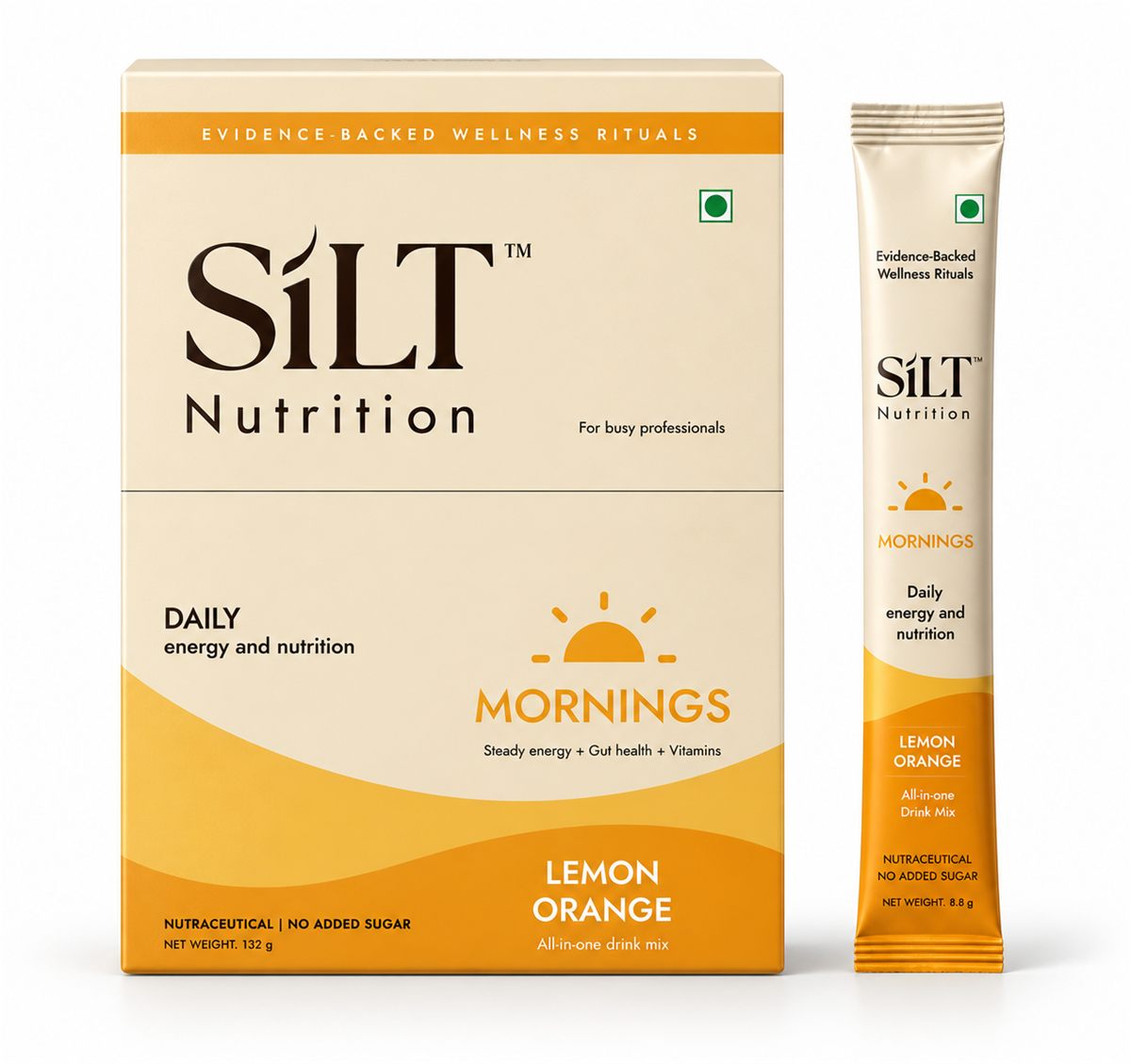
Each 8.8 g stick has 80 mg caffeine, 200 mg L-theanine, 1.4 g taurine, 5 g Sunfiber® PHGG prebiotic fibre, 6 billion CFU from three spore-forming Bacillus species, and 550 mg of digestive herb extracts (saunf, jeera, ajwain, amla). The pack says no added sugar, no maltodextrin and no gluten; it is sweetened with stevia. Stir one stick into 200-250 ml of room-temperature or cold water (not boiling) any time in the morning, one stick a day. Supplier certificates of analysis are on our science page; the vitamin-blend certificate and a finished-product NABL lab report are pending, and we'll publish them when they're ready. If you have a liver or thyroid condition, are pregnant, or take regular medicines, check with your doctor first. If you take a blood thinner such as warfarin, ask your doctor before using SILT Mornings, because it contains vitamin K2 (55 mcg). It contains 80 mg caffeine; the pack says to contact your healthcare practitioner first if you're pregnant or nursing, taking any medications, sensitive to caffeine or have any medical conditions.
MRP ₹1,125 ₹900 · 15 sticks or ₹1,500 for 30 (MRP ₹2,250)
That's ₹60 a stick, or ₹50 in the 30-stick pack.
Shop SILT MorningsUseful, not magic
Taurine is safe at everyday supplement doses. It has modest, real evidence for endurance exercise and for blood pressure, blood sugar and triglycerides. The ageing claim is unproven in humans, and the "energy" in taurine drinks comes from caffeine. Vegetarians get very little from food. If you're weighing caffeine combinations, the evidence on caffeine with L-theanine is in our L-theanine supplement guide; or see SILT Mornings, which adds 1.4 g taurine. Evidence, not hype.
- Wójcik et al., 2010. The potential protective effects of taurine on coronary heart disease. Atherosclerosis. pmc.ncbi.nlm.nih.gov/articles/PMC2813349
- Kurtz et al., 2021. Taurine in sports and exercise. J Int Soc Sports Nutr. pubmed.ncbi.nlm.nih.gov/34039357
- Laidlaw et al., 1990. The taurine content of common foodstuffs. JPEN. pubmed.ncbi.nlm.nih.gov/2352336
- Laidlaw et al., 1988. Plasma and urine taurine levels in vegans. Am J Clin Nutr. pubmed.ncbi.nlm.nih.gov/3354491
- Rana & Sanders, 1986. Taurine concentrations in the diet, plasma, urine and breast milk of vegans compared with omnivores. Br J Nutr. pubmed.ncbi.nlm.nih.gov/3676193
- Waldron et al., 2018. The effects of an oral taurine dose and supplementation period on endurance exercise performance in humans: a meta-analysis. Sports Med. pubmed.ncbi.nlm.nih.gov/29546641
- Giles et al., 2012. Differential cognitive effects of energy drink ingredients: caffeine, taurine, and glucose. Pharmacol Biochem Behav. pubmed.ncbi.nlm.nih.gov/22819803
- Rubio et al., 2022. Caffeine, D-glucuronolactone and taurine content in energy drinks: exposure and risk assessment. Nutrients. pubmed.ncbi.nlm.nih.gov/36501132
- Tzang et al., 2024. Taurine reduces the risk for metabolic syndrome: a systematic review and meta-analysis of randomized controlled trials. Nutr Diabetes. pubmed.ncbi.nlm.nih.gov/38755142
- Nie et al., 2025. Effects of oral taurine supplementation on cardiometabolic risk factors: a meta-analysis. Nutr Rev. pubmed.ncbi.nlm.nih.gov/41275513
- Tao et al., 2022. The effects of taurine supplementation on diabetes mellitus in humans: a systematic review and meta-analysis. Food Chem (Oxf). pubmed.ncbi.nlm.nih.gov/35769396
- Tzang et al., 2024. Insights into the cardiovascular benefits of taurine: a systematic review and meta-analysis. Nutr J. pubmed.ncbi.nlm.nih.gov/39148075
- Guan & Miao, 2020. The effects of taurine supplementation on obesity, blood pressure and lipid profile: a meta-analysis of randomized controlled trials. Eur J Pharmacol. pubmed.ncbi.nlm.nih.gov/32871172
- Singh et al., 2023. Taurine deficiency as a driver of aging. Science. pubmed.ncbi.nlm.nih.gov/37289866
- Fernandez et al., 2025. Is taurine an aging biomarker? Science. pubmed.ncbi.nlm.nih.gov/40472098
- Shao & Hathcock, 2008. Risk assessment for the amino acids taurine, L-glutamine and L-arginine. Regul Toxicol Pharmacol. pubmed.ncbi.nlm.nih.gov/18325648
- EFSA, 12 February 2009. EFSA concludes on taurine and D-glucurono-γ-lactone in energy drinks (news). efsa.europa.eu/en/press/news/ans090212
- EFSA. Caffeine (topic page). efsa.europa.eu/en/topics/topic/caffeine