


Ashwagandha Supplement: 300 mg KSM-66 in SILT Nights
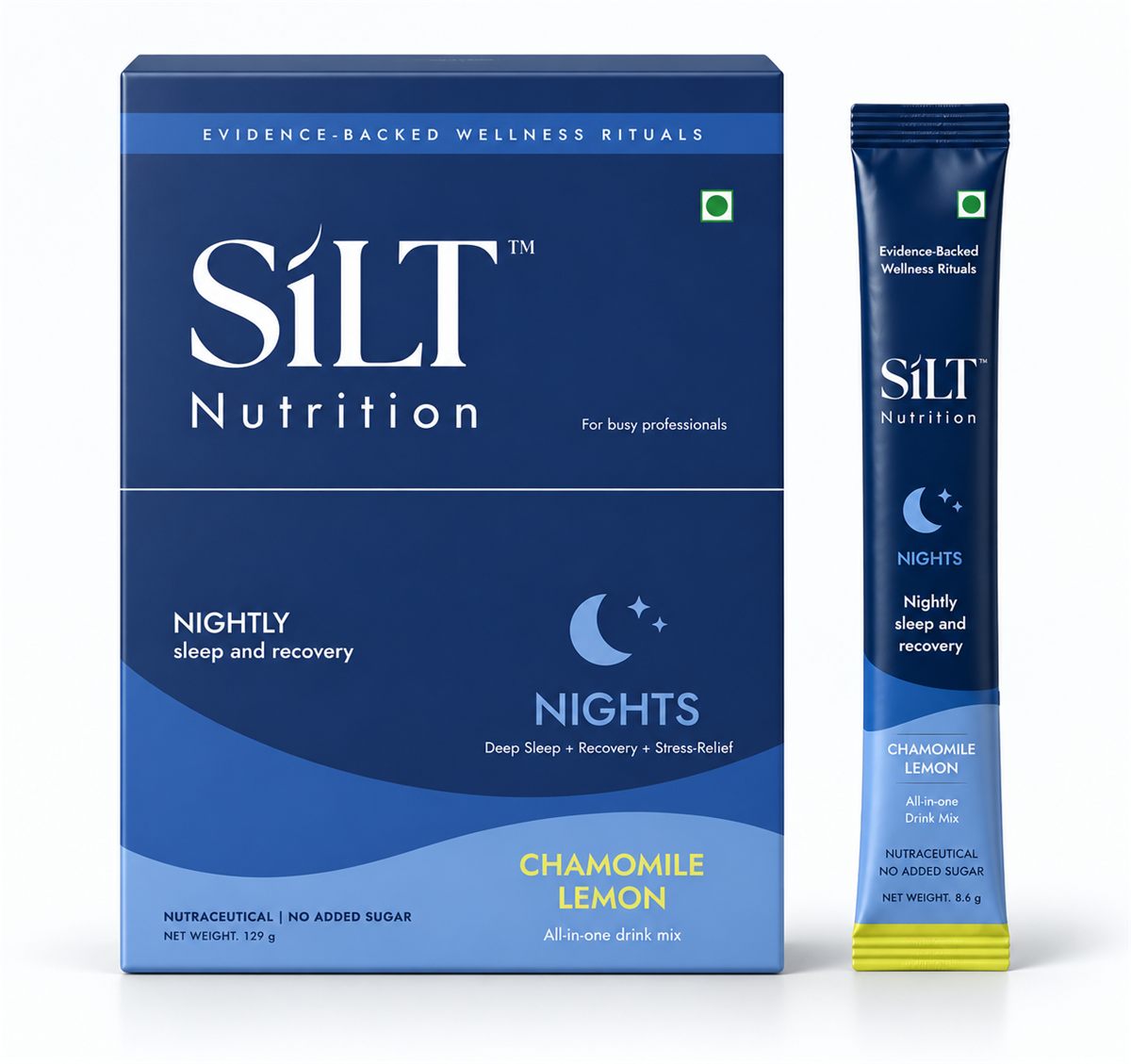
SILT™ Nights is an ashwagandha supplement you drink. Each 8.6 g stick carries 300 mg of KSM-66® ashwagandha root extract, stirred into water 30-60 minutes before bed. Every dose is printed on the back of the pack.
One thing to say up front: SILT Nights is not a standalone ashwagandha supplement. The same stick holds four actives, each listed on the back of the pack with its dose:
- KSM-66 ashwagandha root extract 300 mg
- glycine 3 g
- magnesium bisglycinate (13.8% elemental) 1.8 g = 250 mg magnesium, as the pack prints it
- L-theanine 200 mg
It has no caffeine, and the pack lists it as no added sugar, no maltodextrin and no melatonin. The sweetener is steviol glycosides (stevia, INS 960), and the Chamomile Lemon is flavour only. If you want ashwagandha and nothing else, capsules or churna will suit you better, and we say why below. If you want KSM-66 in a nightly drink alongside three other studied ingredients, with every dose disclosed, read on. (The magnesium half is explained on our magnesium glycinate powder page.)
MRP ₹1,125 ₹900 · 15 sticks or ₹1,500 for 30 (MRP ₹2,250)
That's ₹60 a stick in the 15-stick pack, or ₹50 a stick in the 30.
Shop SILT NightsSee the full SILT Nights formula
What KSM-66 is
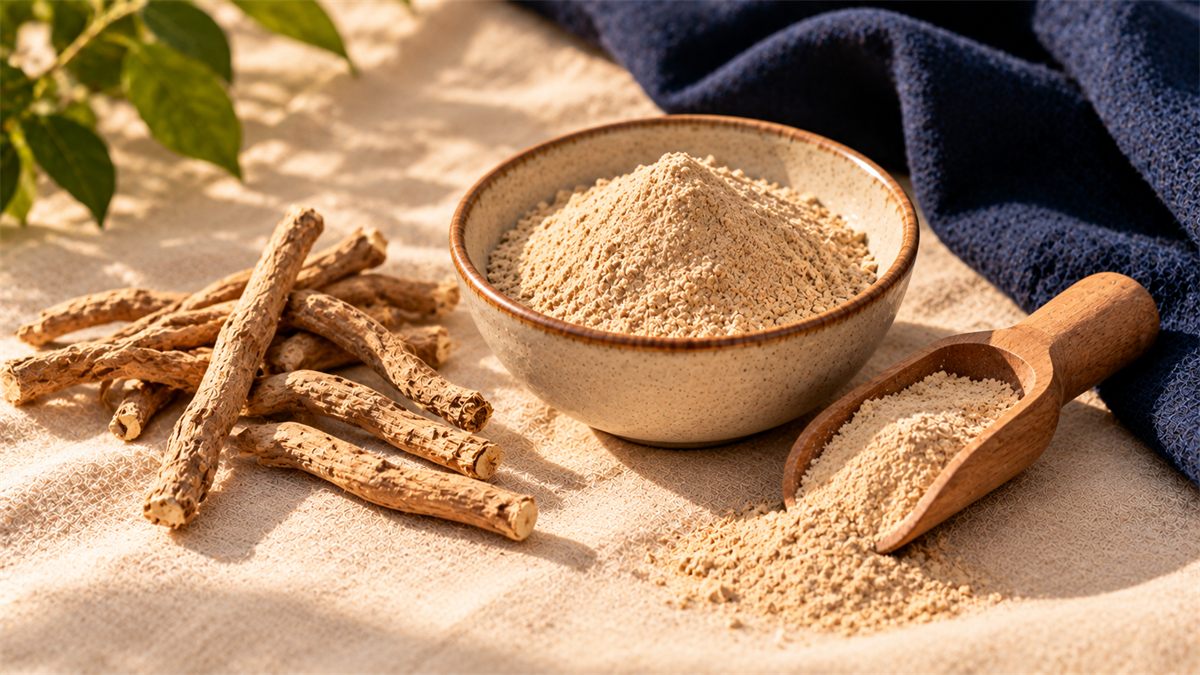
KSM-66 is a branded ashwagandha extract made only from the root, standardised to at least 5% withanolides. A trial paper describes it as a proprietary "root-only extract" made by a single company (Langade et al., 2019), and an earlier trial reports it standardised to at least 5% withanolides, measured by HPLC (Chandrasekhar et al., 2012).
Why does that matter? Ashwagandha (Withania somnifera) contains a group of compounds called withanolides (NCCIH). Germany's food-safety institute, the BfR, notes that supplements use the root and sometimes the leaves, with different extraction methods, so the type and amount of active constituents vary widely between products (BfR, 2024). A named, standardised root extract at least tells you which plant part you're getting and what the withanolide floor is.
Our supplier's certificate of analysis for the KSM-66 in SILT Nights (a 2025 batch, expiry December 2027) reports 5.30% withanolides against a specification of at least 5.0%, and lists the plant part as roots (supplier certificate).
What the human trials studied
KSM-66 has been tested in small Indian trials in stressed adults and in adults with insomnia, at 250-600 mg a day for 8 to 10 weeks. The results were positive, and every trial below used extract supplied by its maker.
| Study | People | Dose and length | What they found | Funding and ties |
|---|---|---|---|---|
| Chandrasekhar et al., 2012 | 64 adults with a history of chronic stress | 300 mg KSM-66 twice a day (600 mg/day), 60 days | Lower scores on all stress scales and lower serum cortisol vs placebo; mild side effects, similar in both groups | Extract provided by KSM-66's maker; "Source of support: nil"; no conflicts declared |
| Salve et al., 2019 | 60 stressed but healthy adults (58 finished) | 125 mg or 300 mg twice a day (250 or 600 mg/day), 8 weeks | Perceived-stress scores and serum cortisol fell at both doses; better sleep quality than placebo | Extract manufactured and gifted by KSM-66's maker; no competing interests declared |
| Langade et al., 2019 | 60 adults with insomnia (40 extract, 20 placebo) | 300 mg twice a day (600 mg/day), 10 weeks | Shorter sleep onset on actigraphy (29.0 vs 33.9, p = 0.019); better sleep efficiency and sleep quality | Extract supplied by KSM-66's maker; no competing interests declared |
Three honest notes. First, these are small, short trials, and two of them share authors (Langade, Salve and Debnath). Second, the results apply to the people studied: stressed adults and adults diagnosed with insomnia, not everyone. Third, we cite these trials as evidence that KSM-66 root extract has been studied. We don't claim a stick of SILT Nights reproduces any single trial's results.
What the reviews say
A 2021 meta-analysis pooled 5 randomised trials (400 adults) and found a small but significant effect of ashwagandha extract on overall sleep (standardised mean difference −0.59) (Cheah et al., 2021). The authors found no serious side effects but said long-term safety data are limited. They declared no competing interests.
Public-health bodies are more cautious than the trial authors. The US NCCIH says some ashwagandha preparations may help with insomnia and stress, but evidence on anxiety is unclear (NCCIH). The BfR says the claimed benefits are not scientifically established and the risks are not well investigated (BfR, 2024). We searched PubMed on 8 October 2026 and found no Cochrane review of ashwagandha. More on the sleep trials is in ashwagandha for sleep, and on the stress trials in ashwagandha for stress.
Studied, not settled. We'd rather tell you both.
Ashwagandha capsules vs a drink
Churna is the dried root ground to powder; capsules and tablets usually hold a root extract; SILT Nights puts a standardised root extract into a drink with three other actives. None is "best" for everyone. It depends on what you want.
| Churna (dried root powder) | Capsules or tablets (extract) | SILT Nights (drink) | |
|---|---|---|---|
| What's in it | Whole dried root, ground | A root (or root-and-leaf) extract; check which | KSM-66 root-only extract, 300 mg |
| Withanolide content stated? | Rarely | Sometimes; check the label | Supplier CoA: 5.3% (spec ≥5%) |
| Other actives | Usually none | Usually none | Glycine 3 g, magnesium 250 mg, L-theanine 200 mg |
| How you take it | Stirred into milk or water | Swallowed | Stirred into 200-250 ml water before bed |
| Best for | Traditional use, lowest cost | Ashwagandha only, at a dose you choose | A nightly drink with four listed doses |
If you searched for ashwagandha powder, you were probably shown churna. It's a different product from a standardised extract, and the BfR notes that the plant part and extraction method change what's in the final product (BfR, 2024). We haven't found a sourced way to convert grams of churna into milligrams of extract, so we don't offer one.
When you compare ashwagandha capsules, read three things on the label: the milligrams of extract per capsule (not of "ashwagandha"), the plant part (root, leaf or both) and the withanolide percentage. We compare the products on Indian shelves in the best ashwagandha brands in India, and cover doses in ashwagandha dosage.
Why it's paired with three others
We put ashwagandha with glycine, magnesium and L-theanine because each has its own human research at night or under stress, not because the four have been tested together. We searched PubMed on 8 October 2026 and found no published trial of this combination, so we make no claim that they work better together.
- Glycine, 3 g. In a study of healthy volunteers whose sleep was cut by 25% for three nights, 3 g of glycine before bed reduced next-day fatigue compared with placebo (Bannai et al., 2012). The authors worked for a glycine maker. More in glycine for sleep.
- Magnesium bisglycinate, 250 mg elemental. In a 4-week trial of 155 adults aged 18-65 with self-reported poor sleep, Insomnia Severity Index scores fell by 3.9 points on magnesium vs 2.3 on placebo (p = 0.049), an effect the authors called small (Schuster et al., 2025). The study was funded by Leibniz University Hannover; the supplement was made by a supplement company, and one author runs a research organisation funded by nutraceutical companies. Label maths on the pack's own figures (13.8% elemental, 1.8 g = 250 mg): 1.8 g of bisglycinate gives 250 mg of magnesium (SILT pack).
- L-theanine, 200 mg. In a 4-week crossover trial of 30 healthy adults, sleep-quality scores improved after 200 mg a day, and three sleep subscales improved compared with placebo (Hidese et al., 2019). Two authors were employees of the company that supplied the tablets. More on our L-theanine supplement page.
None of these ingredients is a treatment for insomnia or anxiety. If poor sleep or stress persists, see a doctor.
Who should avoid it
Ashwagandha is not for everyone: avoid it if you're pregnant or breastfeeding, and ask your doctor first if you have a liver, thyroid or autoimmune condition, are due for surgery, or take regular medicines. The standing caution on SILT Nights is: if you have a liver or thyroid condition, are pregnant, or take regular medicines, check with your doctor first. The pack adds: if you're pregnant or nursing, taking any medications or have any medical conditions, contact your healthcare practitioner before consuming it.
- Common side effects. Drowsiness, stomach upset, diarrhoea and vomiting have been reported. NCCIH says ashwagandha may be safe in the short term (up to 3 months), and there isn't enough information on long-term safety (NCCIH).
- Liver injury (rare, but serious). A US-Iceland series described 5 people who developed jaundice 2-12 weeks after starting ashwagandha; liver tests recovered within 1-5 months in four, and one was lost to follow-up (Björnsson et al., 2020). An Indian series reported 8 cases linked to single-ingredient products; 5 of them had existing chronic liver disease, and 3 of those developed acute-on-chronic liver failure and died (Philips et al., 2023). A 2026 review of 13 publications found 25 patients; most recovered after stopping, but one needed a liver transplant and three with existing cirrhosis died (McIntyre et al., 2026). None of these authors declared conflicts. If you have liver disease, don't take ashwagandha.
- Thyroid. In an 8-week trial of 50 adults with subclinical hypothyroidism, 600 mg a day of root extract raised T3 and T4 and lowered TSH compared with placebo (Sharma et al., 2018; the abstract lists no funding or conflict statement). That's why anyone with a thyroid condition, or on thyroid medicine, should ask a doctor first.
- Pregnancy, breastfeeding, autoimmune conditions and surgery. NCCIH says to avoid ashwagandha in pregnancy and while breastfeeding, and doesn't recommend it before surgery or for people with autoimmune or thyroid disorders (NCCIH).
- Medicines. Ashwagandha may interact with sedatives, anti-seizure medicines, thyroid hormone, and medicines for diabetes, blood pressure or the immune system (NCCIH; BfR, 2024). SILT Nights also contains magnesium, which affects some antibiotics and thyroid medicine; see the magnesium safety notes.
Regulators abroad. In Denmark it is unlawful to sell products containing ashwagandha, following a risk assessment by the Technical University of Denmark (Danish Veterinary and Food Administration). Germany's BfR (Communication 39/2024) advises that children, pregnant and breastfeeding women, and people with acute or existing liver disease should not take ashwagandha supplements, and that everyone else should be cautious; it notes that authorities in the Netherlands, France and Australia have also reassessed the herb (BfR, 2024).
SILT is for everyday energy, gut and sleep. It doesn't treat medical conditions. For those, or if you're pregnant or on medication, talk to your doctor. The full list is in ashwagandha side effects.
How to take it
Stir one stick into 200-250 ml of lukewarm or cold water (not boiling: the pack says heat degrades sensitive actives) and drink it 30-60 minutes before bed, once a day. That's the window we recommend; it isn't printed on the pack. The pack does say 1 stick per day, not to exceed the recommended usage level, and to use it consistently for at least 3 months for best results. NCCIH's short-term safety window for ashwagandha is up to 3 months (NCCIH), so check with your doctor before using it for longer.
- Tear one 8.6 g stick.
- Stir it into 200-250 ml of lukewarm or cold water.
- Drink it 30-60 minutes before bed. One stick a day.
Don't add a second ashwagandha product on top without asking your doctor; count every source. Questions about timing and amounts are covered in ashwagandha dosage.
Lab certificates, ingredient by ingredient
Our suppliers' certificates of analysis cover 13 ingredients and 198 checks, with none failed. For KSM-66, that certificate shows 5.30% withanolides against a minimum of 5.0%; the glycine certificate reads 99.4% (USP pharma grade) and the L-theanine certificate 100.0% (assay). A finished-product report from an NABL-accredited lab is planned but not yet issued, and we'll publish it when it's ready.
Every dose is printed on the back of the pack, with no proprietary blend. The nutrition panel for one 8.6 g stick is below.
| Nutrient | Per stick | %RDA |
|---|---|---|
| Energy | 33.10 kcal | 1.66% |
| Protein | 5.00 g | 9.26% |
| Carbohydrate | 1.75 g | Not established |
| Total sugars | 0.63 g | Not established |
| Added sugars | 0 g | 0% |
| Dietary fibre (AI) | 0.65 g | 2.2% |
| Total fat | 0.66 g | 1.0% |
| Saturated fat | 0.47 g | 2.14% |
| Trans fat | <0.1 g | 0% |
| Cholesterol (NMT) | <1.0 mg | Not established |
| Sodium | 88.75 mg | 4.44% |
| Calcium | 6.48 mg | 0.65% |
%RDA basis printed on the pack: ICMR 2020 (men); FSS (Labelling and Display) Regulations 2020. AI = adequate intake; NMT = not more than.
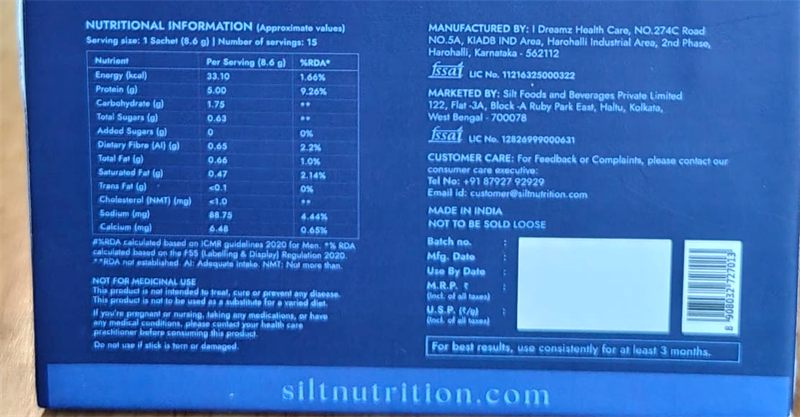
The full ingredient list also names natural flavouring (Chamomile Lemon), citric and malic acid, cumin powder, black salt, iodised salt, silicon dioxide and steviol glycosides: taste and processing ingredients, not actives (SILT pack). SILT is FSSAI compliant (FSSAI Lic. No. 12826999000631), vegetarian and made in India. You can see the formula and the supplier certificates on our science page.
What it costs per stick
SILT Nights costs ₹60 a stick in the 15-stick pack and ₹50 a stick in the 30. Each stick gives you 300 mg KSM-66 plus 3 g glycine, 250 mg elemental magnesium and 200 mg L-theanine.
| Price (MRP) | Per stick (= per 300 mg KSM-66) | |
|---|---|---|
| 15 sticks | ₹900 (₹1,125) | ₹60 |
| 30 sticks | ₹1,500 (₹2,250) | ₹50 |
To be fair to ashwagandha-only products: SILT Nights isn't a like-for-like comparison with a bottle of capsules or a pack of churna. Part of each stick's price pays for the glycine, magnesium and L-theanine. If ashwagandha is all you want, compare plain products on the cost per milligram of standardised extract.
Shop SILT Nights
SILT Nights: 300 mg KSM-66 ashwagandha root extract, 3 g glycine, 250 mg elemental magnesium as bisglycinate, 200 mg L-theanine. Every active listed with its dose. Zero melatonin. Caffeine-free.
MRP ₹1,125 ₹900 · 15 sticks or ₹1,500 for 30 (MRP ₹2,250)
₹60 a stick in the 15, ₹50 a stick in the 30.
Shop SILT Nights- Chandrasekhar K, Kapoor J, Anishetty S (2012). A prospective, randomized double-blind, placebo-controlled study of safety and efficacy of a high-concentration full-spectrum extract of ashwagandha root in reducing stress and anxiety in adults. Indian J Psychol Med. PubMed 23439798
- Salve J et al. (2019). Adaptogenic and anxiolytic effects of ashwagandha root extract in healthy adults: a double-blind, randomized, placebo-controlled clinical study. Cureus. PubMed 32021735
- Langade D et al. (2019). Efficacy and safety of ashwagandha (Withania somnifera) root extract in insomnia and anxiety: a double-blind, randomized, placebo-controlled study. Cureus. PubMed 31728244
- Cheah KL et al. (2021). Effect of ashwagandha (Withania somnifera) extract on sleep: a systematic review and meta-analysis. PLoS One. PubMed 34559859
- National Center for Complementary and Integrative Health (NCCIH). Ashwagandha: usefulness and safety (last updated March 2023). nccih.nih.gov
- German Federal Institute for Risk Assessment (BfR). Ashwagandha: food supplements with potential health risks. Communication 39/2024, 10 September 2024. bfr.bund.de
- Bannai M et al. (2012). The effects of glycine on subjective daytime performance in partially sleep-restricted healthy volunteers. Front Neurol. PubMed 22529837
- Schuster J, Cycelskij I, Lopresti A (2025). Magnesium bisglycinate supplementation in healthy adults reporting poor sleep: a randomized, placebo-controlled trial. Nat Sci Sleep. PMC12412596
- Hidese S et al. (2019). Effects of L-theanine administration on stress-related symptoms and cognitive functions in healthy adults: a randomized controlled trial. Nutrients. PubMed 31623400
- Björnsson HK et al. (2020). Ashwagandha-induced liver injury: a case series from Iceland and the US Drug-Induced Liver Injury Network. Liver Int. PubMed 31991029
- Philips CA et al. (2023). Ashwagandha-induced liver injury: a case series from India and literature review. Hepatol Commun. PubMed 37756041
- McIntyre D et al. (2026). Ashwagandha (Withania somnifera)-associated liver injury: a scoping review of clinical characteristics and safety considerations. Cureus. PubMed 42367407
- Sharma AK, Basu I, Singh S (2018). Efficacy and safety of ashwagandha root extract in subclinical hypothyroid patients: a double-blind, randomized placebo-controlled trial. J Altern Complement Med. PubMed 28829155
- Danish Veterinary and Food Administration (Fødevarestyrelsen). Ashwagandha i kosttilskud og drikkevarer. foedevarestyrelsen.dk