


The most common ashwagandha side effects are mild: drowsiness, an upset stomach and loose stools. The rare but serious one is liver injury, with a few dozen published cases worldwide. It can also raise thyroid hormones, and it isn't recommended in pregnancy, while breastfeeding, before surgery, or with autoimmune or thyroid disorders. Below is what the case reports, trials and regulators actually say, with numbers. Disclosure: we make a sleep drink that contains ashwagandha root extract, and we keep it to one short section near the end; our ashwagandha supplement guide covers the ingredient in full.

Is ashwagandha safe?
For most healthy adults, short-term use looks reasonably safe; for some groups, it isn't a good idea at all. The US National Center for Complementary and Integrative Health (NCCIH) says ashwagandha may be safe when taken for up to 3 months, and that there isn't enough information on longer use (NCCIH). Germany's Federal Institute for Risk Assessment (BfR) goes further: in 2024 it advised that children, pregnant and breastfeeding women and people with liver disease should not take ashwagandha supplements, and that everyone else should be cautious (BfR, 2024).
Both points can be true. Most side effects in trials are mild and pass. The serious ones are rare, idiosyncratic (they hit a few people unpredictably), and mostly come from case reports rather than trials.
The common side effects
The side effects people notice most are sleepiness and gut upset. A review of 30 human studies of the root, by two researchers at the Indian Council of Medical Research, found the most common adverse events (in more than 5% of people) were somnolence, upper-stomach pain or discomfort, and loose stools. Less common ones included giddiness, nasal congestion, nausea, constipation, dry mouth, skin rash and weight gain. No serious adverse events were reported in those studies (Tandon & Yadav, 2020).
NCCIH lists drowsiness, stomach upset, diarrhoea and vomiting (NCCIH). BfR adds headaches, dizziness and skin rashes, and makes an important caveat: most human studies were designed to look for benefits, so side effects "were not systematically recorded" (BfR, 2024).
Two small studies looked at safety directly:
- 80 healthy adults, 8 weeks. Root extract at 300 mg twice a day vs placebo. Blood counts, blood biochemistry (including liver markers) and thyroid hormones didn't change, and no one reported an adverse event (Verma et al., 2021). The PubMed record gives no funding or conflict-of-interest statement.
- 18 healthy men, 4 weeks. An open-label study (no placebo) of 1,000 mg a day of one branded root extract found no change in liver, kidney or thyroid function (Vaidya et al., 2024). Three of the six authors work for the extract's maker, and one for a contract research company, though the paper declares no competing interests.
Neither study is big or long enough to catch a rare reaction. If drowsiness is your side effect, take it in the evening rather than before a drive; our guide to ashwagandha for sleep covers timing.
Liver injury: rare but real
Ashwagandha can, rarely, injure the liver. The US government's LiverTox database (updated December 2024) notes it hasn't been linked to liver-enzyme rises during routine use, but has recently been implicated in cases of clinically apparent liver injury (LiverTox, 2024).
What the case reports show:
- Iceland and the US (2020). Five people (mean age 43) developed jaundice 2-12 weeks after starting ashwagandha-containing supplements, with nausea, tiredness, itching and stomach discomfort. None had liver failure; in four, liver tests returned to normal within 1-5 months (one was lost to follow-up). Four were also taking other supplements (Björnsson et al., 2020). The authors declared no conflicts.
- India (2023), the largest Indian series. Doctors in Kerala and West Bengal found 23 patients with ashwagandha-linked liver injury between 2019 and 2022, and reported the 8 who had taken a single-ingredient product. Five had existing chronic liver disease; three of them developed acute-on-chronic liver failure, and all three died. Where the products could be tested, no adulteration or contamination was found (Philips et al., 2023). The authors declared no conflicts.
- Worldwide review (2026). A scoping review of 13 publications covering 25 patients found injury usually appeared after weeks of use, mostly as cholestatic (bile-flow) or mixed injury with jaundice and itching. Most people recovered after stopping. Severe outcomes: one liver transplant and three deaths, all in people who already had cirrhosis (McIntyre et al., 2026). The authors report no funding.
Rare is not the same as never.
Put plainly: the risk is small and unpredictable, and it is far more dangerous if your liver is already damaged. If you have liver disease, don't take it. If you develop yellow eyes or skin, persistent itching, nausea or unusual tiredness while taking ashwagandha, stop it and see a doctor; those were the presenting symptoms in the case series above.
Ashwagandha and your thyroid
Ashwagandha can raise thyroid hormone levels. That matters if you have a thyroid condition or take thyroid medicine. In an 8-week trial of 50 adults in Varanasi with subclinical hypothyroidism (mildly raised TSH), 600 mg a day of root extract raised T3 and T4 and lowered TSH more than placebo (Sharma et al., 2018). The PubMed record gives no funding statement. The ICMR review also notes a rise in T4 in some studies (Tandon & Yadav, 2020).
In some people that effect has gone too far. Published case reports of thyrotoxicosis (too much thyroid hormone) include:
- a healthy 32-year-old woman in the Netherlands whose symptoms began after she raised her dose, and resolved when she stopped (van der Hooft et al., 2005);
- a 73-year-old woman with a fast, abnormal heart rhythm after two years of taking ashwagandha on her own for an underactive thyroid (Kamal et al., 2022);
- a previously healthy 47-year-old man in Japan with painless thyroiditis two months after starting it (Hayashi et al., 2024).
All three improved after stopping. NCCIH says ashwagandha is not recommended for people with thyroid disorders (NCCIH). If you take thyroxine or have hyperthyroidism, talk to your doctor first, and don't use ashwagandha as a do-it-yourself thyroid fix.
Pregnancy and breastfeeding
Avoid it. NCCIH says to avoid ashwagandha during pregnancy and that it isn't recommended while breastfeeding (NCCIH). BfR advises pregnant and breastfeeding women not to use it, citing a lack of safety data and its historical use as an abortifacient, a substance used to end a pregnancy (BfR, 2024).
There is no trial evidence either way. A PubMed search for randomised controlled trials of ashwagandha in pregnancy returned none (8 October 2026; see Sources). A 2025 review argued that the abortifacient claims rest on weak historical sources and called the evidence "inconclusive" (Tallon et al., 2025); its lead author works for a UK company, and a co-author for a contract testing lab, though the authors declare no conflicts. "Inconclusive" is not "safe", so the advice stands. If you're trying to conceive, ask your doctor.
Medicines, surgery and autoimmune conditions
Ashwagandha can interact with several common medicines, and it isn't recommended before surgery or with autoimmune disease. NCCIH says it is not recommended for people about to have surgery or with autoimmune or thyroid disorders (NCCIH). BfR notes evidence that it can affect the immune system, cortisol and blood glucose (BfR, 2024).
| If you take medicine for… | Why it matters | Source |
|---|---|---|
| Diabetes | Possible interaction; BfR notes effects on blood glucose | NCCIH; BfR 2024 |
| High blood pressure | Possible interaction with antihypertensives | NCCIH; BfR 2024 |
| A transplant or autoimmune disease (immunosuppressants) | Possible interaction; may affect the immune system | NCCIH; BfR 2024 |
| Sleep or anxiety (sedatives) | Possible interaction; drowsiness is already a common side effect | NCCIH; Tandon 2020 |
| Epilepsy (anticonvulsants) | Possible interaction | NCCIH |
| Thyroid (thyroid hormone) | Possible interaction; it can raise thyroid hormones | NCCIH; Sharma 2018 |
NCCIH also says people with hormone-sensitive prostate cancer should avoid it, because it may raise testosterone (NCCIH). If any row applies to you, check with your doctor or pharmacist before starting, and tell your surgeon if you take it.
What regulators say, abroad and in India
BfR says the data aren't good enough to set a safe daily intake, and several regulators have acted or are reviewing ashwagandha.
- Germany (BfR, September 2024). BfR advises against the groups above using it and says the data are not enough to derive a safe intake level. It also says Denmark's technical university (DTU), the Dutch (RIVM) and French (ANSES) agencies and Australia's TGA reassessed ashwagandha between 2020 and 2024, and that "the BfR and other European authorities advise against" ashwagandha food supplements (BfR, 2024).
- UK (Food Standards Agency). The FSA ran a call for evidence on ashwagandha supplements in summer 2024 and published the summary in June 2026; the responses go to the Committee on Toxicity, and a risk assessment will then be conducted and published (UK FSA, 2026).
- Denmark (Danish Veterinary and Food Administration). The authority says it is illegal to sell products containing ashwagandha in Denmark. It cites a risk assessment by the Technical University of Denmark that found negative effects on sex hormones and reproduction in both men and women, and says the plant may also affect metabolism, the immune system and the central nervous system (Fødevarestyrelsen).
- India (FSSAI, 16 April 2026). For health supplements and nutraceuticals, only ashwagandha roots and their extracts are permitted; leaves, in crude, extract or any other form, are not. The Ministry of Ayush gave the same direction to Ayush manufacturers on 15 April 2026 (FSSAI advisory, 2026).
The practical takeaway for Indian shoppers: check the label says root or root extract. Our best ashwagandha brand in India comparison checks this for each product.
How long has it been studied?
Mostly for weeks, not years. NCCIH's "may be safe" applies to up to 3 months (NCCIH). The two safety studies above lasted 8 and 4 weeks. BfR says the consequences of long-term intake have been insufficiently investigated (BfR, 2024). Animal studies of root extract ran up to 8 months (Tandon & Yadav, 2020), which doesn't settle human safety.
So if you take it for months on end, you are past what the evidence covers. Our ashwagandha dosage guide covers the doses and durations studied.
Who should avoid ashwagandha
Based on NCCIH and BfR (sources above), skip ashwagandha, or take it only after your doctor agrees, if you:
- are pregnant or breastfeeding (and ask your doctor first if you're trying to conceive);
- have liver disease, or have had liver injury from a supplement before;
- have a thyroid condition, or take thyroid medicine;
- have an autoimmune condition, or take immunosuppressants;
- have surgery coming up;
- take medicine for diabetes, blood pressure, sleep, anxiety or epilepsy;
- have hormone-sensitive prostate cancer;
- are buying it for a child.
Stop and see a doctor if you notice yellow skin or eyes, dark urine, persistent itching, a racing heart, or new tremor or weight loss. Dark urine, tremor and weight loss aren't from the sources above; they are general signs of liver or thyroid trouble worth acting on.
Ashwagandha in SILT Nights
SILT™ Nights is our bedtime drink, and it contains ashwagandha, so everything on this page applies to it.
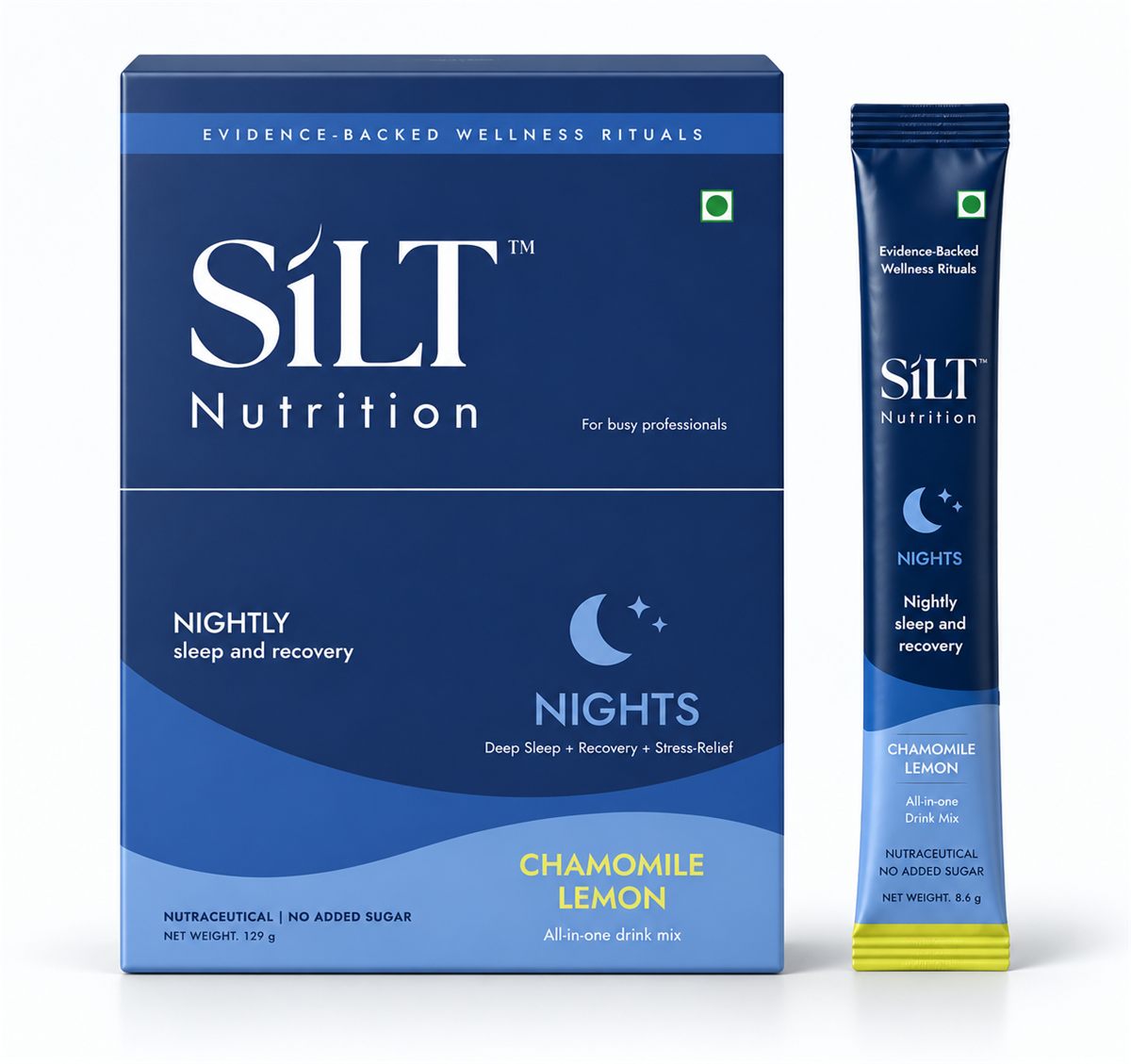
Each 8.6 g stick has 300 mg KSM-66® ashwagandha root extract (root, not leaf), 3 g glycine, 1.8 g magnesium bisglycinate (250 mg elemental magnesium) and 200 mg L-theanine. No melatonin, no caffeine, no maltodextrin, sweetened with stevia (steviol glycosides), no added sugar. Directions on the pack: 1 stick per day, not to exceed the recommended usage level, stirred into 200-250 ml of lukewarm or cold water; do not use boiling water, because heat degrades sensitive actives. We suggest 30 to 60 minutes before bed.
The honest limits: no study has tested this drink, and we don't claim any ashwagandha trial result carries over to it. Each ingredient comes with a supplier certificate of analysis. The KSM-66 certificate lists the plant part as roots, which is the part FSSAI's April 2026 advisory above permits, and shows 5.3% withanolides against a minimum of 5%. They are listed on our science page; a finished-product NABL lab report is pending, and we'll publish it when it's ready. If you have a liver or thyroid condition, are pregnant, or take regular medicines, check with your doctor first. The pack's own caution is broader: not for medicinal use, not intended to treat, cure or prevent any disease, and if you're pregnant or nursing, taking any medications or have any medical conditions, contact your healthcare practitioner. Our suggestion: don't add it on top of another ashwagandha product. SILT is FSSAI compliant (FSSAI Lic. No. 12826999000631), vegetarian and made in India. More on the ingredient in our ashwagandha supplement guide.
MRP ₹1,125 ₹900 · 15 sticks or ₹1,500 for 30 (MRP ₹2,250)
That's ₹60 a stick, or ₹50 in the 30-stick pack.
Shop SILT NightsMild for most, risky for some
Most ashwagandha side effects are mild: sleepiness and stomach upset. The rare serious ones are liver injury and thyroid overactivity, and the groups who should avoid it are clear: pregnancy, breastfeeding, liver disease, thyroid and autoimmune conditions, upcoming surgery, and several regular medicines. It has mostly been studied for weeks, not years. If you still want to try it, buy a root extract, read our ashwagandha supplement guide and the ashwagandha benefits evidence, and stop at the first warning sign. Evidence, not hype.
- NCCIH. Ashwagandha (last updated March 2023). nccih.nih.gov/health/ashwagandha
- BfR (German Federal Institute for Risk Assessment). Ashwagandha: food supplements with potential health risks. Communication 39/2024, 10 September 2024. bfr.bund.de
- Food Standards Agency (UK). Summary of responses to call for evidence on ashwagandha, 25 June 2026. gov.uk
- FSSAI. Advisory regarding non-use of ashwagandha (Withania somnifera) leaves in crude or extract or any other form in food products. F. No. RCD-15001/11/2021-Regulatory-FSSAI, 16 April 2026. fssai.gov.in
- LiverTox (NIDDK). Ashwagandha, updated 3 December 2024. pubmed.ncbi.nlm.nih.gov/31643854
- Tandon & Yadav, 2020. Safety and clinical effectiveness of Withania somnifera (Linn.) Dunal root in human ailments. J Ethnopharmacol. pubmed.ncbi.nlm.nih.gov/32201301
- Verma et al., 2021. Safety of ashwagandha root extract: a randomized, placebo-controlled study in healthy volunteers. Complement Ther Med. pubmed.ncbi.nlm.nih.gov/33338583
- Vaidya et al., 2024. Clinical safety and tolerability evaluation of Withania somnifera root extract in healthy human volunteers. J Ayurveda Integr Med. pubmed.ncbi.nlm.nih.gov/38154316
- Björnsson et al., 2020. Ashwagandha-induced liver injury: a case series from Iceland and the US Drug-Induced Liver Injury Network. Liver Int. pubmed.ncbi.nlm.nih.gov/31991029
- Philips et al., 2023. Ashwagandha-induced liver injury: a case series from India and literature review. Hepatol Commun. pubmed.ncbi.nlm.nih.gov/37756041
- McIntyre et al., 2026. Ashwagandha-associated liver injury: a scoping review of clinical characteristics and safety considerations. Cureus. pubmed.ncbi.nlm.nih.gov/42367407
- Sharma et al., 2018. Efficacy and safety of ashwagandha root extract in subclinical hypothyroid patients. J Altern Complement Med. pubmed.ncbi.nlm.nih.gov/28829155
- van der Hooft et al., 2005. Thyrotoxicosis following the use of ashwagandha (in Dutch). Ned Tijdschr Geneeskd. pubmed.ncbi.nlm.nih.gov/16355578
- Kamal et al., 2022. Ashwagandha as a unique cause of thyrotoxicosis presenting with supraventricular tachycardia. Cureus. pubmed.ncbi.nlm.nih.gov/35475098
- Hayashi et al., 2024. Painless thyroiditis by Withania somnifera (ashwagandha). Cureus. pubmed.ncbi.nlm.nih.gov/38559552
- Tallon et al., 2025. A systematic and ethnobotanical review of ashwagandha's teratogenic and abortifacient potentials. Phytother Res. pubmed.ncbi.nlm.nih.gov/40887707
- PubMed search, 8 October 2026: (ashwagandha[tiab] OR withania[tiab]) AND (pregnant[tiab] OR pregnancy[tiab]) AND randomized controlled trial[pt], 0 results. pubmed.ncbi.nlm.nih.gov
- Fødevarestyrelsen (Danish Veterinary and Food Administration). Ashwagandha i kosttilskud og drikkevarer. foedevarestyrelsen.dk